Break of Structure and Change of Character: Reading SMC Market Structure Properly
· 8 min read · LunqFX Team
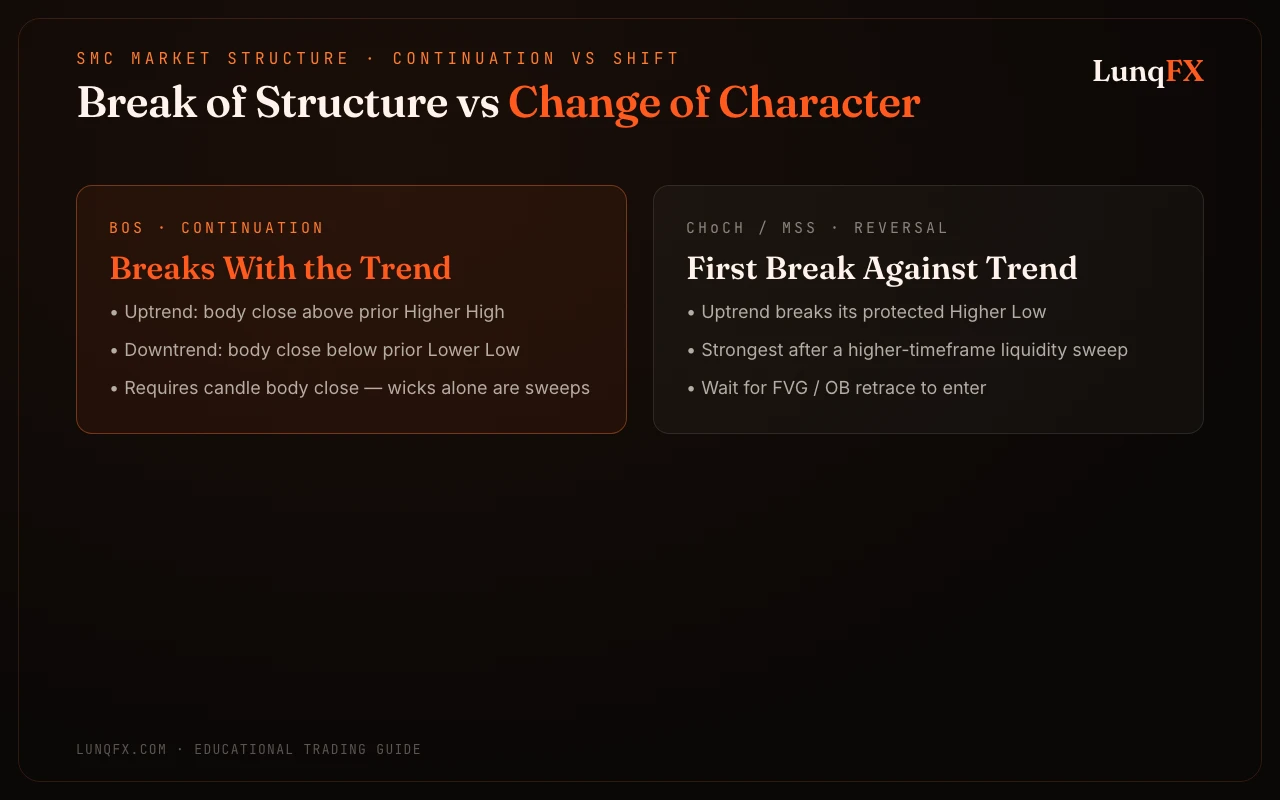
A break of structure is supposed to be the simplest idea in smart money trading: price takes out a swing point, and the trend either continues or turns. In practice, most traders marking BOS and CHoCH on their charts are labelling noise. They count every wiggle as a swing, every wick as a break, and every break as a signal — and then wonder why the "change of character" they traded was just another candle in a range.
This guide covers which swings actually count, the difference between a break and a sweep, why displacement matters, how internal and external structure fit together across timeframes, and a practical sequence for turning structure into an entry.
Swing Highs and Swing Lows: What Counts
Everything in SMC market structure rests on swing points, so define them precisely.
The fractal definition: a swing high is a candle whose high is higher than the highs of N candles on each side; a swing low is the inverse. Bill Williams' fractal uses N = 2 — five candles in total. Some traders use 3 or more for a cleaner, slower structure. Pick one N and stick to it, or your structure will change with your mood.
Not every swing matters. The swings that define trend are the ones that caused something. In an uptrend, the important low is the one from which price rallied to break the previous high. That's often called the protected low — as long as it holds, the uptrend is intact. In a downtrend, the protected high is the swing high from which price fell to make the latest lower low.
This is the single most useful filter in structure trading. Minor swing high swing low pairs inside a leg come and go. The protected swing is the line in the sand.
Break of Structure (BOS): Continuation
A break of structure happens when price breaks a swing point in the direction of the existing trend:
- Bullish BOS: in an uptrend, price closes above the most recent swing high.
- Bearish BOS: in a downtrend, price closes below the most recent swing low.
A BOS confirms continuation. Each new BOS creates a new protected swing behind it — the low (or high) that launched the breaking move.
Change of Character (CHoCH) and Market Structure Shift
A change of character is the first break against the prevailing trend. In an uptrend, that's price closing below the protected low. It's the first evidence that the sequence of higher highs and higher lows has failed.
Market structure shift (MSS) is ICT's term for essentially the same event, usually with an extra requirement: the break must come with displacement (more on that below). In everyday use, CHoCH and MSS are interchangeable; what matters is that you apply the same rules every time.
One CHoCH is not a new trend. It's a warning. The new trend is confirmed when price retraces, fails to reclaim the broken level, and then prints a BOS in the new direction.
BOS vs CHoCH at a glance
| Break of structure (BOS) | Change of character (CHoCH) | |
|---|---|---|
| Direction | With the current trend | Against the current trend |
| What breaks | Most recent swing high (uptrend) / low (downtrend) | Protected low (uptrend) / high (downtrend) |
| Meaning | Trend continuation | First sign of possible reversal |
| How often | Many per trend | Once, at the turn |
| Typical use | Add to or hold trend trades; look for pullback entries | Stop looking for continuation; look for reversal entries |
| Common error | Trading every BOS late, at the extreme | Treating a sweep or range noise as a CHoCH |
Body Close vs Wick: The Break That Isn't
This is where most BOS vs CHoCH confusion comes from. If price spikes through a swing low on a wick and then closes back above it, structure did not break. Liquidity was taken. That's a liquidity sweep — stops resting below the swing were triggered, filled by a larger participant, and price rejected. Our liquidity sweeps and order blocks guide covers that mechanic in depth.
The rule that keeps you consistent: a valid BOS requires a candle body close beyond the swing. A wick through followed by a close back inside is a sweep — and frequently the opposite signal. A sweep of a swing low in a downtrend is often the start of a reversal, not a continuation.
Some traders accept wick breaks on higher timeframes. You can, but then you need a separate rule for sweeps, and the two will contradict each other more often than you'd like. Body closes are simpler.
Displacement: Why the Quality of the Break Matters
A close one pip beyond a swing after twenty slow candles isn't the same event as a large-bodied candle that slices through it. Displacement is the second kind: a strong, fast move with large bodies and small wicks, often leaving a fair value gap behind.
Displacement is evidence that a participant with size wanted price on the other side of that level. A drift through a swing is evidence of nothing in particular. If you only take structure breaks with displacement, you'll trade far fewer of them — and the ones you skip are mostly the ones that fail.
Internal vs External Structure
External structure is the major swing highs and lows on your chosen timeframe — the protected points that define the trend.
Internal structure is the smaller swings inside a single leg. During a pullback in an H4 uptrend, the lower timeframe will show its own downtrend: lower highs, lower lows, and eventually an internal CHoCH back to the upside as the pullback ends.
The mistake is mixing them. An internal CHoCH against an intact external trend is usually just the end of a pullback — a continuation entry, not a reversal. Label which structure you're looking at, every time.
Timeframe Hierarchy
Structure only means something relative to a timeframe. A practical hierarchy:
- H4 or D1: defines the external trend and the protected swing. This is your bias.
- M15–H1: shows where price is within the higher-timeframe leg — pullback or extension.
- M5: where you look for the CHoCH that signals the pullback has ended.
An M5 CHoCH in the direction of the H4 trend, from an H4 area of interest, is a high-quality entry trigger. An M5 CHoCH against the H4 trend is a scalp at best. Our multi-timeframe analysis guide covers how to stack timeframes without contradicting yourself.
A Practical Sequence: Sweep → CHoCH → Retrace Entry
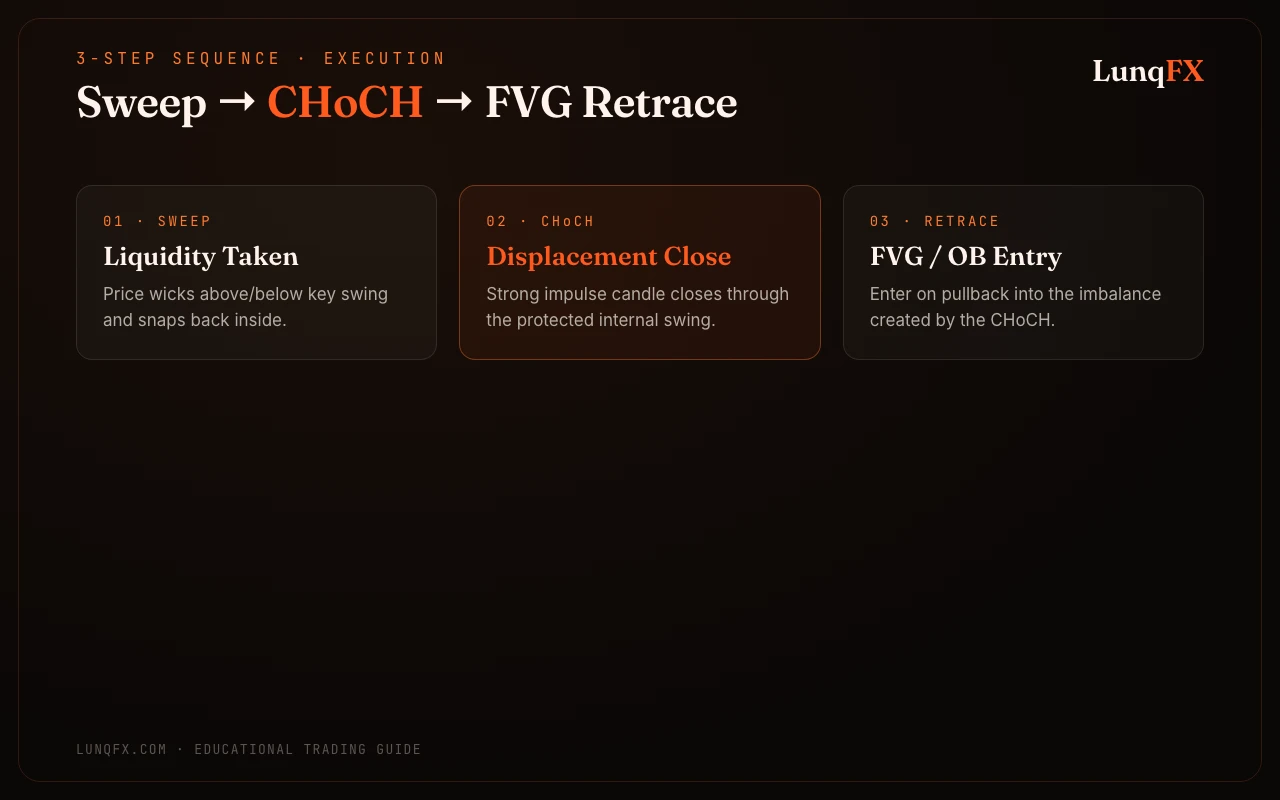
Here's how a structural break becomes a trade, using a long example:
- Context: the H4 trend is up, and price is pulling back into an H4 demand area or towards a Fibonacci retracement zone.
- Sweep: on M5, price takes out a recent swing low on a wick and closes back above it. Sell stops are gone.
- CHoCH: price displaces upward and closes above the last M5 lower high. Internal structure has turned back in line with the H4 trend.
- Retrace: the displacement leg leaves an FVG or an order block. Wait for price to pull back into it.
- Entry: at the FVG or order block, ideally with a confirmation close.
- Stop loss: below the sweep low. If price takes that out, the sequence has failed.
- Target: the next opposing liquidity — the M15/H1 swing high, or equal highs above.
The order matters. A CHoCH without a prior sweep is weaker. An entry at the break candle's close, without a retrace, gives you a worse price and a wider stop.
The Honest Limitations
Swing selection is subjective. Two traders looking at the same chart will often label different swings as "protected", and therefore disagree on whether a break was a BOS or CHoCH. A fixed fractal definition reduces this but doesn't remove it.
Ranges produce endless false CHoCHs. In a sideways market, price breaks structure up, then down, then up again. Every one of them looks like a change of character on the lower timeframe. If the higher timeframe is ranging, structure trading on the lower timeframe is a coin toss with extra steps.
Hindsight makes it look easy. On a finished chart, the protected low is obvious. In real time, you won't know which swing will matter until after it has mattered.
It's not a full system. A BOS gives you a direction and a trigger. You still need location, session timing and position sizing.
Detection tools help most with consistency. RIPTIDE confirms sweeps on bar close and grades them, so a wick through a swing is flagged as a sweep rather than mislabelled as a break. On TradingView, the LunqFX Premium SMC script looks for the full sequence — sweep, structure shift, FVG entry — and scores each setup 0–100 on closed candles. What neither can do is tell you whether the higher timeframe is trending or ranging. That judgement is still yours.
FAQ
What is a break of structure in trading? A BOS occurs when price closes beyond a swing point in the direction of the current trend, such as above the latest swing high in an uptrend. It confirms the trend is continuing.
What is the difference between BOS and CHoCH? A BOS breaks structure with the trend and signals continuation. A CHoCH is the first break against the trend, usually of the protected swing, and signals a possible reversal.
Is a market structure shift the same as a change of character? Mostly, yes. Market structure shift is ICT terminology for the first break against the trend, often with an added requirement for displacement.
Does a wick count as a BOS? Generally no. A wick through a swing followed by a close back inside is a liquidity sweep. Most traders require a candle body close beyond the level to call it a break.
Which timeframe should I use for market structure? Define the trend on H4 or D1, then look for entry triggers like a CHoCH on M5 to M15. Lower-timeframe structure only matters in the context of the higher timeframe.