How to Calculate Lot Size in Forex: The Exact Formula and Worked Examples
· 9 min read · LunqFX Team
Most traders pick their position size backwards. They decide they "trade 0.10 lots" or "use 0.50 on gold," then put their stop wherever the chart looks tidy — which means a 15-pip scalp risks $15 and a 60-pip swing risks $60. Learning how to calculate lot size properly flips that order: you decide the dollar risk first, measure the stop distance second, and let arithmetic dictate the lot size.
This guide gives you the universal forex lot size formula, a five-step procedure you can run in ten seconds, worked examples for EURUSD, USDJPY, XAUUSD, and NAS100, and the prop-firm daily loss maths most traders get wrong.
How to Calculate Lot Size: The Core Formula
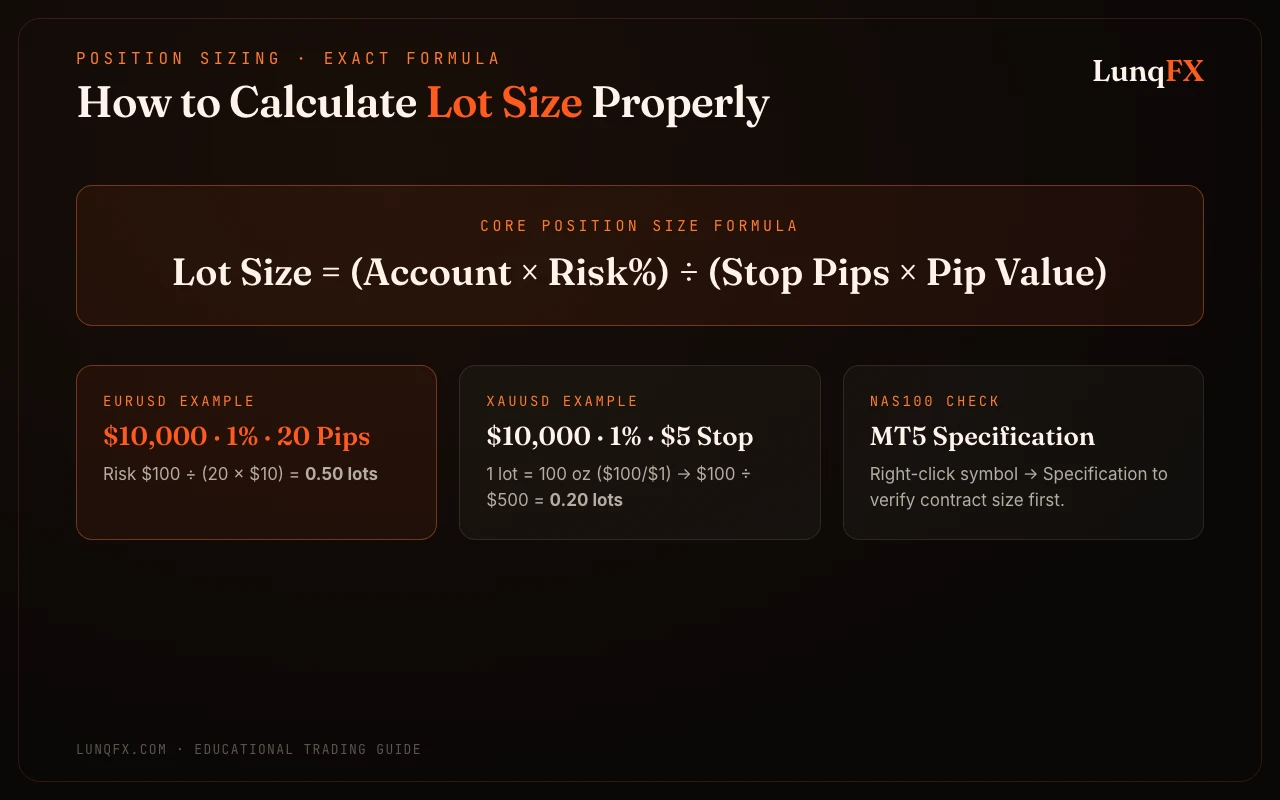
Every position size calculation comes down to one equation:
Lot size = (Account balance × Risk %) ÷ (Stop loss in pips × Pip value per standard lot)Three inputs, one output:
- Account balance × Risk % is your risk per trade in account currency (for example, $10,000 × 1% = $100).
- Stop loss in pips is the exact distance from your entry price to your invalidation level.
- Pip value per standard lot is how much one full lot (1.00) gains or loses for each 1-pip move in the instrument you are trading.
Notice what happens when your stop widens: the denominator grows, so your lot size shrinks. Your dollar risk stays identical whether the stop is 12 pips or 80 pips.
Step-by-Step: Calculating Your Position Size
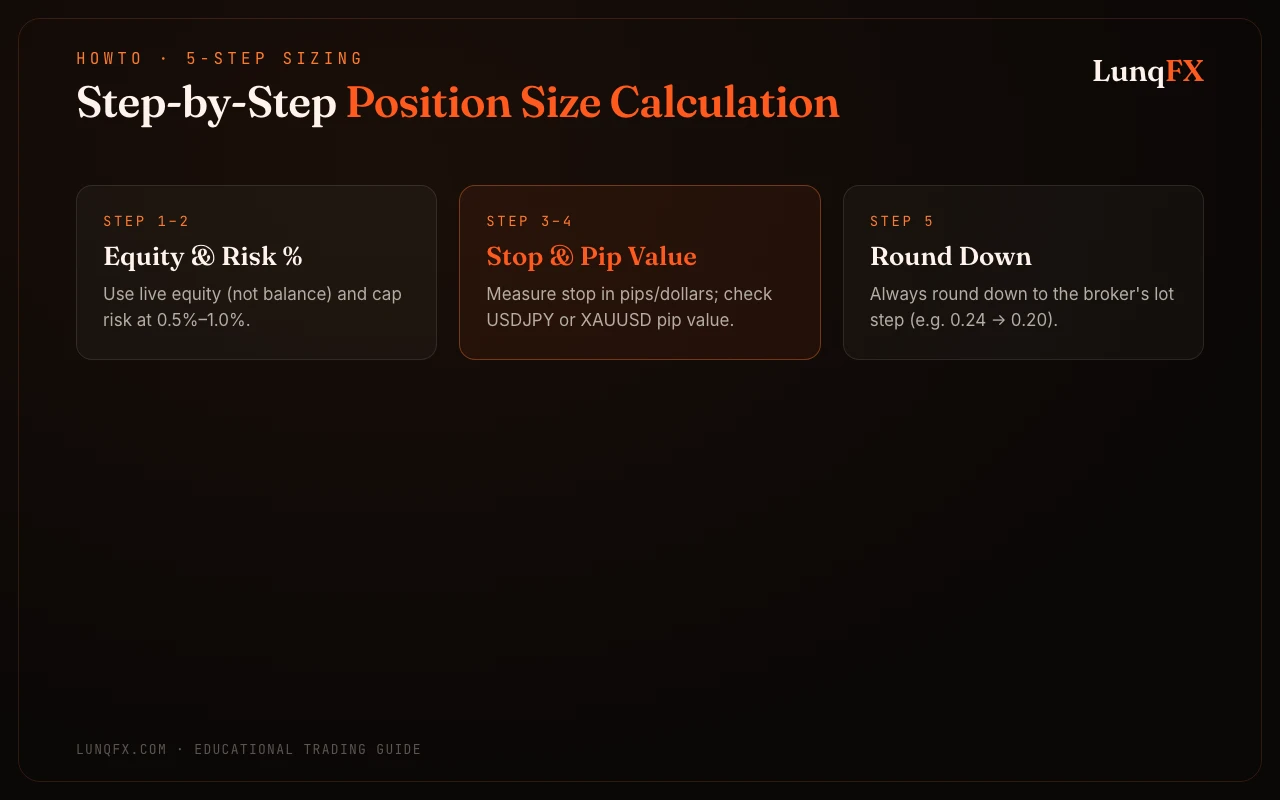
Step 1 — Fix your risk per trade in currency
Choose a percentage of your current account balance — typically 0.5% to 1% for intraday trading, or 0.25% to 0.5% on funded challenges. Convert it to dollars before you look at the chart. On a $10,000 account at 1% risk, your ceiling for this trade is $100.
Step 2 — Measure your stop distance from the chart
Place your stop where the trade idea is invalidated — beyond structure, an order block, or an ATR stop loss buffer — not where a round lot size feels comfortable. Measure the distance from entry to stop in pips (or dollars/points for gold and indices).
Step 3 — Find the pip value per standard lot
For pairs where USD is the quote currency (EURUSD, GBPUSD, AUDUSD), 1 standard lot (100,000 units) = $10 per pip. For cross pairs or USD-base pairs like USDJPY, pip value fluctuates with the exchange rate. For metals and indices, check the contract specification in your platform.
Step 4 — Divide dollar risk by stop risk per lot
Multiply your stop distance by the pip value per standard lot to get the dollar risk of trading 1.00 lot. Divide your maximum dollar risk (Step 1) by that number.
Step 5 — Round down to your broker's lot step
Brokers typically step in increments of 0.01 lots (one micro lot). Always round down, never up. If the formula gives 0.378 lots, enter 0.37 lots. Rounding up pushes your actual risk above your rule; rounding down keeps you safely under it.
Worked Examples Across Four Markets
Every example below assumes a $10,000 USD account risking 1% ($100 per trade).
| Instrument | Stop Distance | Value per 1.00 Lot | Raw Formula Result | Rounded Lot Size | Actual Risk |
|---|---|---|---|---|---|
| EURUSD | 25 pips | $10.00 / pip | 0.400 lots | 0.40 lots | $100.00 |
| USDJPY (at 150.00) | 30 pips | $6.67 / pip | 0.499 lots | 0.49 lots | $98.05 |
| XAUUSD (Gold) | $5.00 move | $100.00 / $1 move | 0.200 lots | 0.20 lots | $100.00 |
| NAS100 ($1/pt broker) | 40 points | $1.00 / point | 2.500 lots | 2.50 lots | $100.00 |
1. EURUSD (USD quote currency)
You are buying EURUSD at 1.0850 with a stop at 1.0825 (25 pips). Because USD is the quote currency, 1 standard lot is worth $10 per pip.
Lot size = $100 ÷ (25 × $10) = $100 ÷ $250 = 0.40 lotsCheck: 0.40 lots × 25 pips × $10 = $100. Clean and exact.
2. USDJPY (USD base currency)
When USD comes first, the pip value is paid in JPY and must be converted back to USD. For 1 standard lot (100,000 USD), 1 pip is 0.01 JPY, which equals 1,000 JPY per pip. Divide 1,000 JPY by the current USDJPY rate to get the USD pip value:
Pip value per lot (USDJPY at 150.00) = 1,000 ÷ 150.00 = $6.67 per pipWith a 30-pip stop and $100 risk:
Lot size = $100 ÷ (30 × $6.67) = $100 ÷ $200.10 = 0.4997 → 0.49 lotsNotice the trap: if you assumed "$10 per pip" on USDJPY, you would trade 0.33 lots and under-size every position by a third.
3. XAUUSD (Gold — why "pips" cause errors)
On almost every retail broker, 1 standard lot of XAUUSD = 100 ounces. That means a $1.00 move in gold price equals $100 per standard lot (and a $0.10 move equals $10).
Here is where traders trip up: brokers define a "pip" on gold differently. Some call a $0.10 move one pip; others call $0.01 one pip. If you plug "500 pips" into a generic position size calculator without checking which definition it uses, you can size a trade 10× too large or 10× too small.
Ignore "pips" on gold and calculate directly in dollars of price movement:
XAUUSD lot size = Risk in $ ÷ (Stop distance in $ × $100)Suppose you enter at 2,650.00 with a stop at 2,645.00 ($5.00 stop distance) and $100 risk:
Lot size = $100 ÷ ($5.00 × $100) = $100 ÷ $500 = 0.20 lotsCheck: 0.20 lots × 100 oz × $5.00 = $100. If you trade gold scalping setups with tight $2.00 stops, the same $100 risk gives 0.50 lots.
4. NAS100 (Indices — contract size varies by broker)
Never copy an index lot size from another trader's screenshot. Unlike forex pairs, contract sizes on NAS100 vary wildly by broker: one broker sets 1.00 lot = $1 per point, another sets 1.00 lot = $2, $5, $10, or $20 per point (matching futures sizing).
Before you calculate anything on US indices like NAS100 and US30, check your broker's contract in MT5:
- Open Market Watch.
- Right-click NAS100 (or your broker's ticker, such as USTEC or NDX100).
- Click Specification.
- Read Contract size and Tick value / Tick size.
If 1.00 lot moves $1 per point and your stop is 40 points:
Lot size = $100 ÷ (40 × $1) = 2.50 lotsIf you switched brokers to one where 1.00 lot moves $20 per point and typed in 2.50 lots out of habit, a 40-point stop would lose $2,000 — 20% of the account on a single trade.
Why Risk Percentage Beats Fixed Lots
Fixed lot sizing feels consistent because the volume number never changes. In reality, it makes your risk erratic:
- Volatility distorts your results. A quiet Asian setup with a 12-pip stop and a volatile London setup with a 45-pip stop cannot both be 0.20 lots if you want equal risk.
- Your journal becomes unreadable. Meaningful trading journal metrics depend on R-multiples — measuring every win and loss against a constant 1R risk unit. Fixed lots turn every trade into a different R value.
- Drawdowns accelerate. Fixed lots bet the same dollar amount as your balance falls, raising percentage risk during a losing streak. Percentage risk scales down automatically and scales back up only as equity recovers.
Prop-Firm Daily Loss Maths
Funded challenges fail more often from sizing arithmetic than from bad entries. Consider a $100,000 prop-firm account with a 5% maximum daily loss ($5,000) and 10% overall drawdown ($10,000):
- At 1% risk ($1,000): five consecutive losses hit the $5,000 daily limit — and with commissions and spread, even four and a half losses can breach.
- At 0.5% risk ($500): you need ten consecutive losses in one day to breach.
- At 0.25% risk ($250): you have a 20-loss daily buffer while compounding cleanly on 2R–3R winners.
To survive a prop firm challenge, divide the daily loss limit by at least 8 to 10 to find your ceiling risk per trade.
Where Sizing Calculations Break Down
Even traders who know the forex lot size formula still make four avoidable mistakes:
Forgetting commissions and spread. On a tight 8-pip scalp, a $7 round-turn commission adds 0.7 pips of cost. Factor transaction costs into your stop distance or widen your buffer slightly on low-timeframe trades.
Rounding up on small accounts. If a $500 account at 1% risk ($5) with a 60-pip EURUSD stop calculates to 0.008 lots, you cannot trade it at 0.01 lots without risking $6 (1.2%). The correct action is to skip the trade or wait for a tighter setup — not override your risk cap.
Ignoring correlated exposure. Opening 0.40 lots on EURUSD, 0.40 lots on GBPUSD, and 0.40 lots against USDCHF at the same time is not three separate 1% trades. It is largely one 3% short-USD bet.
Doing the maths slowly during live price action. When price taps your level and you spend 45 seconds typing into a web-based position size calculator, you either miss the fill or guess the lot size under pressure. A chart tool that handles sizing automatically — such as RIPTIDE, where you drag your stop level on the chart and the exact lot size is computed for your risk percentage alongside a daily loss lockout, or Obsidian for one-click execution — removes the arithmetic bottleneck when a candle closes. What a tool cannot do is stop you from moving your stop wider after entry, which breaks the entire calculation.
FAQ
What is the formula to calculate lot size in forex? Lot size = (Account balance × Risk %) ÷ (Stop loss in pips × Pip value per standard lot). Always round the result down to your broker's minimum lot step, usually 0.01 lots.
How much is 0.01 lot in forex? A 0.01 lot is one micro lot, equal to 1,000 units of the base currency. On USD-quote pairs like EURUSD, 0.01 lot moves approximately $0.10 per pip.
How do I calculate XAUUSD lot size accurately? Use dollars of price movement instead of pips, since brokers define gold pips differently. Divide your dollar risk by (Stop distance in dollars × $100), because 1 standard lot of XAUUSD equals 100 ounces.
Should I round lot size up or down? Always round down to the nearest 0.01 lot. Rounding up pushes your actual dollar risk above your rule and violates daily loss limits on funded accounts.
What risk per trade is best for a prop firm challenge? Most consistent challenge passers risk 0.25% to 0.5% per trade. On a 5% daily loss limit, 0.5% gives you a 10-loss daily cushion after accounting for commissions and spread.