ATR Stop Loss Guide: Volatility-Based Stops That Adapt to the Market
· 7 min read · LunqFX Team
Fixed-pip stop losses fail for a simple reason: the market does not move the same number of pips every week. A 20-pip stop on EURUSD might survive three days of quiet consolidation in August and get swept in four minutes during an active London session in March. An ATR stop loss solves that by tying your invalidation distance to current market volatility instead of an arbitrary round number.
This guide covers what Average True Range actually measures, which ATR settings and multipliers make sense as starting points, why placing a stop beyond structure plus an ATR buffer beats multiplying from entry, how to run an ATR trailing stop, and where the indicator lags.
What Average True Range Measures
Average True Range (ATR) was introduced by J. Welles Wilder Jr. in his 1978 book New Concepts in Technical Trading Systems. Unlike a simple candle range (High minus Low), Wilder's True Range captures overnight gaps and sharp session opens by taking the greatest of three values for each bar:
- Current High − Current Low
- |Current High − Previous Close|
- |Current Low − Previous Close|
ATR is the smoothed moving average of those True Range values over N periods.
- Default setting: 14 periods (Wilder's original default). On most forex pairs and gold, 14 bars is long enough to smooth out a single outlier spike while still reacting within a few sessions when volatility shifts.
- Faster ATR settings (7–10): react quickly to sudden expansion, useful for short-term scalping or fast regime transitions.
- Slower settings (20–22): smooth out short-term noise, commonly used for trend-following trailing stops.
Importantly, ATR is non-directional. A rising ATR tells you candles are getting larger; it says nothing about whether price is going up or down.
ATR Multipliers by Trading Style
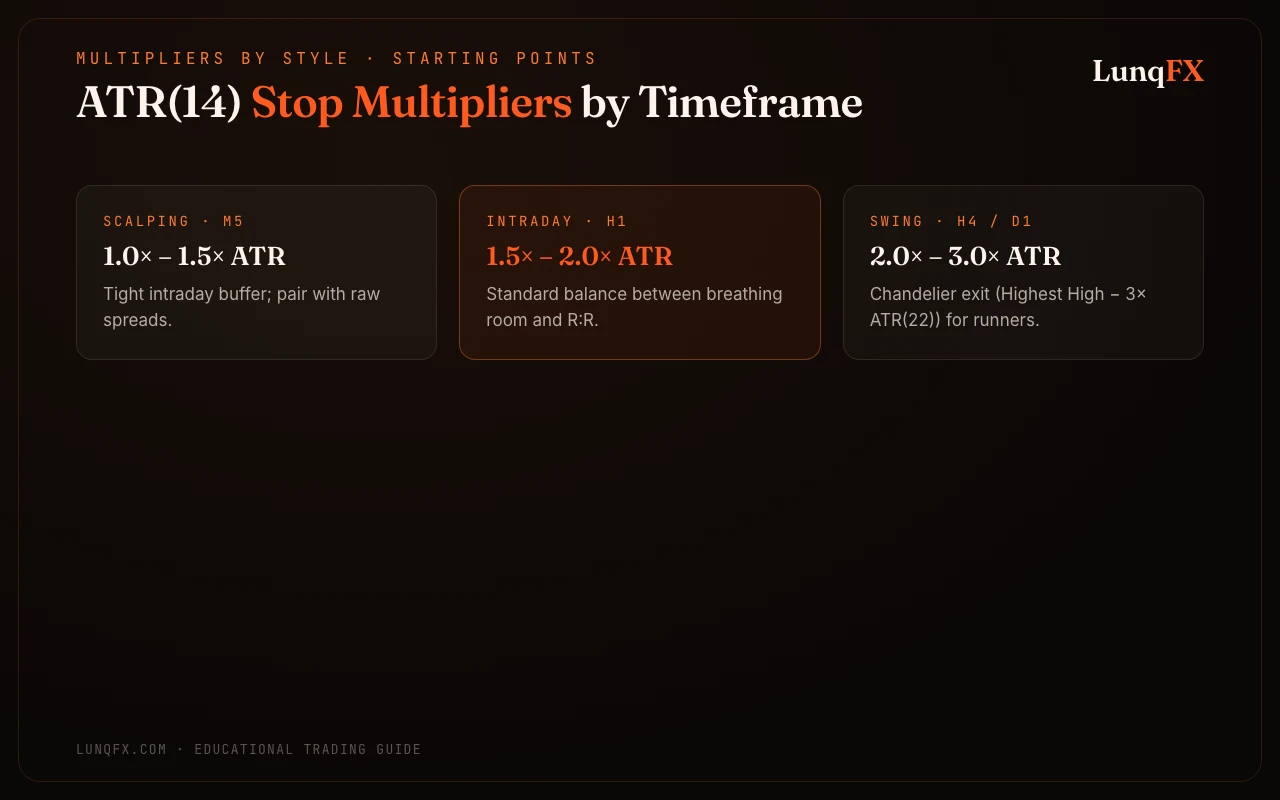
Traders often ask for "the best ATR multiplier." There isn't one—there are only sensible starting points that you calibrate against your own MT5 backtesting results and journal data:
| Trading Style | Typical Timeframes | Common ATR Multiplier | Why It Fits |
|---|---|---|---|
| Scalping | M1 – M5 | 1.0× – 1.5× ATR | Tight invalidation; relies on immediate reaction |
| Intraday / Day Trading | M15 – H1 | 1.5× – 2.0× ATR | Gives room for normal intra-session pullbacks |
| Swing Trading | H4 – D1 | 2.0× – 3.0× ATR | Survives multi-day noise and session sweeps |
Treat these multipliers as common starting points, not rigid rules. A mean-reversion entry at an extreme level behaves differently from a breakout entry in a fast trend, and scalping vs swing trading tolerances differ across pairs.
Setting an ATR Stop Loss: Structure Plus Buffer Beats Entry Multiples
Most tutorials teach a mechanical shortcut:
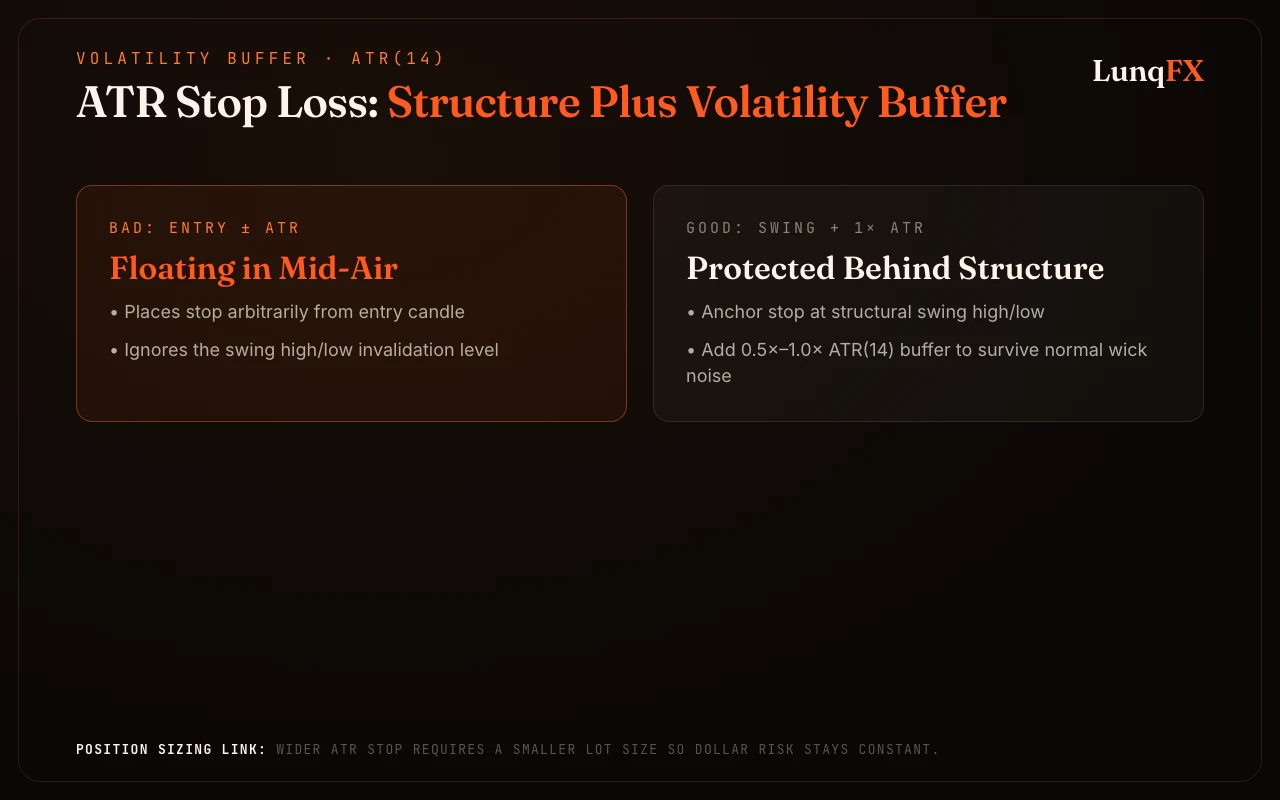
Long stop = Entry price − (1.5 × ATR)The problem with placing a stop purely from your entry price is that it ignores market structure. If the nearest swing low sits 26 pips below entry and 1.5 × ATR puts your stop 22 pips below entry, you have placed your stop inside the exact liquidity pool smart money tends to sweep before reversing.
The better practice: structure + ATR buffer.
- Find the structural invalidation level first — the swing high or low, order block, or range boundary that proves your trade thesis is wrong if broken.
- Add a 0.5× to 1.0× ATR buffer beyond that level so ordinary spread widening and minor wicks do not stop you out right before the real move begins.
Worked Example: EURUSD H1 Long
Suppose you enter a long position on EURUSD on the H1 chart at 1.0850. Your 14-period ATR reads 0.0018 (18 pips), and the nearest structural swing low sits at 1.0828 (22 pips below entry).
- Naive entry-based stop (
1.5 × ATR):1.0850 − (1.5 × 0.0018) = 1.0823(27 pips). Only 5 pips below the swing low — vulnerable to a minor stop run. - Structure + ATR buffer (
0.5 × ATR):1.0828 − (0.5 × 0.0018) = 1.0819(31 pips from entry). Your invalidation is anchored to real structure, cushioned by half an hour-bar of typical volatility.
For gold scalping on XAUUSD, this distinction matters even more: gold routinely wicks $1.50–$2.50 past obvious swing levels during New York hours before continuing. A raw entry multiple leaves your stop sitting right inside that wick zone.
Using an ATR Trailing Stop (Chandelier Exit)
Beyond initial stop placement, ATR works well for trailing profits in trending markets. The classic method is Chuck LeBeau's Chandelier Exit:
Long trailing stop  = Highest High(22) − (3 × ATR(22))
Short trailing stop = Lowest Low(22)  + (3 × ATR(22))
Think of it as hanging a chandelier from the highest ceiling price has reached over the past 22 bars:
- As price makes new highs, the trailing stop ratchets upward.
- If price pauses or pulls back, the stop never moves backward (for a long, you take the maximum of the previous stop and the new Chandelier value).
- In high volatility, the
3 × ATRcushion widens automatically to let the trend breathe; in quiet consolidations, it tightens to lock in gains.
If you want a tighter trail on intraday swings, dropping the lookback to 14 and the multiplier to 2.0×–2.5× ATR reacts faster, at the cost of being stopped out earlier on deeper pullbacks.
ATR and Position Size: Keep Risk Constant
A volatility-based stop only works if your position sizing adapts with it. If your ATR doubles because volatility expanded, your stop distance doubles — which means your lot size must halve to keep dollar risk constant.
Using the formula from our guide on how to calculate lot size:
- $10,000 account, 1% risk ($100), 20-pip ATR stop:
$100 ÷ (20 × $10) = 0.50 lots - Volatility doubles → 40-pip ATR stop:
$100 ÷ (40 × $10) = 0.25 lots
Wider ATR stops do not mean bigger losses. They mean smaller lot sizes for the exact same dollar risk, giving the trade the breathing room current volatility demands.
Timeframe Matters — And ATR vs ADR
ATR is strictly relative to the chart timeframe you attach it to:
- On EURUSD M5, ATR(14) might be 4 pips.
- On EURUSD H1, ATR(14) might be 18 pips.
- On EURUSD D1, ATR(14) might be 65 pips.
Never take an H1 ATR reading and apply a D1 multiplier, or vice versa. Match the ATR timeframe to the chart where you are defining structure.
Traders also frequently confuse ATR with ADR (Average Daily Range). ATR measures the average True Range per bar on any timeframe (including overnight gaps); ADR measures the average total high-to-low distance of a full trading day. Use ATR to size stops and trail exits; use Average Daily Range to judge whether a pair has already exhausted most of its daily travel before you enter late in the session.
The Honest Limitations of ATR Stops
ATR is a practical volatility tool, not magic. Keep three limitations in mind:
ATR is backward-looking. Because it averages the past 14 bars, it always lags sudden regime shifts. After a quiet Asian session where ATR(14) on M15 shrinks to 3 pips, entering right before London open or CPI with a 1.5 × ATR stop (4.5 pips) is far too tight for the volatility about to arrive. Conversely, right after an NFP spike, ATR stays artificially inflated for the next 14 candles, pushing your stops unnecessarily wide.
Wider stops reduce your R-multiple if targets stay fixed. If your target sits at a fixed resistance 40 pips away and expanding ATR forces a 35-pip stop, your reward-to-risk drops to 1.14R. Sometimes the right decision when ATR expands is to skip the trade, not force a terrible R-multiple.
ATR alone cannot tell you when price is overextended. That is a separate use case: measuring how far price has stretched away from fair value in ATR units. For instance, Nova Reversal Bands measures distance from fair value in ATR multiples—flagging readings beyond 2× ATR as overextended—while Phantom Pulse MT4 reads current volatility to calculate SL and TP levels automatically. What neither tool can replace is your judgment on whether a fundamental catalyst has permanently shifted the market regime.
FAQ
What is the best ATR setting for a stop loss? The default 14-period ATR is the most reliable starting point across forex, gold, and indices. Use 7–10 periods for faster reaction on low timeframes, or 20–22 periods for smoother trend trailing.
Is 1.5× or 2× ATR better for an ATR stop loss? Neither is universally better. Scalpers often start around 1–1.5× ATR, intraday traders around 1.5–2× ATR, and swing traders around 2–3× ATR, ideally anchored beyond a structural swing level rather than from entry price alone.
Does a wider ATR stop loss mean I risk more money? No, provided you adjust your position size. If your stop widens from 20 pips to 40 pips, cutting your lot size in half keeps your dollar risk identical.
What is the difference between ATR and ADR? ATR measures the average True Range of individual candles on any timeframe (including gaps), while ADR measures the average high-to-low range of a complete trading day. ATR is used for stop placement; ADR is used for daily exhaustion and target context.