Average Daily Range in Forex: How to Budget Targets and Spot Exhaustion
· 8 min read · LunqFX Team
Most target mistakes in intraday trading come from asking a pair for a move it rarely delivers in a single session. A trader enters EURUSD late in the London–New York overlap, places a 70-pip take-profit, and watches price stall 15 pips into the trade before drifting sideways into the close. The setup wasn't necessarily wrong — the average daily range was already spent.
ADR is one of the simplest metrics on a trading desk, and one of the most neglected by retail traders. This guide covers how to calculate it, why ADR vs ATR is a distinction worth keeping straight, how to use daily range exhaustion as a practical filter, and the calendar quirks that distort the number.
What Average Daily Range Actually Measures
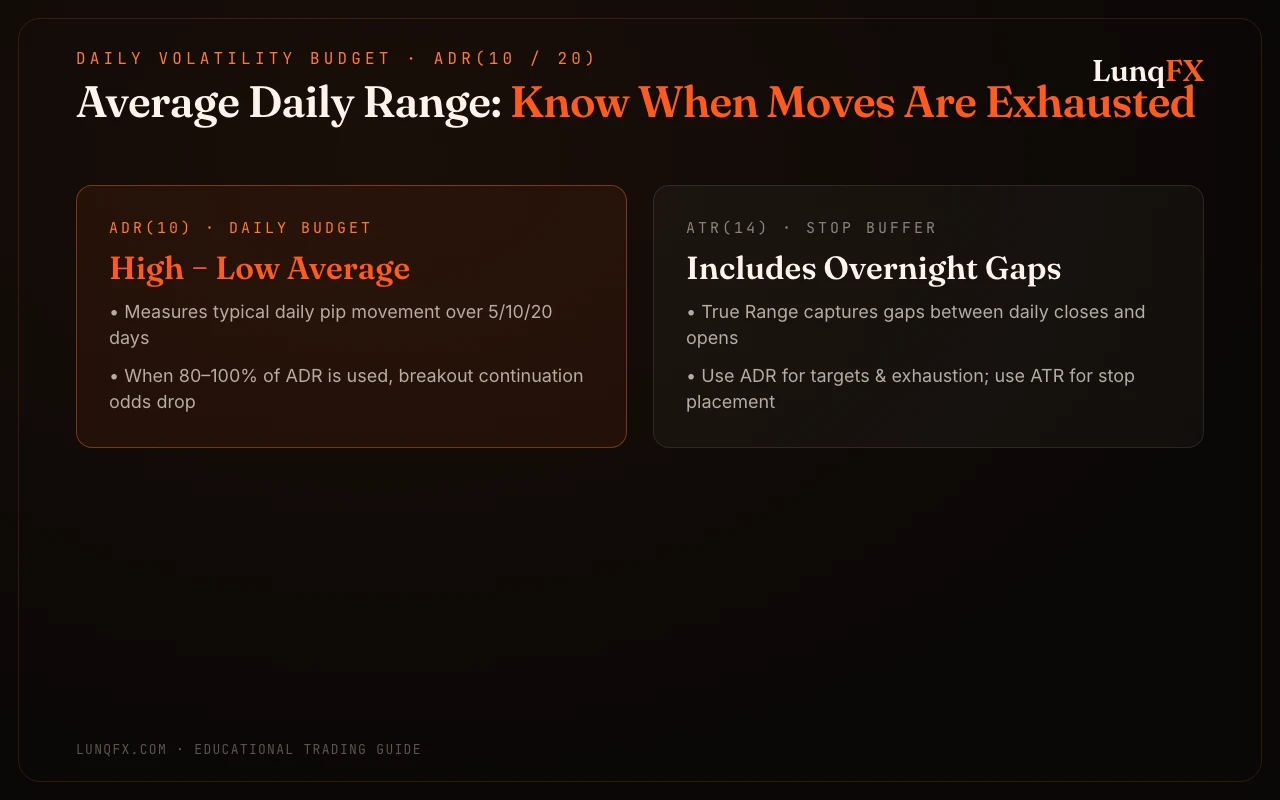
The average daily range (ADR) is the arithmetic mean of each day's High − Low over a chosen lookback window of N trading days — most commonly 5, 10, or 20 days.
Unlike momentum oscillators or moving averages, ADR does not tell you which direction price will move. It tells you how much total distance an instrument typically travels from its session low to its session high in a single day. Think of it as a daily fuel budget: once a pair has burned through most of its budget, chasing fresh breakouts in the same direction carries diminishing reward for the risk.
Choosing the lookback period is a trade-off between responsiveness and stability:
- 5-day ADR: Reacts quickly to a new volatility regime (such as a central-bank week), but a single massive news candle can skew it by 20–30%.
- 10-day ADR: The practical default for most intraday traders — two trading weeks of data, smooth enough to ignore one outlier yet responsive to seasonal shifts.
- 20-day ADR: Roughly one trading month. Useful as a baseline when comparing pips per day by pair, though slow to reflect sudden quiet or volatile weeks.
How to Compute ADR (With a Worked Example)
The formula is straightforward:
Daily Range_i = Daily High_i − Daily Low_i
ADR(N) = (Range_1 + Range_2 + ... + Range_N) ÷ N
Say you are calculating a 5-day ADR on EURUSD using five completed daily candles (excluding Sunday's partial candle if your broker feed prints one):
| Day | Daily High | Daily Low | Daily Range (Pips) |
|---|---|---|---|
| Day 1 | 1.0890 | 1.0818 | 72 |
| Day 2 | 1.0912 | 1.0824 | 88 |
| Day 3 | 1.0885 | 1.0821 | 64 |
| Day 4 | 1.0940 | 1.0845 | 95 |
| Day 5 | 1.0908 | 1.0842 | 66 |
Total 5-day range = 72 + 88 + 64 + 95 + 66 = 385 pips. Divide by 5: ADR(5) = 77 pips.
If today's Asian and London sessions have already produced a low of 1.0830 and a high of 1.0895 (65 pips used), roughly 84% of the 5-day ADR is already consumed. That single calculation immediately changes how you treat a fresh breakout signal at 1.0896.
ADR vs ATR: Why You Need Both
Traders frequently confuse ADR with Average True Range (ATR). They sound interchangeable, yet they answer two different questions.
ADR measures strictly Daily High − Daily Low. It ignores where the previous day closed, which means it ignores overnight or weekend price gaps.
ATR uses True Range, which takes the greatest of:
- Today's High − Today's Low
- |Today's High − Yesterday's Close|
- |Today's Low − Yesterday's Close|
Because ATR incorporates gaps and is usually calculated on whatever chart timeframe you are viewing (M15, H1, D1), it measures bar-by-bar volatility. As covered in our ATR stop loss guide, ATR belongs in your stop placement and position sizing rules.
ADR forex analysis belongs in your daily range budgeting and target selection. Use ATR to decide how much breathing room a trade needs right now; use ADR to decide whether the day still has enough room left to pay you.
Four Practical Ways to Use Average Daily Range
1. Spotting daily range exhaustion
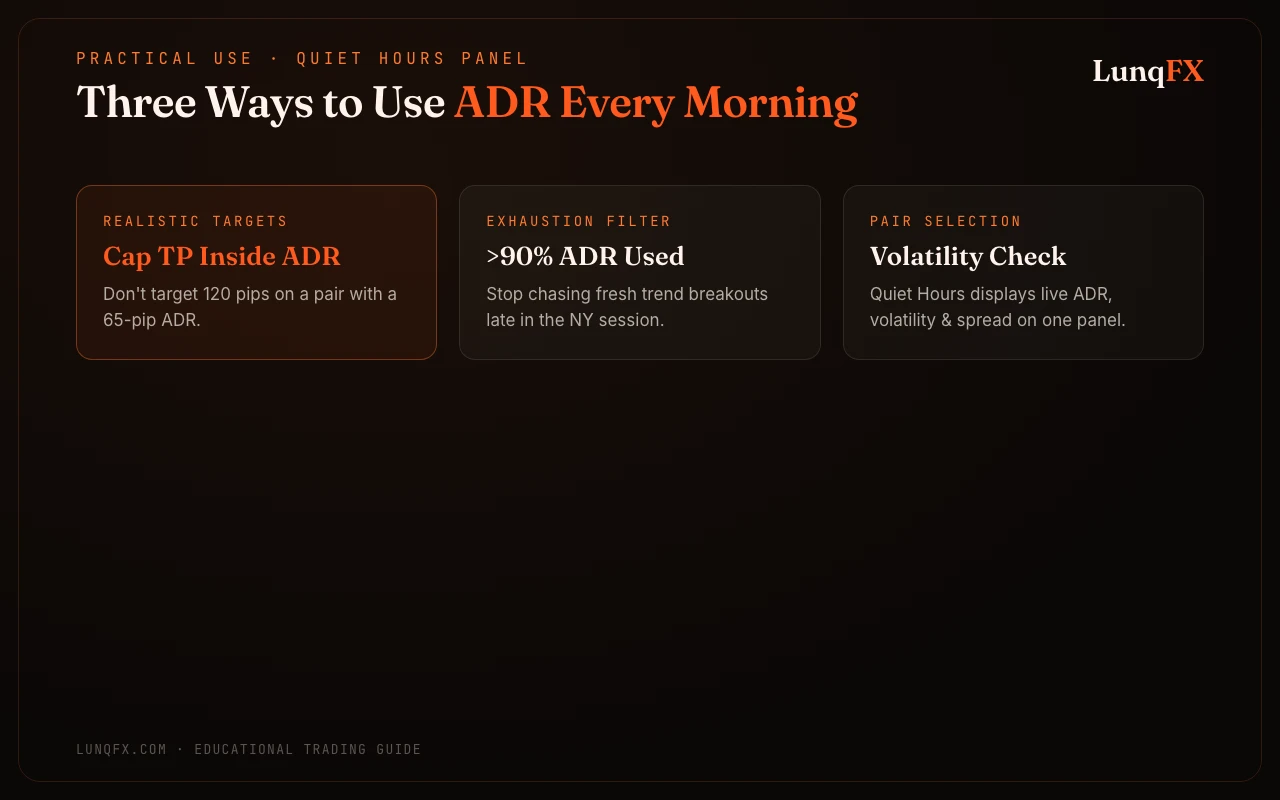
A useful rule of thumb — treat this as a practical heuristic rather than a mathematical guarantee — is that once an instrument has consumed 80–100% of its 10-day ADR, the odds of sustained trend continuation drop sharply while the odds of stalling or mean-reverting rise.
Two mistakes traders make with this heuristic:
- Fading blindly at 100% ADR: An exhausted range does not mean price must reverse. On strong trend or macro-catalyst days, pairs routinely push to 130–160% of ADR. Use 80–100% ADR as a veto on late breakout entries, not as an automatic counter-trend signal unless price also hits a higher-timeframe structure level.
- Ignoring the open vs the extreme: ADR is measured from the day's actual high to the day's actual low, not from the daily open. If a pair rallies 40 pips from the open, reverses, and drops 50 pips below the open, it has already printed a 90-pip daily range even though it sits only 50 pips from the open.
2. Setting realistic take-profit targets
If EURUSD's 10-day ADR is roughly 75 pips and you enter long after 55 pips of range have already printed, expecting another 50 pips before the New York close is asking for a 140% ADR day. Scale your targets to the remaining ADR budget — or accept that the move you wanted happened two hours earlier and wait for tomorrow.
3. Choosing pairs by volatility
Rather than relying on static pips per day by pair tables that go stale whenever central banks shift policy, rank pairs by relative ADR order and check your own live feed in your ADR forex routine:
- Wide daily movers: XAUUSD and GBPJPY consistently sit at the top of the intraday range table, followed by GBPUSD and GBPAUD. These suit traders who want room for multi-R intraday swings — provided position sizes are scaled down to match (see our gold scalping strategy for how gold's wide range changes execution).
- Moderate movers: EURUSD, USDJPY, and AUDUSD offer balanced daily ranges with tighter spreads, making them forgiving for structured intraday setups.
- Narrow movers: EURCHF and EURGBP compress into far tighter daily ranges. As an illustrative example only (always check your own current 10-day data), EURCHF often prints less than half the pip range of GBPJPY — trying to scalp a narrow pair with a wide-pair target simply traps you in overnight holds.
4. Budgeting by session share
Daily range is never distributed evenly across the 24-hour clock. Typically:
- Asian session (
00:00–07:00 GMT): Consumes a smaller fraction of ADR on European and US pairs as price consolidates. - London open & morning (
07:00–12:00 GMT): Delivers the primary expansion wave. - London–New York overlap (
12:00–16:00 GMT): Consumes the remainder of the daily budget before volatility tapers off after the London close (16:00 GMT).
Knowing which session consumes what share prevents a common trap in the London breakout strategy: if Asia unexpectedly burns 45% of ADR before Frankfurt even opens, London often spends the morning consolidating rather than expanding. For exact desk handoff windows, review our forex session times and kill zones guide.
Mondays, Fridays, and High-Impact News Days
An ADR indicator only averages recent history; it does not read the economic calendar. Three calendar effects regularly break naive ADR assumptions:
- Mondays: Often open quietly while institutional desks digest weekend risk, printing 60–75% of normal ADR — unless a geopolitical weekend gap already consumed range before Tokyo opened.
- Fridays: Afternoon profit-taking ahead of the weekend close (
21:00–22:00 GMT) frequently caps upside continuation after15:00 GMT, even if ADR isn't technically exhausted. - CPI, NFP, and rate decisions: High-impact releases routinely push pairs to 150–200% of their 10-day ADR in hours. Crucially, that single spike then inflates a 5-day ADR for the next week, making normal days look "under-exhausted" when volatility has actually returned to baseline. Using a 10-day or 20-day window dampens that distortion.
Where ADR Misleads You
ADR is a context filter, not a standalone strategy. Three limitations to keep in mind:
- Broker feed differences: A broker whose daily candle rolls over at
00:00 GMTvs22:00 GMT(New York 5pm close) will compute slightly different daily highs and lows on days with late-session spikes. Stay consistent with one feed. - Volatility regime shifts: Coming out of a multi-week holiday lull into a rate-hike cycle, a 20-day ADR will understate how fast the market is actually moving today. Watch price relative to XAUUSD key levels or major FX swing levels alongside ADR, never in isolation.
- No directional edge: Knowing a pair has 30 pips of ADR left tells you capacity, not direction.
Calculating 5-day and 10-day ADR by hand across six pairs every morning is tedious enough that most traders stop doing it after a week. A free MT4/MT5 tool like Quiet Hours puts the Asia, London, and New York session boxes, live spread, volatility, and current ADR reading onto a single chart panel with no key or card required. It removes the arithmetic friction — though deciding whether to pass on a late-day breakout at 90% ADR is still your discipline.
FAQ
What is the best period setting for an ADR indicator? A 10-day lookback is the most balanced default for intraday forex and gold trading. Five days reacts faster to new volatility but is easily skewed by a single news spike; 20 days is better for comparing long-term pair volatility.
What is the difference between ADR and ATR in forex? ADR averages each day's High − Low and ignores overnight gaps, making it ideal for daily range budgeting and realistic targets. ATR uses True Range (including prior close gaps) and is better suited for stop-loss placement and position sizing.
Does price always reverse when it hits 100% of ADR? No. Reaching 80–100% of ADR is a heuristic warning that continuation odds are falling, not a guarantee of a reversal. Strong macro catalysts can push price to 150% or more of ADR.
Should I include Sunday candles in my ADR calculation? No. Short Sunday evening candles (often only 1–2 hours long) artificially drag down the average. Exclude partial Sunday bars and calculate ADR using full 24-hour weekday sessions.
Which forex pairs have the highest average daily range? In relative order, XAUUSD and cross pairs like GBPJPY and GBPAUD consistently have the widest daily ranges, majors like EURUSD and USDJPY sit in the middle, and crosses like EURCHF and EURGBP sit at the narrow end.