XAUUSD Key Levels: Which Round Numbers and Session Levels Actually Hold
· 9 min read · LunqFX Team
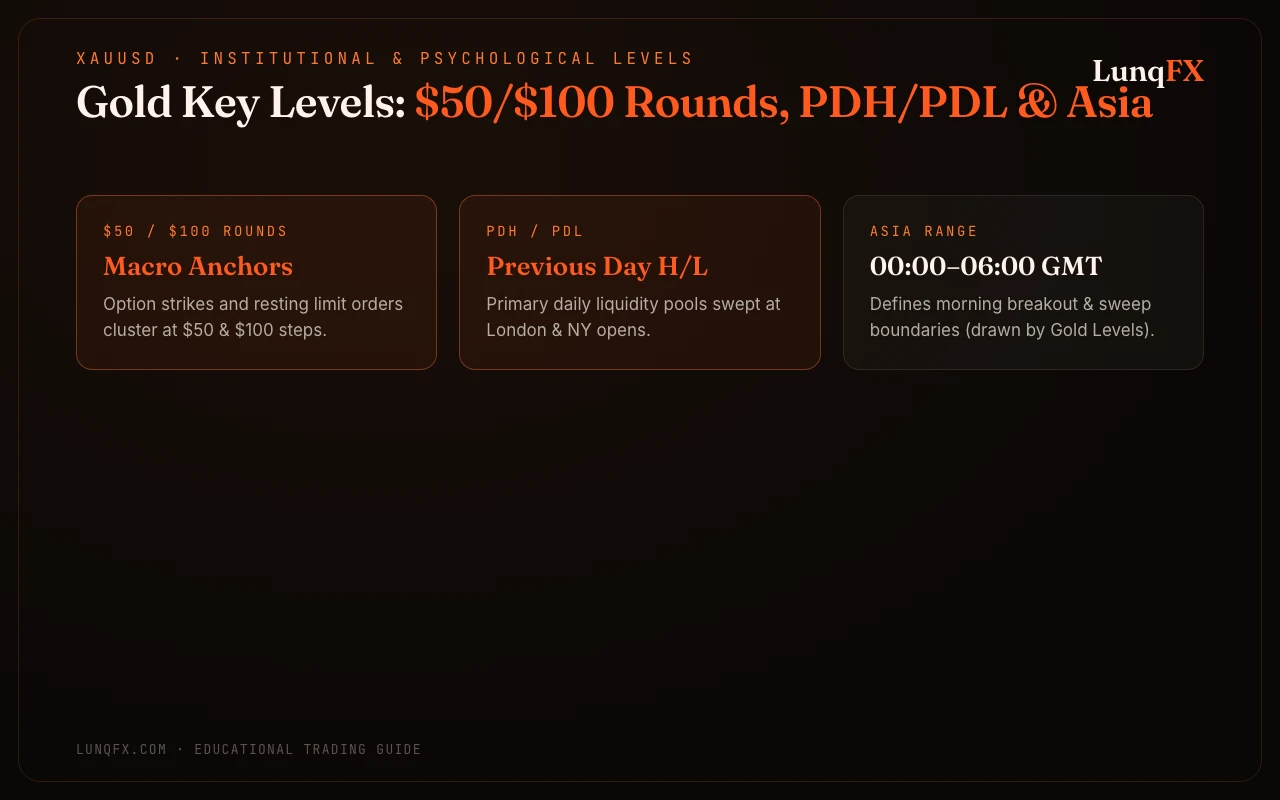
Most gold traders draw too many lines. By Tuesday afternoon, their chart looks like a prison cell — twenty horizontal levels of equal thickness, none of them ranked, and every candle appears to be "reacting" to something. Identifying XAUUSD key levels is not about finding more lines; it is about discarding the ninety percent that carry no resting liquidity and focusing on the handful of prices where real orders actually cluster.
Gold respects specific structural and psychological reference points far more reliably than arbitrary swing-high lines drawn from three weeks ago. This guide breaks down which levels matter, why order flow congregates there, how to handle gold's pip-definition confusion, and how to trade a reaction without guessing.
The Five XAUUSD Key Levels Worth Marking
Not all gold support and resistance is created equal. Five categories account for most clean intraday and swing reactions on XAUUSD.
1. $100, $50, and $10 round numbers
Gold psychological levels work for mechanical reasons, not mystical ones:
- Option strikes and hedging: Bullion desks and options dealers hedge exposure around major strikes — particularly $100 and $50 increments, creating real order-book friction.
- Resting orders: Execution desks and retail traders alike anchor to clean digits. Limit orders pile up ahead of a round number; stops pile up just beyond it.
- Retail anchoring: Nobody targets $2,743.80; traders target $2,750 or $2,800.
One adjustment for modern gold prices: at prices north of $2,500+, $10 levels sit close together, and price can slice through two or three $10 increments in one London impulse. Match the increment to your timeframe:
- H1 and above: Mark $100 and $50 handles only.
- M5–M15 scalping: Add $10 levels as intraday reaction and target waypoints.
2. Previous day high and low (PDH / PDL)
The previous day high low are the most-watched daily reference points in spot gold. Yesterday's high marks where buyers stalled and overnight short stops sit; yesterday's low marks where sellers exhausted themselves and long stops rest. When London or New York drives into PDH or PDL, you are watching a direct test of whether that prior extreme holds or gets swept.
3. The Asia session range
Gold typically spends Tokyo (00:00–07:00 GMT) compressing inside a contained range before European desks arrive. Marking the gold Asia range high and low gives you the boundaries the London breakout strategy targets — and the edges where a false break traps early breakout traders.
4. Weekly open, high, and low
The weekly open (Sunday 22:00 GMT / Monday 00:00 GMT depending on broker feed) acts as a directional pivot through mid-week, while the weekly high and low behave like higher-timeframe PDH/PDL levels that often flip from resistance to support once broken cleanly.
5. Prior London and New York session highs/lows
During New York (13:00 GMT onwards), the London morning high and low are fresh liquidity pools where intraday traders still hold active stops. For exact desk handoffs, see our forex session times and kill zones guide.
| Level Type | Primary Timeframe | What Rests There | Best Use |
|---|---|---|---|
| $100 / $50 rounds | H1, H4, D1 | Option strikes, large resting limits | Swing targets, major reaction zones |
| $10 rounds | M1, M5, M15 | Intraday profit-taking, scalp entries | Scalp waypoints, trailing targets |
| PDH / PDL | M15, H1 | Overnight stops, breakout orders | Sweep-and-reject or break-and-retest |
| Asia Range | M5, M15 | Early breakout stops | London open sweep or expansion |
| Weekly Open / H / L | H1, H4 | Multi-day positioning | Weekly bias and structural pivots |
Levels Are Liquidity Pools, Not Brick Walls
The single biggest mistake in round number trading is treating a key level like a rigid wall where you place a blind limit order the moment price touches it.
In gold, levels behave like magnets for liquidity. Because everyone can see PDH or a $50 handle, stop-losses cluster just beyond them. Larger participants know this. Instead of reversing cleanly to the cent at $2,750.00, gold routinely pierces $2,751.50 or $2,752.00, triggers the buy-stops and stop-losses sitting above the handle, absorbs that liquidity, and then reverses back below $2,750.00.
This distinction — sweep-and-reject versus a clean break — is the core of liquidity sweeps and order blocks:
- Sweep-and-reject: Price wicks through the level, fails to close above it (or closes back inside on the very next candle), and leaves a long rejection wick. That is a failed auction and a high-probability fade signal.
- Clean break: A full-bodied candle closes decisively beyond the level with follow-through volume, and subsequent candles hold above it rather than snapping back inside.
If you place blind limit orders directly on $2,750.00 with a tight stop at $2,752.00, you are volunteering to be the liquidity that fuels the sweep.
How to Rank Levels: The Confluence Rule
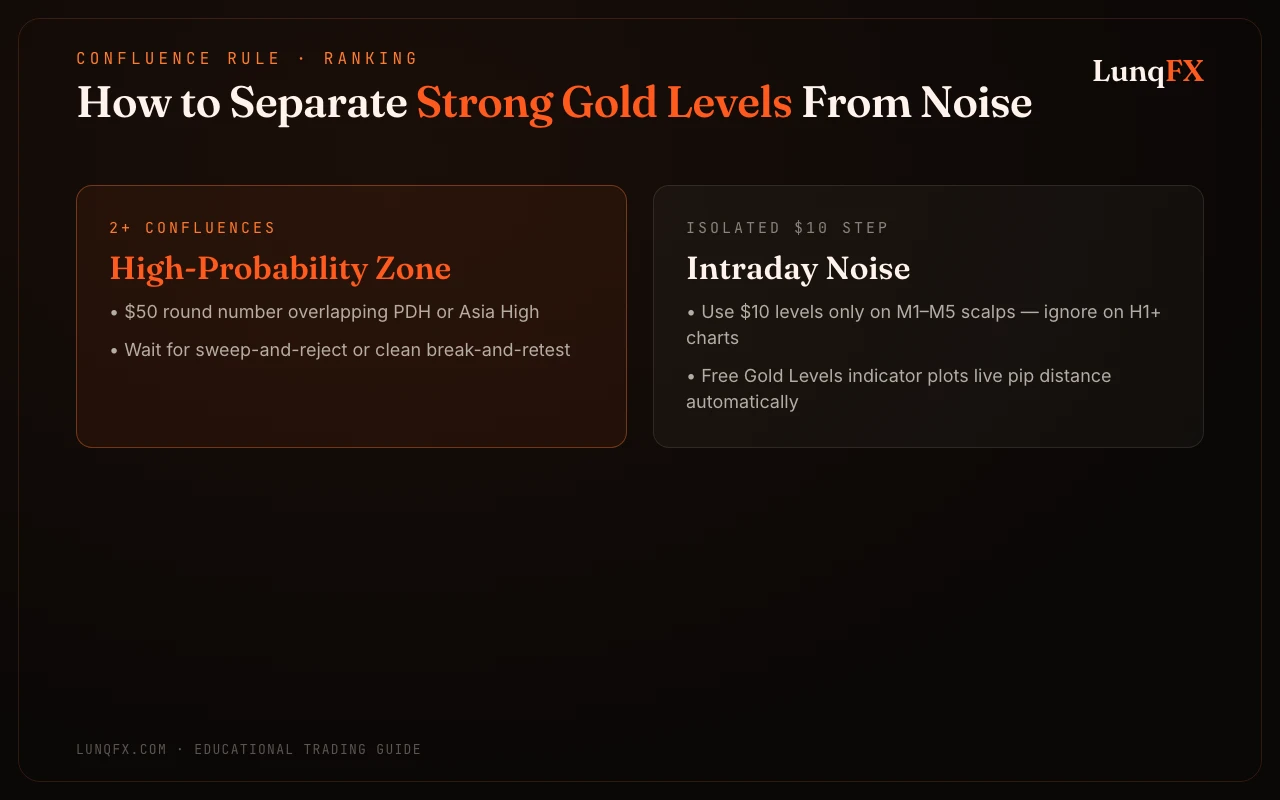
If your chart has a $50 round number, PDH, and the Asia high all visible, how do you know which one deserves your risk? You rank them by confluence of two or more independent factors.
A standalone $10 level in the middle of yesterday's range is weak gold support and resistance. A $50 round number within $1.00–$2.00 of the previous day high low and aligned with the gold Asia range high is a high-conviction zone where resting orders compound.
A quick ranking checklist before taking any round number trading setup:
- Tier 1 (Trade): 2+ overlapping levels (e.g. $50/$100 round + PDH/PDL or session high/low) with room left in gold's average daily range.
- Tier 2 (Monitor): Single major level ($50/$100 or PDH/PDL) with clear higher-timeframe trend alignment.
- Tier 3 (Ignore as entry): Isolated $10 round numbers or multi-week historical lines with no session context. Use these only as profit-taking waypoints.
Gold Pip Definition Confusion and Distance-in-Pips Thinking
Before you measure how far price is from a level — or set a stop buffer behind one — you need to settle the gold pip definition, because brokers quote XAUUSD inconsistently and it ruins traders' risk maths.
On most MT4/MT5 brokers, XAUUSD is quoted to two decimal places (e.g., 2750.00 to 2750.10), though some quote three. In standard spot-gold convention:
- 1 pip = $0.10 (first decimal place):
2750.00to2751.00is 10 pips. - 1 point (pipette) = $0.01 (second decimal place):
2750.00to2751.00is 100 points.
Some brokers label $0.01 a pip, calling a $10 move "1,000 pips" instead of "100 pips". On a standard 100-oz lot, a $1.00 move is always $100 regardless of label — just verify your indicator's pip convention before typing in a distance.
Distance-in-pips thinking matters for execution. If gold is sitting 18 pips ($1.80) below a Tier 1 resistance confluence, entering a long there with a 30-pip target means you are buying straight into a wall. Knowing the live distance to the next $10, $50, and PDH/PDL level stops you from taking low-reward entries right into opposing liquidity. For tactical execution around these zones, see our gold scalping strategy guide.
Two Ways to Trade XAUUSD Key Levels
Once price reaches a Tier 1 or Tier 2 zone, there are only two disciplined ways to engage.
1. The reaction trade (sweep-and-reject)
Wait for price to probe the level — ideally piercing through it by a few dollars — and close a confirmation candle (M5 for scalps, M15/H1 for intraday swings) back on the side you want to trade.
- Entry: On the close of the rejection candle, or a slight retrace into the wick.
- Stop loss: Beyond the extreme of the sweep wick, plus a spread buffer (never right on the round number itself).
- Target: The nearest opposing liquidity — the Asia midpoint, the next $10/$50 handle, or the opposite session extreme.
2. The break-and-retest
When a major level breaks with a strong, full-bodied close, do not chase the candle. Wait for price to pull back and test the broken level from the other side. Former resistance (PDH or a $50 handle) holding as new support confirms that buyers have absorbed the resting supply.
- Entry: Rejection candle off the retest of the broken level.
- Stop loss: Back inside the broken range, beyond the retest candle.
- Target: The next $50/$100 handle or remaining daily range budget.
Where Level Trading Breaks
Even the cleanest XAUUSD key levels fail under specific conditions. Recognising them upfront saves unnecessary drawdowns:
- High-impact US data (NFP, CPI, FOMC): During scheduled macro releases, resting limit orders are pulled from the book. Gold can slice through three $10 levels and a $50 handle in ninety seconds without pausing. Levels do not hold when liquidity providers step back.
- Exhausted daily range: If gold has already travelled 90–100% of its 10-day average daily range before New York lunch, a break-and-retest at a fresh high is far more likely to stall than trend another $30.
- Mid-range chop: On quiet Monday mornings or holiday sessions, gold can oscillate around a single $10 level for hours, triggering false breakouts in both directions.
Marking PDH/PDL, the Asia range, and round numbers by hand every morning takes five minutes, and skipping it is where most intraday bias errors start. A free tool like Gold Levels draws the $10 and $50 round numbers, previous day high/low, Asia range, and live distance in pips automatically on MT4 and MT5 (and comes with a 10-page Gold Scalper's Playbook PDF). If you want execution signals layered onto those same zones, AURUM adds closed-candle graded arrows, a trend ladder, and a stop with three targets built specifically for XAUUSD. What neither tool can do is decide whether a news release or an exhausted daily range makes the setup worth skipping — that filter stays with you.
FAQ
What are the best XAUUSD key levels to watch every day? Start with four: $100 and $50 round numbers, the previous day's high and low (PDH/PDL), the Asia session range, and the weekly open. Add $10 round numbers only if you are scalping on M1–M15.
Why does gold react so strongly to $50 and $100 round numbers? Large options strikes, institutional hedging flows, and retail limit and stop orders cluster at clean round figures. That concentration of resting liquidity creates predictable pauses, sweeps, and reversals.
How many pips is a $10 move in gold? Under the standard spot-gold convention where 1 pip equals $0.10, a $10 move is 100 pips. Some brokers quote $0.01 as a pip (1,000 pips per $10), so always verify your platform's pip definition before sizing a trade.
Should I place limit orders directly on gold psychological levels? Usually no. Because round numbers are visible to everyone, price frequently sweeps slightly past the level to trigger resting stops before reversing. Waiting for a candle close back inside the level avoids getting stopped out by the sweep.
What timeframe is best for trading gold round numbers? Use H1 and H4 to identify reactions at $50, $100, and PDH/PDL levels, then drop to M5 or M15 to time the rejection or break-and-retest entry.