London Breakout Strategy: Asian Box Rules and the Sweep-Reversal Fix
· 8 min read · LunqFX Team
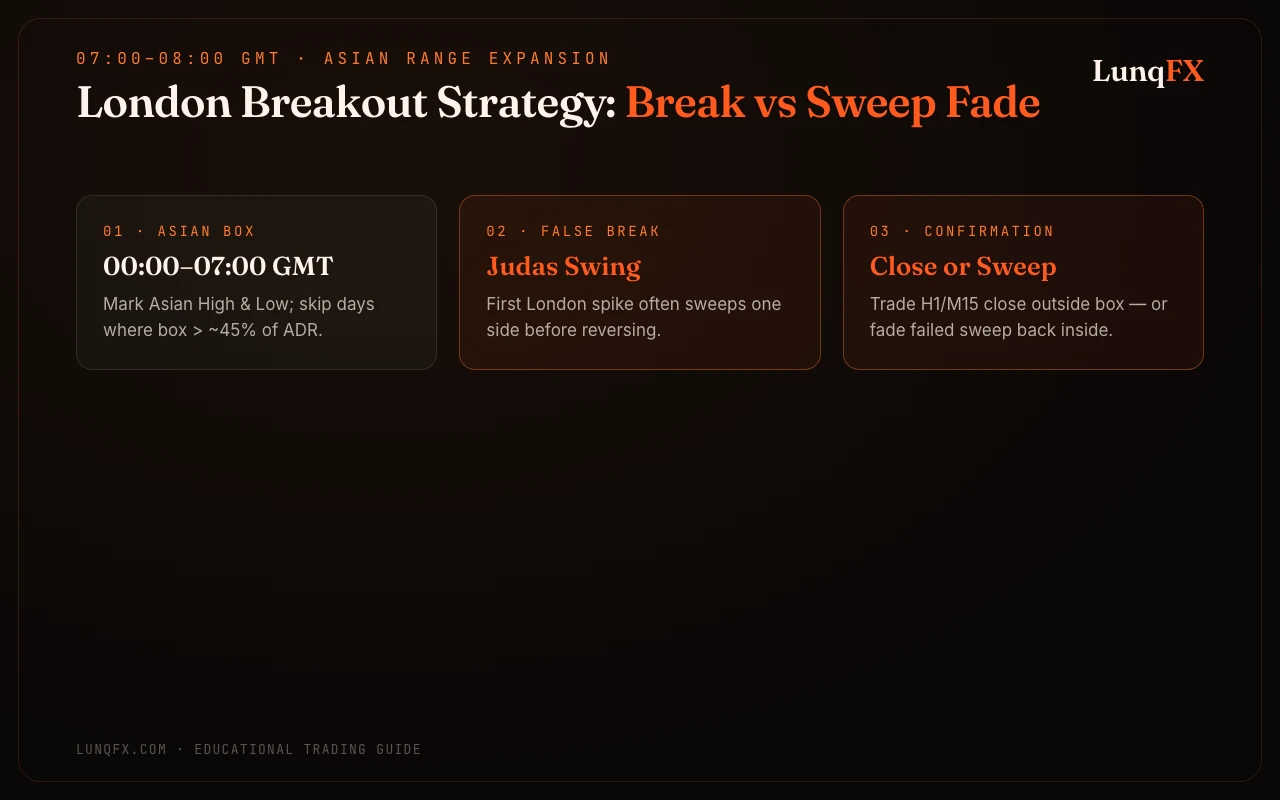
The classic London breakout strategy is taught as a three-step mechanical miracle: draw a box around the Asian session, place a buy-stop above it and a sell-stop below it, and collect pips when London opens. Anyone who has actually traded that textbook version for a month knows what happens next — you get tagged into a long at the Frankfurt open, stopped out ten minutes later as price snaps back through the box, and watch the real move happen without you.
The underlying market logic is sound; the naive execution is what breaks. This guide covers the exact GMT timing (including the UK summer shift), the ADR width filter that eliminates dead days, the three entry methods, and the Judas-swing sweep variant that turns the strategy's biggest flaw into its cleanest edge.
The Logic: Compression Into Expansion
During the Asian session, European and US institutional desks are closed. Liquidity is thinner, order flow on European pairs and gold is quieter, and price typically rotates inside a contained horizontal range.
When Frankfurt and London desks come online, real institutional volume enters the book simultaneously — corporate FX hedging, overnight order execution, and macro rebalancing. That sudden liquidity injection breaks the overnight equilibrium and drives the first directional leg of the day. The Asian range breakout works when overnight accumulation resolves into morning expansion; it fails when the market uses the obvious box edges to harvest stops first.
Defining the Breakout Box (GMT and BST)
Precision on session times matters because a 60-minute error shifts your box right across the Frankfurt open. All times below are in GMT (winter), with the UK summer shift noted alongside:
- Asian breakout box:
00:00–07:00 GMT(covers the core Tokyo session and pre-European lull). - Frankfurt open:
07:00 GMTin winter (06:00 GMTduring UK British Summer Time / BST, late March to late October). - London open:
08:00 GMTin winter (07:00 GMTduring BST).
Mark the highest high and lowest low formed between 00:00 and 07:00 GMT in winter (or 00:00–06:00 GMT in summer if you want the box closed strictly before Frankfurt). Note that because London is the world's largest FX hub, the 07:00–09:00 GMT window is where both genuine breakouts and engineered false breakout sweeps concentrate. For the full 24-hour desk schedule, see our forex session times and kill zones guide.
Best Pairs for the London Breakout Strategy
Not every instrument responds to the European open. Stick to pairs where London volume creates a sharp contrast against Tokyo:
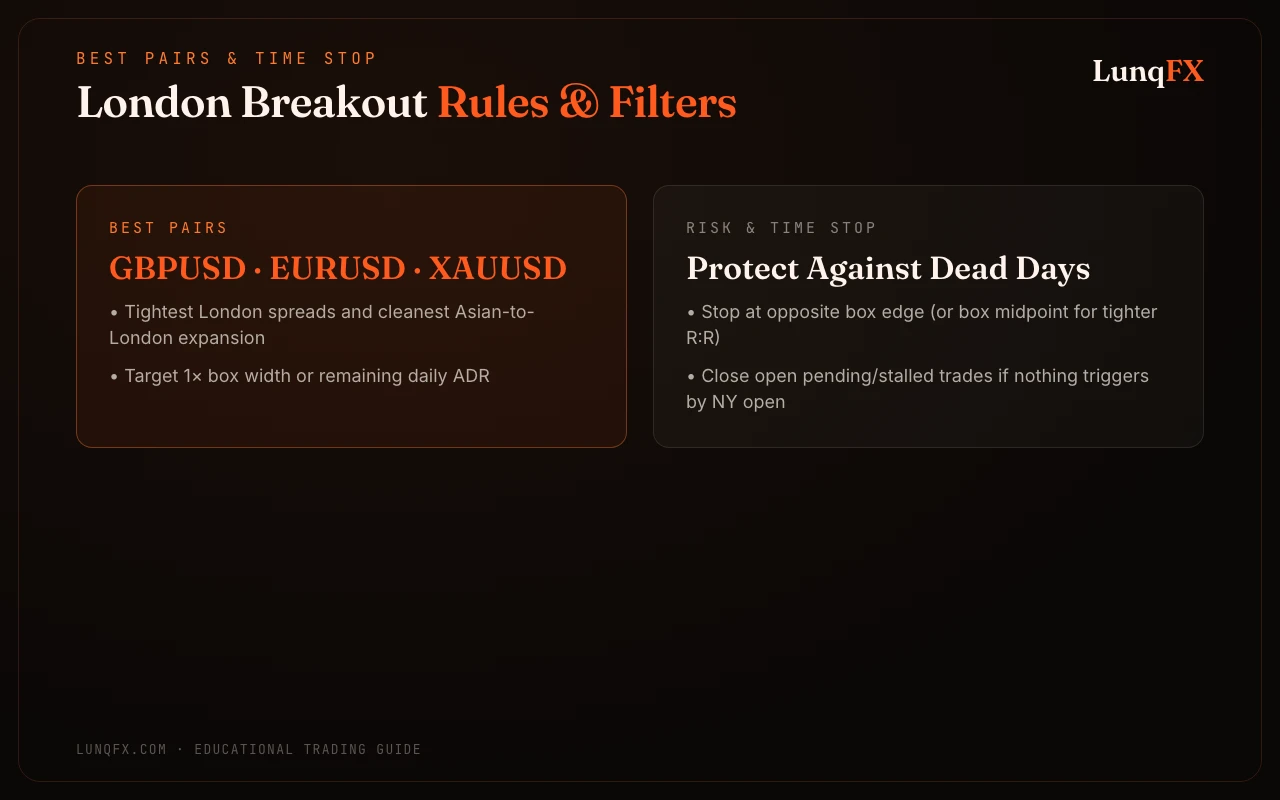
- GBPUSD and EURUSD: The core European majors. Tight spreads, clean Asian consolidation, and reliable
07:00–09:00 GMTexpansion. - GBPJPY: Wider range and sharper momentum, though it requires strict box-width filtering so you don't chase an already-exhausted morning.
- XAUUSD (Gold): Gold's Asian range is one of the cleanest intraday reference zones on the chart, especially when it overlaps with XAUUSD key levels like a $50 round number or previous day high/low.
Avoid commodity crosses like AUDNZD or USDJPY for this setup — their primary volume already occurred during Tokyo and Sydney, so London often brings chop rather than expansion.
The ADR Filter: When to Skip the Box
Before placing any order, measure the height of the breakout box against the pair's 10-day average daily range. Treat these thresholds as practical heuristics:
- Box > 40–50% of 10-day ADR → Skip. If EURUSD has a 75-pip ADR and the Asian box is already 38 pips tall, nearly half the day's fuel is spent before London even arrives. Continuation odds fall sharply.
- Box < 10–15% of ADR (abnormally narrow) → Be cautious. Ultra-tight boxes look tempting because stops are small, but spread friction and minor pre-open wicks trigger both sides effortlessly.
- Sweet spot: A box measuring roughly 20–35% of 10-day ADR gives enough compression to fuel expansion without suffocating in spread noise.
Three Entry Methods Compared
How you enter determines whether you are the trader getting swept or the trader profiting from it.
| Entry Style | Trigger | Pros | Cons |
|---|---|---|---|
| 1. Pending stop orders | Buy-stop / sell-stop 2–5 pips outside box | Never misses a fast spike | Highest false-breakout rate |
| 2. Candle-close confirmation | M15 or M30 candle closes cleanly outside box | Filters out wick-only spikes | Worse entry price on big candles |
| 3. Sweep-reversal (Judas swing) | Price pierces box edge, then closes back inside | Uses retail stops as fuel; tight invalidation | Misses clean one-way trend days |
Method 1: Pending stop orders (classic)
Place a buy-stop 2–5 pips (or $0.50–$1.00 on gold) above the box high and a sell-stop the same buffer below the box low. Cancel the opposite order once one triggers (OCO). This captures every runaway move, at the cost of absorbing every London open stop hunt.
Method 2: Wait for a closed candle
Wait for a full M15 (or M30) candle to close outside the box boundary before entering, or enter on a shallow retest of the broken edge. You sacrifice the first 10–15 pips of a fast breakout in exchange for filtering out the majority of 5-minute false breakout wicks.
Method 3: Fade the false break (the Judas swing)
Because thousands of traders draw the exact same 00:00–07:00 GMT box, buy-stops and sell-stops sit in predictable clusters just millimetres outside both edges. A classic London open pattern — often called the Judas swing — is for Frankfurt or early London to push price 5–15 pips beyond one side of the box, trigger the breakout stops, absorb that liquidity, and snap violently back inside toward the opposite side.
To trade the sweep-reversal variant:
- Wait for price to pierce the box high (or low) without holding above it.
- Enter only after a closed M5 or M15 candle rejects back inside the box.
- Place your stop just beyond the extreme of the sweep wick.
This turns the exact mechanism that kills the textbook London breakout strategy into your entry signal — the same dynamic detailed in our liquidity sweeps and order blocks guide.
Stop Loss, Targets, and the Time Stop
Stop loss placement
- Narrow boxes (< 25% ADR): Place your stop on the opposite side of the box plus a spread buffer.
- Wider boxes (25–40% ADR): Placing a stop across the entire box ruins your risk-to-reward. Use the box midpoint (50%) or the most recent intraday swing structure inside the box, and calculate your exact position size using our lot size formula so dollar risk stays constant regardless of box width.
- Sweep-reversal entries: Stop goes beyond the sweep wick extreme, plus spread.
Profit targets
- Target 1:
1×the box width projected from the breakout edge (or the opposite side of the box on a Judas swing fade). - Target 2: Remaining 10-day ADR budget, or the nearest higher-timeframe PDH/PDL level.
The time stop
If no breakout triggers — or price stalls inside the box — by the New York open (12:00–13:00 GMT), cancel all pending orders and close flat positions. By New York, the Asian range has lost its relevance and US macro flow takes over.
Where This Strategy Breaks
Even with an ADR filter and a time stop, the London breakout strategy has clear failure modes:
- Pre-London ECB / UK data: Scheduled releases at
06:00–07:00 GMT(such as UK GDP or German CPI) can spike spreads and blow through both sides of the box in seconds. Check the calendar before setting orders. - Bank holidays: UK or European bank holidays drain London morning liquidity. A breakout on a London holiday is usually a drift that reverses by midday.
- Strong higher-timeframe trends: In a relentless D1 trend, the sweep-reversal variant will try to fade a genuine trend-continuation breakout and get run over. Never fade a breakout against a clear higher-timeframe impulse without confirmation.
Drawing the Asian box and checking ADR manually every morning is easy to skip when you're rushed at 06:55 GMT. On MT4 and MT5, Quiet Hours plots the Asia, London, and New York session boxes alongside live spread, volatility, and ADR on a single panel, while Gold Levels marks the Asia range and PDH/PDL automatically on XAUUSD. If you prefer the sweep-reversal variant over chasing breakouts, RIPTIDE detects pierce-and-reject sweeps of range highs and lows on closed candles, grades the setup A+ to C, and calculates lot size from your stop drag. None of those tools will check the UK economic calendar for you — that morning habit remains yours.
FAQ
What is the best time to draw the London breakout box? Draw the box from 00:00 to 07:00 GMT in winter (00:00–06:00 GMT during UK British Summer Time), capturing the Asian consolidation before Frankfurt (07:00 GMT winter) and London (08:00 GMT winter) open.
Why do so many London breakouts fail? Because the Asian high and low are visible to everyone, breakout orders and stop-losses cluster just outside the box. Larger participants frequently sweep one side to trigger those stops before driving price in the opposite direction.
What box size is too big for the London breakout strategy? As a practical heuristic, skip the setup if the Asian box already exceeds 40–50% of the pair's 10-day average daily range, as too much of the day's expected movement is already spent.
Which pairs work best for the Asian range breakout? GBPUSD, EURUSD, GBPJPY, and XAUUSD respond best because their primary institutional volume arrives at the Frankfurt and London opens. Pairs like AUDNZD or USDJPY see much of their flow earlier in Asia.
When should I close an open London breakout trade if nothing happens? Apply a time stop at the New York open (12:00–13:00 GMT). If price hasn't followed through by then, cancel pending orders and exit flat trades, as US session flow changes the market regime.