Forex Kill Zones and Session Times: When to Trade and When to Close the Laptop
· 6 min read · LunqFX Team
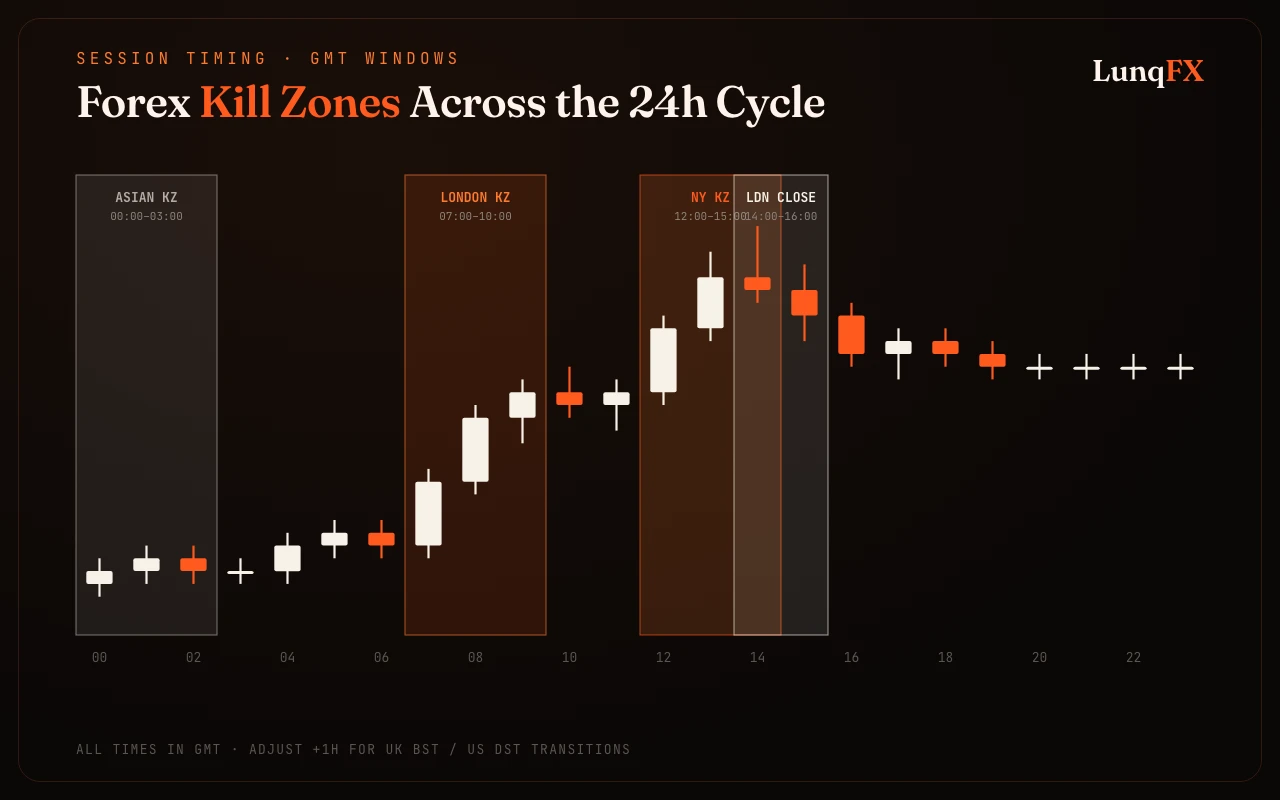
The forex market is open 24 hours a day, which sounds like an advantage and functions as a trap. Most of those hours are noise: thin liquidity, drifting ranges, and setups that look identical to the good ones but resolve into nothing. Forex kill zones are the short, high-activity windows where volume, volatility, and directional intent actually concentrate — and where nearly all of a day's tradable movement occurs.
This guide gives you the exact windows, what each one does to price mechanically, and an honest method for choosing the single session you should build your trading around.
Why Timing Beats Almost Everything Else
A setup is not a fixed object; it is a pattern whose reliability depends entirely on whether enough participants are present to act on it. The same break of a level is a genuine expansion at the London open and a fake-out at 3 a.m. New York time. Nothing about the candles differs — the liquidity behind them does.
This is why traders who fix nothing else about their process except when they trade often see immediate improvement. You are not trading a better strategy; you are trading the same strategy at the hours it was implicitly designed for.
The Four Kill Zones (With Exact Times)
Times below are given in GMT and New York local time, because that is how you'll see them quoted. Note that London and New York shift for daylight saving on different dates, so for a few weeks each spring and autumn the GMT figures move by an hour — always verify against your chart's server time.
Asian kill zone — roughly 00:00–03:00 GMT (19:00–22:00 NY, previous day)
Low volume, tight ranges, and the reason most manual traders should be asleep. Its value is not as a trading window but as data: the Asian session builds a compact range whose high and low become the day's most obvious liquidity pools. London routinely raids one of them.
Mark the Asian high and low. That single habit converts the quietest session into the most useful preparation you can do.
London kill zone — roughly 07:00–10:00 GMT (02:00–05:00 NY)
The first genuinely directional window of the day, dominated by EUR and GBP flow. The characteristic London-open sequence:
- A sweep of the Asian high or low, triggering the stops resting there.
- A reversal and expansion in the opposite direction.
- The day's directional bias established, often holding into the afternoon.
If that pattern sounds familiar, it should — it is the liquidity sweep structure, delivered on a schedule. The clock tells you when to expect it; the price structure tells you whether it happened.
New York kill zone — roughly 12:00–15:00 GMT (07:00–10:00 NY)
The highest-volume window of the day, because London is still open when American volume arrives. USD pairs, gold, and index products all come alive. It carries the most news risk: US data releases land at 12:30 and 14:00 GMT (08:30 and 10:00 NY) with regularity.
This overlap is the prime window for gold scalping and the only session most index traders need, since the US cash equity open at 14:30 GMT (09:30 NY) sits inside it.
London close kill zone — roughly 14:00–16:00 GMT (09:00–11:00 NY)
As London desks square up, the day's move often partially retraces. This is a mean-reversion window rather than an expansion one — the tactics that worked at the London open work backwards here, which is exactly why traders who don't distinguish sessions get chopped in the afternoon after a profitable morning.
What Actually Changes Between Sessions
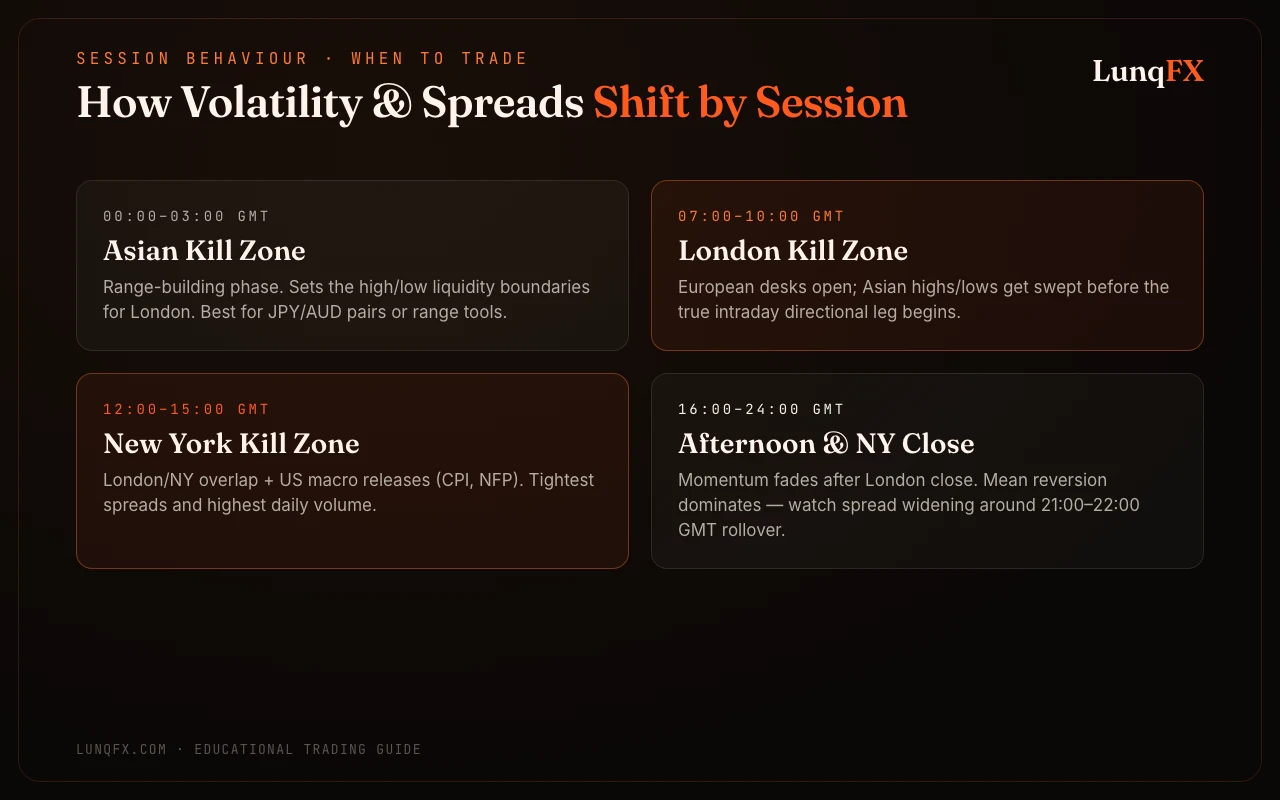
Three mechanical variables, all of which you can observe:
Spread. Widest in the late US session and the rollover hour, tightest during the London–New York overlap. On a strategy targeting small moves, this alone determines viability.
Average range. Gold, indices, and the majors can easily move several times more per hour during the overlap than during the Asian session. A fixed-pip stop that is sensible at 14:00 GMT is absurdly wide at 02:00 — which is why ATR-based sizing exists.
Participant type. Asian hours are dominated by regional flow and algorithms; London and New York bring institutional volume with genuine directional intent. The volume profile built during the overlap produces levels that hold; one built overnight often doesn't.
Choosing Your One Session
The advice that helps most: pick one kill zone and trade only it for three months. Not because the others don't work, but because a session is a set of behaviours you learn by repetition — how it opens, how it fakes, how it dies. Sampling four sessions gives you four shallow samples instead of one deep one.
Choose by your actual life, not by which session is "best":
- European daytime job? London close or the New York overlap.
- US-based, mornings free? The New York kill zone is yours, and it's the highest-quality window on the list.
- Asian timezone? Trade the Asian range's edges with reversion tactics, or the London open if your evening allows — and consider automation for the hours you can't attend, which is precisely the argument in our forex robots guide.
- Only evenings free, US timezone? Honestly: swing trade instead. Trading a dead session because it's when you're free is the most expensive scheduling decision in retail trading, and our scalping vs swing comparison covers the alternative.
Building a Session Routine
A workable daily structure, 30 minutes of work plus your trading window:
- Before the session: mark the Asian high/low, the previous day's high/low, and the previous session's volume levels. Check the economic calendar for releases inside your window.
- First 15 minutes: watch, don't trade. Let the session show whether it is sweeping, expanding, or ranging.
- The window: take only setups aligned with your higher-timeframe bias — the multi-timeframe process is what keeps a session trade from becoming a counter-trend gamble.
- After the session: close the laptop. Trades taken after your window are, statistically, the ones your journal will show as losses.
Session-marking tools automate step one — plotting kill-zone boxes, the Asian range, and prior-session levels before you sit down. It is exactly the kind of mechanical preparation worth automating, since doing it by hand at 06:50 GMT is when mistakes get made.
FAQ
What are forex kill zones? Short high-activity windows — Asian, London, New York, and London close — where volume and volatility concentrate. The term was popularised by Michael Huddleston (ICT), but the underlying session behaviour predates the label.
What is the best time to trade forex? The London–New York overlap, roughly 12:00–15:00 GMT, has the highest volume and tightest spreads for most major pairs, gold, and indices.
Why does the London open often reverse? Because the Asian session builds an obvious tight range whose extremes hold clustered stop losses. London volume frequently sweeps one side to source liquidity before establishing the real direction.
Do kill zone times change with daylight saving? Yes. London and New York change on different dates, so the GMT times shift by an hour for a few weeks each spring and autumn. Verify against your platform's server time rather than assuming.
Should I trade more than one session? Not while learning. Each session has distinct behaviour that takes months of repetition to read; trading several at once produces shallow familiarity with all of them.