Forex Rollover Time: Why Spreads Widen and Your Stops Get Hit
· 8 min read · LunqFX Team
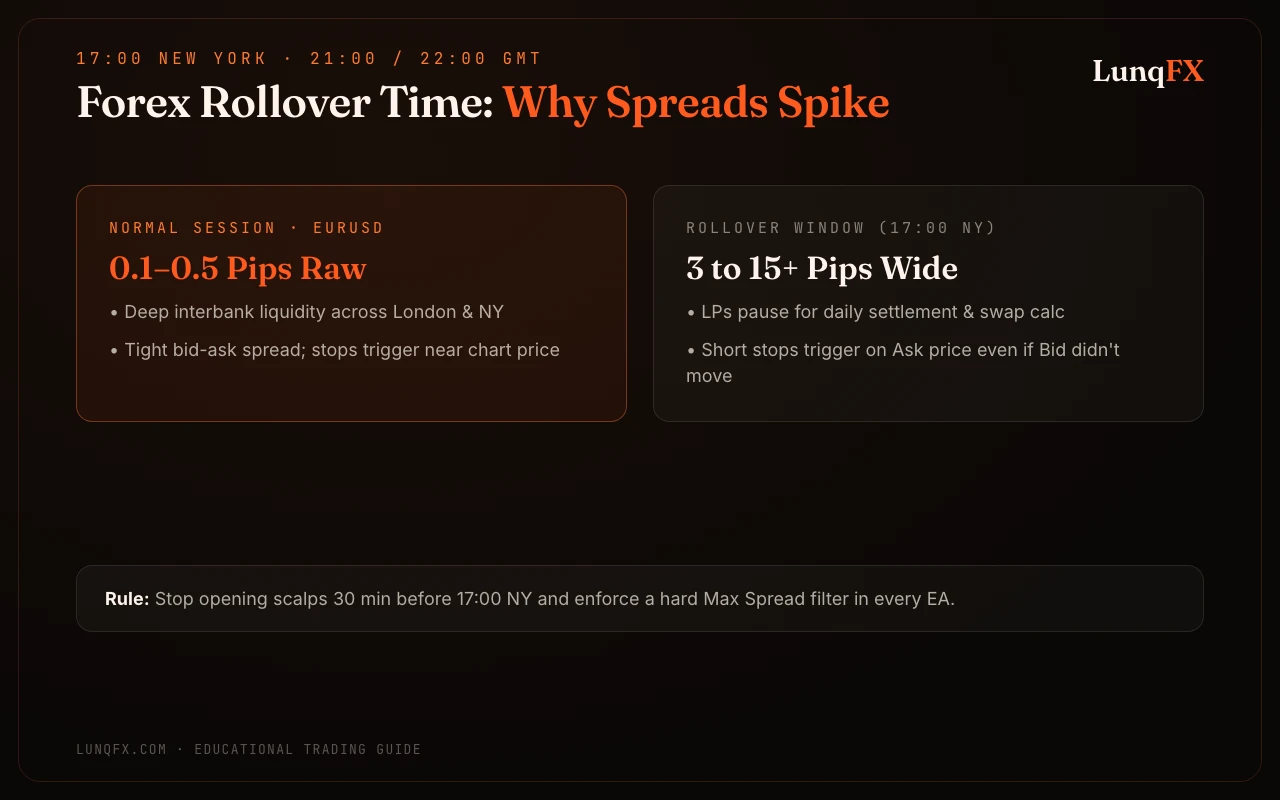
Every weekday at 17:00 New York time, the spot forex market closes one trading day and opens the next. If you have ever watched a quiet chart suddenly stop you out even though the candlestick never came close to your stop level, you have already met forex rollover time — and the spread widening at rollover that catches retail traders off guard.
This guide explains what actually happens during the 5pm New York close, how much spreads typically widen across majors, crosses, and gold, why short stops get hit by the Ask price without a visible price move, and how both manual traders and Expert Advisors should handle the window.
When Is Forex Rollover Time?
The global spot FX settlement day rolls over at 17:00 Eastern Time (New York):
- 21:00 GMT during US Daylight Saving Time (EDT, roughly March to November)
- 22:00 GMT during US Standard Time (EST, roughly November to March)
Notice that rollover is anchored to New York, not London or GMT. Many MetaTrader brokers set their server clock to GMT+2 in winter and GMT+3 in summer specifically so that 00:00 server time aligns with the 5pm New York close — giving you clean five-day weekly candles without a tiny Sunday bar. You can see how this transition bridges the end of the New York session and the start of the Asian session in our forex session times and kill zones guide.
Why Liquidity Disappears at Rollover
Between roughly 16:55 and 17:15 New York time (sometimes stretching 30–45 minutes on thinner pairs), institutional liquidity providers pull their tight quotes from ECN bridges and prime-of-prime feeds. Three things happen simultaneously:
- Bank books close and reconcile. Institutional desks flatten intraday inventory, settle net positions, and reset credit lines for the new value date.
- Swap rates are calculated and booked. Brokers and LPs apply overnight financing (swap) to all open positions held across 17:00 NY.
- No one wants adverse flow. Because volume is near zero and order books are shallow, market makers widen their bid-ask quotes defensively so they are not picked off by stale pricing.
With fewer LPs streaming top-of-book liquidity, the gap between the highest bid and the lowest ask expands sharply — even on a raw spread vs standard account.
How Wide Do Spreads Actually Get?
Exact spikes vary by broker, liquidity bridge, and day of the week, and they are often widest on Fridays or ahead of thin holidays. Generally across retail ECN/raw feeds at rollover:
| Instrument | Typical Active-Session Spread | Typical Rollover Window Range |
|---|---|---|
| EURUSD | 0.0–0.4 pips | 2.0–8.0+ pips |
| GBPUSD / USDJPY | 0.2–0.8 pips | 3.0–12.0+ pips |
| Minor crosses (e.g. GBPJPY, EURAUD) | 1.0–2.5 pips | 10.0–25.0+ pips |
| XAUUSD (Gold) | 10–30 cents (1–3 pips) | 100–300+ cents (10–30+ pips) |
On a Friday close or ahead of major weekend risk, those upper bounds can be exceeded. Any strategy targeting 5–10 pip stops on crosses or gold scalping is mathematically broken if it holds tight stops straight through that window.
Why Stops Get Hit Without Price "Touching" Them
This is the single biggest source of "my broker hunted my stop" complaints, and 99% of the time it is pure Bid/Ask mechanics.
By default, MetaTrader and TradingView plot Bid candles only. What actually executes depends on your direction:
- Long trades open at the Ask and close (hit Stop Loss or Take Profit) at the Bid.
- Short trades open at the Bid and close (hit Stop Loss or Take Profit) at the Ask.
Now walk through a worked numeric example on EURUSD at 21:00 GMT:
- You are short EURUSD with your stop loss at 1.08500.
- At 20:58 GMT, Bid is
1.08440and Ask is1.08442(0.2 pip spread). Your stop is 5.8 pips away. - At 21:00:05 GMT, Bid dips slightly to
1.08435, so the candlestick on your chart moves down in your favour. - Simultaneously, liquidity pulls and the spread widens to 7.0 pips: Bid is
1.08435, Ask jumps to1.08505. - Because short positions close on the Ask, your stop at
1.08500fills immediately — even though the Bid chart never printed higher than1.08440.
Turning on the Ask line in MT4/MT5 (F8 → Show Ask line) makes this visible in real time. Once you see it, you stop placing 5-pip stops right above obvious levels at 16:59 NY.
Swap and Triple Swap Wednesday
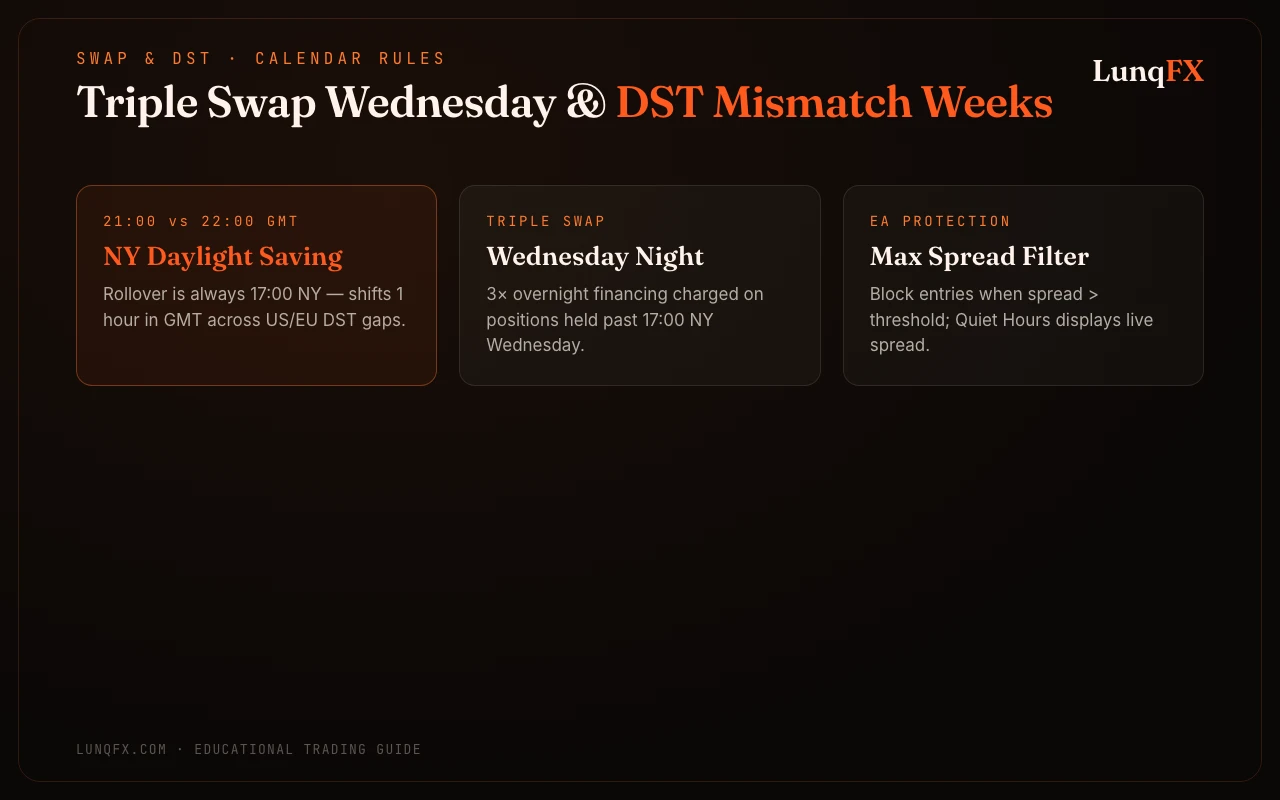
Holding a trade past forex rollover time incurs swap (overnight interest) based on the interest rate differential between the two currencies in the pair, plus the broker's financing markup.
Spot forex settles on a T+2 basis (two business days after the trade date). Positions held across the Wednesday-to-Thursday rollover settle from Friday to Monday — covering the weekend. To account for those three calendar days of financing, brokers charge or credit triple swap on Wednesday at 17:00 NY. (One common exception: USDCAD settles T+1, so many brokers apply triple swap on Thursday instead.)
If you swing trade negative-swap pairs or indices, check your broker's contract specifications before holding a heavy position through Wednesday rollover.
DST Mismatch Weeks: The Hidden Trap
Most traders know London and New York shift clocks for Daylight Saving Time, but they forget they do it on different dates:
- The US shifts to DST on the second Sunday in March and back to Standard Time on the first Sunday in November.
- Europe and the UK shift on the last Sunday in March and the last Sunday in October.
That creates two to three weeks in March and one week in late October / early November where the London–New York offset changes by one hour. Because rollover stays pinned to 17:00 New York, rollover shifts from 22:00 GMT to 21:00 GMT in mid-March before UK clocks move. If your routine or EA schedule is hard-coded to GMT without accounting for US DST, you will suddenly trade straight into rollover during those mismatch weeks.
How an EA Should Handle Rollover
An Expert Advisor running unattended on a forex VPS needs a dedicated rollover filter EA configuration, because a bot will happily open a trade into a 15-pip spread if you do not stop it. Four rules belong in any serious EA setup:
- Max-spread filter: Reject any new entry if current spread exceeds a fixed cap (for example, 1.5–2.0 pips on EURUSD or 35–40 cents on XAUUSD).
- Time blackout around 17:00 NY: Block new entries for 15–30 minutes before and after rollover (e.g.
20:45–21:30 GMTin summer,21:45–22:30 GMTin winter) unless the strategy is built specifically for post-rollover liquidity. - Verify broker server time vs GMT: Never assume
00:00on your chart is00:00 GMT. Check your broker's server offset (GMT+2winter /GMT+3summer is standard, but not universal) before entering session inputs. - Watch stop-modification logic: Avoid trailing stops or tightening stops into the rollover window, where a temporary spread spike will clip a stop that was healthy ten minutes earlier.
The Contrarian Point: Why Quiet Hours Still Have an Edge
Most traders treat the entire post-rollover evening as untradeable dead time. In reality, spread widening at rollover is temporary — once banks finish reconciling and Tokyo/Sydney liquidity trickles in, spreads settle back down while directional momentum stays muted.
That quiet post-close window is precisely where mean-reversion EAs like NIGHT OWL operate, trading the 21:00–24:00 GMT "quiet night range" with fixed stop losses and zero martingale. The crucial distinction is spread control: any edge in late-session mean reversion depends on filtering out the rollover spike itself and executing only once spreads normalise within acceptable limits. For manual traders checking whether spreads have settled or whether an afternoon/evening pair still has range left, the free Quiet Hours indicator plots Asia, London, and New York session boxes alongside live spread, volatility, and ADR on a single chart panel.
The Honest Limitations
Broker feeds diverge sharply at rollover. Two brokers showing identical spreads at 14:00 GMT can differ by 5–10 pips on EURUSD or 150 cents on gold at 17:02 NY, depending on their LP mix and markup. Backtests using fixed spreads completely hide this cost.
Stop widening is not a free fix. Widening your stop loss just to survive rollover increases your dollar risk per trade or forces smaller lot sizes — and a 30-pip spread spike on a thin cross can still clip a poorly placed level. If your strategy does not belong in that window, being flat before 16:55 NY is cleaner than trying to tank the spread.
FAQ
What time is forex rollover in GMT? Forex rollover occurs at 17:00 New York time, which is 21:00 GMT during US Daylight Saving Time (roughly March to November) and 22:00 GMT during US Standard Time (roughly November to March).
Why do forex spreads widen at 5pm New York time? Institutional banks and liquidity providers close daily books, reconcile positions, and calculate overnight swap rates, temporarily pulling tight quotes from ECN feeds and leaving thinner order books.
Why did my stop loss get hit when the chart never reached my price? Charts display the Bid price by default, whereas short positions close on the Ask price. When the spread widens sharply at rollover, the Ask price can jump through your stop level even if the Bid candle barely moves.
What is triple swap Wednesday in forex? Because spot forex settles on a T+2 basis, positions held across the Wednesday-to-Thursday rollover cover weekend settlement (Friday to Monday), resulting in three days of overnight swap interest booked at once.
Should I turn off my EA during forex rollover time? You should either block new entries during the rollover window using a time filter or enforce a strict rollover filter EA spread cap so the bot never opens positions into abnormal spreads.