Raw Spread vs Standard Account: Which One Actually Costs Less?
· 7 min read · LunqFX Team
Almost every retail forex broker offers the same two flagship account types: a "commission-free" Standard account and a "zero-spread" Raw or ECN account. Beginners gravitate towards Standard because "zero commission" sounds cheaper. Experienced scalpers gravitate towards Raw because "0.0 pips" looks cleaner on a chart. Both assumptions miss the only number that matters: your true cost per trade after combining spread, commission per lot, and execution quality.
This raw spread vs standard account breakdown compares how each model actually charges you, walks through illustrative cost maths for EURUSD and XAUUSD, separates real execution differences from "ECN" marketing, and gives you a practical checklist to test any broker's real numbers.
Raw Spread vs Standard Account: How Each Model Charges
You never trade for free. The difference between the two accounts is simply where the broker puts its fee:
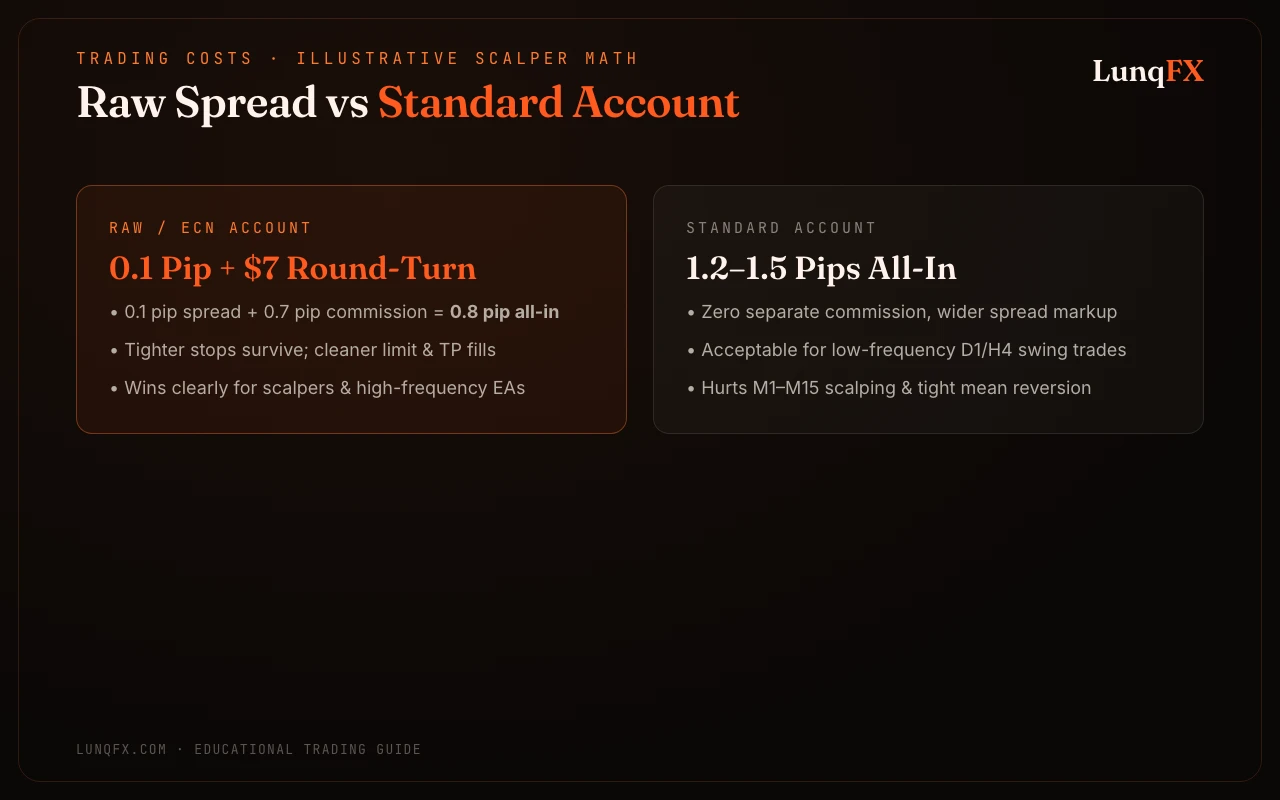
- Standard account: The broker charges zero explicit commission, and instead builds its markup directly into the bid/ask spread. If the underlying market spread on EURUSD is 0.1 pips, a Standard account might quote 1.1 to 1.5 pips.
- Raw spread account: The broker passes through tight liquidity-provider spreads (often 0.0 to 0.2 pips on major pairs during liquid hours) and charges a separate commission per lot—typically quoted round-turn (covering both opening and closing the trade).
Watch how commission is quoted. A broker advertising "$3.50 commission" usually means $3.50 per side—which is $7.00 round-turn per standard lot (1.00). Always verify whether the headline figure is per side or round-turn before comparing accounts.
Worked Cost Comparison: EURUSD and XAUUSD
To see which account actually saves money, convert both models into all-in dollars per standard lot (and equivalent pips). The figures below are illustrative examples representing typical retail broker pricing during liquid London/New York hours.
| Instrument (1.00 Standard Lot) | Standard Account (All-In Spread) | Raw Account (Spread + $7 Round-Turn) | Raw Pip Equivalent | Savings on Raw |
|---|---|---|---|---|
| EURUSD ($10/pip) | 1.2 pips = $12.00 | 0.1 pip ($1.00) + $7.00 = $8.00 | 0.8 pips | $4.00 / lot (0.4 pips) |
| XAUUSD ($10 per $0.10) | $0.28 spread = $28.00 | $0.10 spread ($10.00) + $7.00 = $17.00 | $0.17 move | $11.00 / lot ($0.11) |
EURUSD Maths
On 1.00 standard lot of EURUSD, 1 pip equals $10.
- Standard:
1.2 pips × $10 = $12.00per round-turn trade. - Raw:
0.1 pip ($1.00) + $7.00 round-turn commission = $8.00(0.8 pips equivalent).
Over 100 trades at 1.00 lot, that 0.4-pip difference saves $400. At 0.10 lots, it saves $40—still identical in percentage terms.
XAUUSD (Gold) Maths
On 1.00 standard lot of XAUUSD (100 oz), a $0.10 price move equals $10 (and $0.01 equals $1).
- Standard: A typical $0.28 spread costs $28.00 the instant you click buy.
- Raw: A $0.10 raw spread ($10.00) plus $7.00 round-turn commission costs $17.00 total.
On gold, the gap between raw and standard pricing is often noticeably wider than on EURUSD, which is why serious gold scalping strategies almost universally favour raw accounts.
Break-Even Logic: When Raw Wins — and When It Doesn't
Mathematically, a raw account beats a standard account on cost whenever:
Raw spread + Commission (in pips) < Standard spreadIn our EURUSD example (0.8 pips < 1.2 pips), raw wins on every trade regardless of how often you trade, because both spread and commission scale linearly with lot size.
Where trading style changes the decision is how much that 0.4-pip difference matters to your edge:
- Scalping (5–10 pip targets): On a 6-pip target, paying 1.2 pips vs 0.8 pips is 20% of your target vs 13.3%. That 0.4-pip drag can turn a slightly positive system into a losing one over 500 trades. Raw is clearly the best account type for scalping.
- Swing trading (100–200 pip targets): On a 150-pip target, 0.4 pips is 0.27% of the move. At that horizon, overnight swap rates, execution reliability, and account minimums matter far more than saving $4 per lot. Comparing scalping vs swing trading makes this clear: frequency amplifies friction.
Standard accounts also remain useful for small accounts where minimum deposit requirements on Raw tiers are higher, or when a broker's Standard spread on a specific exotic pair happens to be tighter than Raw + commission.
Slippage and Execution Model: The Honest Nuance on "ECN"
Many traders choose a Raw account believing it guarantees true ECN account (Electronic Communication Network) or STP routing with zero conflict of interest. Here is the honest reality:
"ECN" on retail MT4/MT5 is often marketing. Many brokers run the exact same hybrid A-book/B-book risk engine behind both their Standard and Raw accounts. Choosing "Raw" changes the pricing feed and fee structure, not necessarily whether your broker internalises your flow.
Execution behaviour also differs in subtle ways:
- Slippage: On a genuine market-execution raw feed, limit and stop orders fill at the next available price—meaning you can experience slippage (both negative during thin liquidity/news and positive when price gaps in your favour).
- Spread widening vs requotes: Market-maker Standard accounts may advertise "zero slippage" in normal conditions, only to widen spreads aggressively or requote during fast markets.
- Stop-loss sensitivity: On a Standard account with a 1.5-pip spread, a sell trade's stop loss (triggered by the Ask price) gets hit 1.5 pips before the Bid chart ever touches your line. Tight raw spreads reduce that hidden premature-stop effect—critical for tight-stop scalpers and automated EAs.
Swap-Free Accounts: Check the Hidden Cost
If you use a swap-free (Islamic) account, do not assume overnight holding is free. Brokers still pay or earn interest on overnight positions in the interbank market. To recover that financing cost without charging explicit swap, brokers commonly:
- Widen spreads on swap-free tiers,
- Add a higher commission per lot, or
- Charge a flat daily administrative fee after holding a trade past 3 to 7 days.
Always read the swap-free fee schedule before holding multi-day positions.
What Matters for Gold Scalpers and Automated EAs
For gold scalpers (such as AURUM users trading XAUUSD) and automated EAs (such as SIESTA, which trades mean-reversion setups during the 16:00–18:00 GMT afternoon lull):
- Session-specific spread stability: A broker that advertises "0.0 pips" during the London–New York overlap may widen to 2.5 pips on EURUSD or $0.60 on XAUUSD after 17:00 GMT. Judge spreads during the exact hours your strategy trades—never by peak-hour screenshots.
- Rollover discipline: Between 21:00 and 22:00 GMT, liquidity dries up and spreads spike across both Standard and Raw accounts. Understand forex rollover spread widening before blaming an account type for an 8-pip stop-out at 21:05 GMT.
- Low-latency execution: For EAs and fast scalps, running your terminal on a forex VPS near your broker's trade server often reduces slippage more than switching account tiers.
Checklist: How to Test a Broker's Real Costs
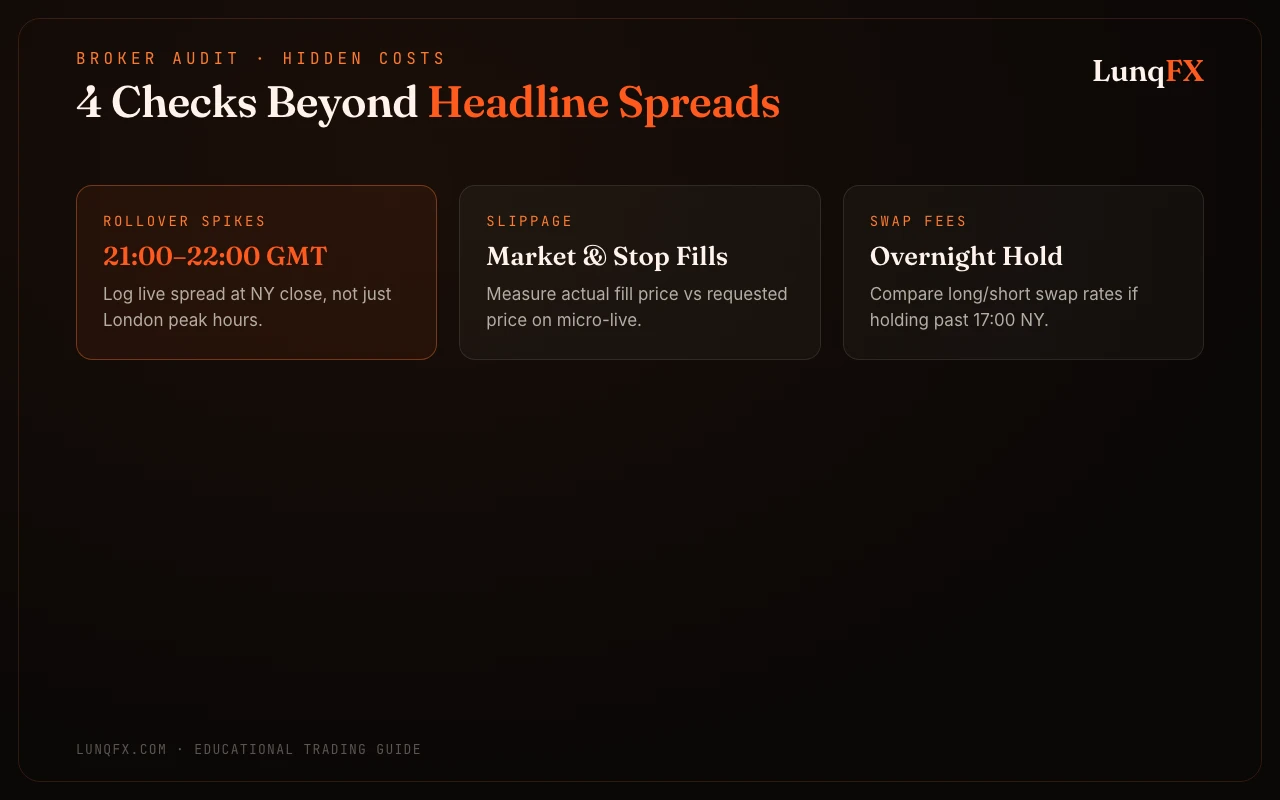
Never trust a broker's pricing page alone. Run this four-step audit before funding size:
- Compare live vs demo spreads: Open a minimum-deposit live account alongside demo. Demo feeds are frequently cleaner, faster, and tighter than live execution.
- Log spreads across all sessions: Check EURUSD and XAUUSD during London open, NY overlap, your off-peak window, and 21:00–22:00 GMT rollover.
- Measure slippage over 20–30 small trades: Trade 0.01 lots and compare your requested entry/stop price against the actual fill price in your account history.
- Watch live spread on your chart: Use a lightweight session panel like Quiet Hours (free on MT4/MT5) to display the live spread readout alongside session boxes and ADR while you trade, so you spot abnormal widening before clicking buy or sell.
A raw spread account is not automatically superior in every situation—but if you scalp, trade XAUUSD, or run tight-stop EAs, verifying the true cost per trade usually makes the maths unambiguous.
FAQ
What is the best account type for scalping forex or gold? A raw spread account is almost always the best account type for scalping, because tight targets cannot absorb a 1.2-pip or $0.28 standard spread markup on every entry and exit.
How much commission is normal on a raw spread account? Most retail brokers charge between $6.00 and $7.00 round-turn per standard lot ($3.00 to $3.50 per side) on major forex pairs and gold, though some VIP tiers drop lower with higher volume.
Do raw spread accounts have slippage? Yes. Market-execution raw feeds fill at the best available liquidity price, which means fast news or thin sessions can produce negative—or occasionally positive—slippage.
Why did my stop loss hit when the chart didn't touch it? Charts plot the Bid price by default. A buy trade closes at Bid, while a sell trade closes at Ask (Bid + spread). Wider Standard spreads trigger sell stop losses earlier than tighter raw spreads.
Are ECN and raw spread accounts the same thing? In retail marketing, the terms are often used interchangeably. However, "Raw" describes the pricing model (interbank spread plus commission), whereas true ECN refers to order routing—and many brokers hybrid-route flow regardless of the account label.