Best Time to Trade Gold (XAUUSD): An Hour-by-Hour GMT Breakdown
· 8 min read · LunqFX Team
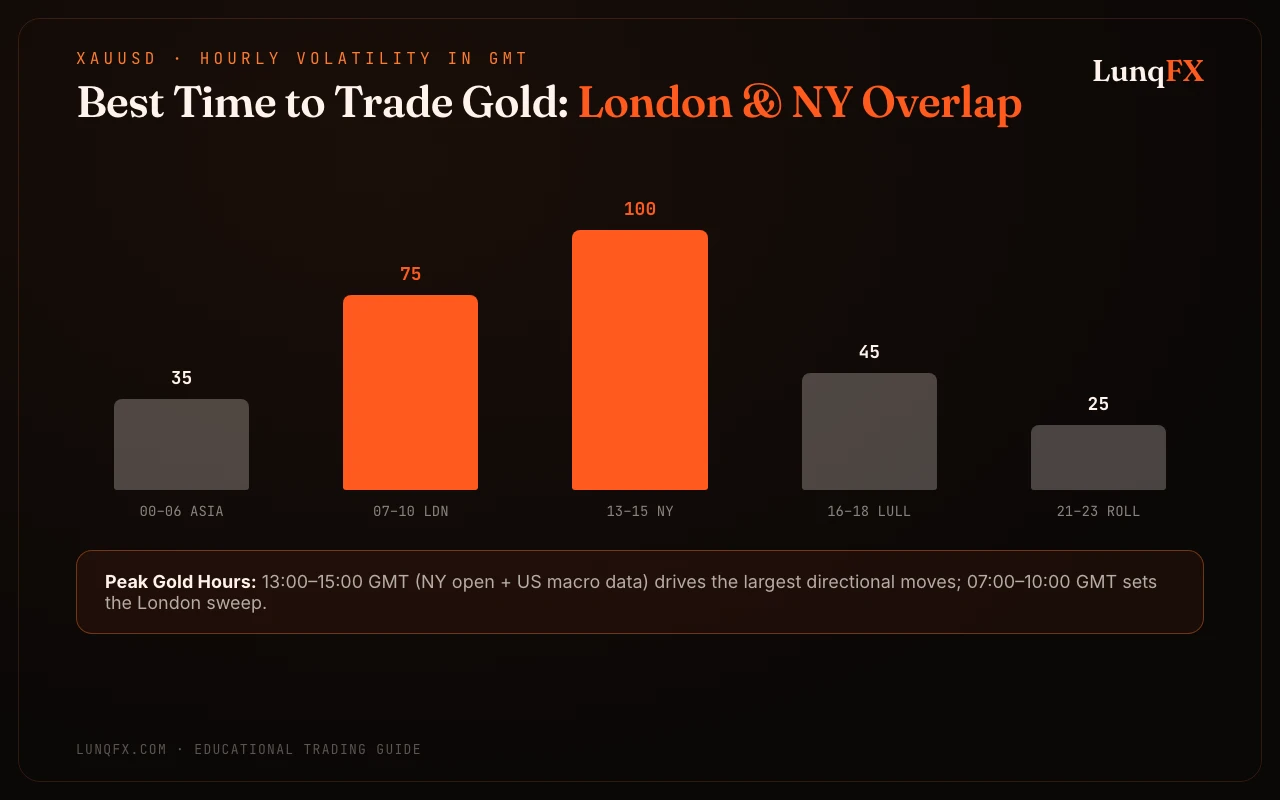
If you trade XAUUSD at the wrong hour, the chart looks broken. Spreads widen, candles print overlapping wicks, and every breakout reverses three minutes after filling your order. Finding the best time to trade gold is not about memorising a generic "London and New York are good" slogan — it is about matching your strategy to the exact GMT windows when institutional order flow actually moves the metal.
Gold trades nearly 24 hours a day from Sunday 23:00 GMT to Friday 22:00 GMT (with a daily rollover pause around 22:00–23:00 GMT), yet roughly 70% of its meaningful directional movement happens in less than six hours. Below is the honest, practitioner breakdown of XAUUSD volatility by hour, why the Asian range sets up the London trap, and how to avoid paying spread for zero follow-through.
Why XAUUSD Volatility Clusters Around Specific GMT Hours
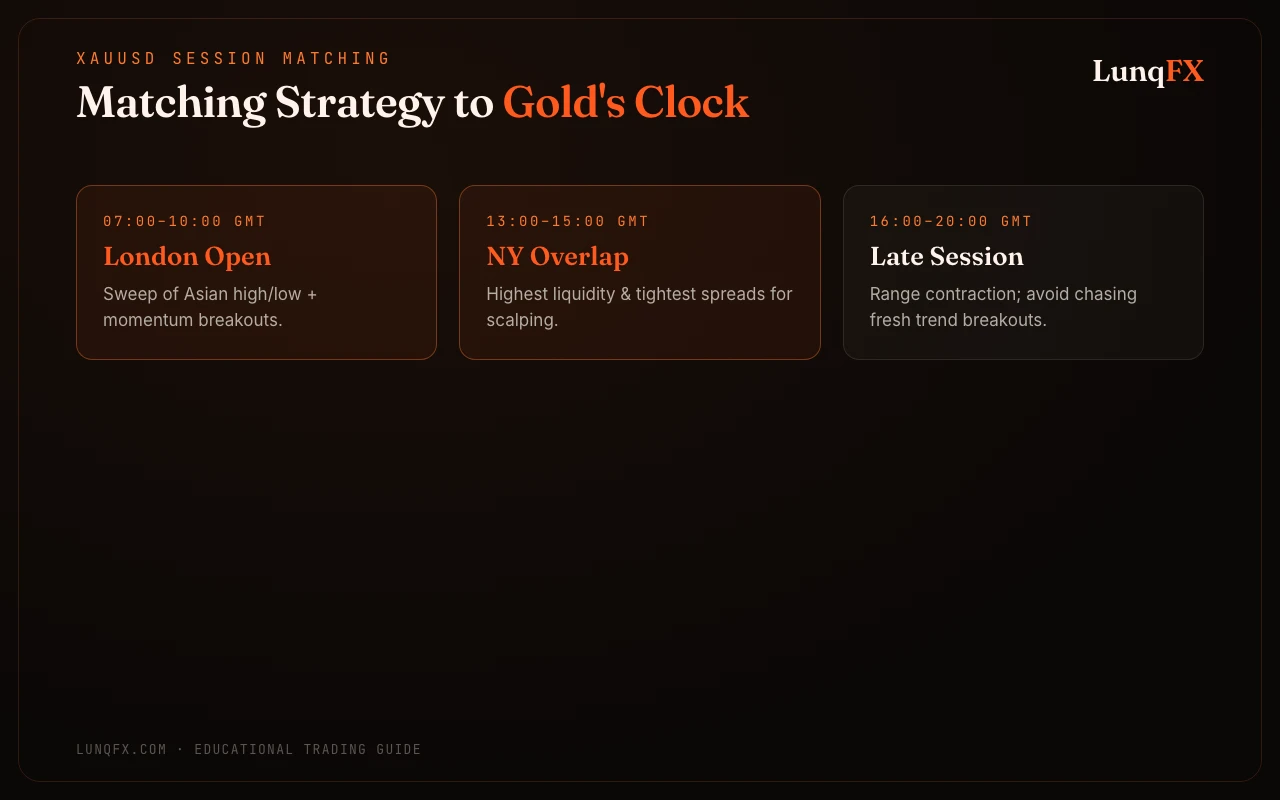
Unlike currency pairs where two domestic bond markets dictate flow, gold is priced in US dollars and traded simultaneously as a commodity, a sovereign reserve asset, and a macro risk hedge. Physical bullion desks in Zurich and London, COMEX futures in Chicago/New York, and Shanghai Gold Exchange benchmarks each inject liquidity at fixed clock times.
When two major centres overlap, order books thicken, spreads compress to 10–25 points (1.0–2.5 pips on a standard quote), and directional impulses carry through. When only one regional desk is open — or worse, during the handover between New York close and Sydney open — market makers widen quotes to protect inventory against thin liquidity.
Our forex session times and kill zones guide covers the broader FX clock, but gold exaggerates every session transition. An average daily range (ADR) of \$25–\$40 sounds generous until you realise \$18 of that can occur in a single 90-minute New York window while the other 18 hours drift sideways inside a \$6 box.
Hourly XAUUSD Volatility in GMT: Session Comparison
The table below shows typical XAUUSD behaviour across the 24-hour GMT cycle (standard winter GMT; shift US/UK daylight saving transitions by one hour when London and New York are out of sync for two weeks in March and October–November).
| GMT Window | Session | Typical Hourly Range | Spread Behaviour | Best Strategy Fit |
|---|---|---|---|---|
| 22:00–23:00 | Daily Rollover | \$1–\$3 (illiquid) | Extremely wide (50–150+ pts) | Do not trade; close or widen stops |
| 23:00–05:00 | Sydney / Tokyo | \$3–\$7 per hour | Moderate (20–35 pts) | Range fade or box marking only |
| 05:00–07:00 | Pre-London | \$4–\$8 per hour | Tightening (18–28 pts) | Mark Asian high/low for sweeps |
| 07:00–10:00 | London Open | \$10–\$18 per hour | Tight (12–22 pts) | Breakout-retest, liquidity sweeps |
| 10:00–12:00 | London Midday | \$5–\$9 per hour | Tight (12–20 pts) | Mean reversion or sit on hands |
| 12:00–13:00 | Pre-NY / Early US | \$8–\$14 per hour | Tight (12–22 pts) | Early positioning ahead of US data |
| 13:00–15:00 | London–NY Overlap | \$15–\$28 per hour | Tightest (10–18 pts) | Momentum continuation, news reaction |
| 15:00–17:00 | London Close / NY Mid | \$8–\$15 per hour | Tight (12–22 pts) | Reversals at daily extremes |
| 17:00–21:00 | Late New York | \$4–\$8 per hour | Gradually widening | Trail existing trades; avoid new entries |
Look closely at the two standout windows: 07:00–10:00 GMT and 13:00–15:00 GMT. If your calendar only permits two hours of screen time per day, those are the hours that justify the risk.
The Best Time to Trade Gold: London Open vs NY Overlap
Choosing between London open and the New York overlap depends on whether you prefer structured technical sweeps or high-velocity dollar-driven expansion.
London Open (07:00–10:00 GMT)
What happens: European bullion desks, London Fix participants, and institutional FX algorithms come online between 07:00 and 08:00 GMT. Their first order of business is frequently a raid on the liquidity resting just above or below the Asian session range.
How to trade it: Mark the Asian high and low established between 00:00 and 06:55 GMT. Do not buy the first 07:05 breakout blindly — gold is notorious for spiking \$4–\$6 past the Asian boundary, triggering retail breakout stops, and snapping back inside the range. Wait for a 15-minute candle close back inside or a clean retest of the broken level before committing risk.
Who it suits: Traders who want clean technical structure without sudden US macroeconomic bombshells (CPI, NFP, FOMC) blowing through stop losses. If you are running a gold scalping strategy with fixed R:R targets, London open offers the cleanest balance of movement and predictability.
London–New York Overlap (13:00–15:00 GMT)
What happens: COMEX gold futures open alongside New York equity cash and US bond markets, while London is still active. Major US economic releases (13:30 GMT in standard time, 12:30 GMT during US DST) hit the tape directly inside this window.
How to trade it: Expect the day's highest tick volume and widest 15-minute candles. Rather than fading moves during 13:00–15:00 GMT, align with the dominant H1/H4 trend or trade pullbacks into intraday VWAP and key structural levels.
A concrete worked example: Suppose XAUUSD has an average daily range of \$32 over the past 14 days. By 13:00 GMT, gold has only travelled \$14 from its Asian low to its London high. That leaves roughly \$18 of statistical room for the New York session to expand. Conversely, if gold has already rallied \$31 by 12:45 GMT on a surprise European headline, buying a breakout at 13:30 GMT means chasing an exhausted range — a classic setup for a London-close reversal at 15:00–16:00 GMT.
Asian Range vs New York Close: Where Gold Traps Retail Traders
Most retail losses on XAUUSD happen outside the two prime windows, specifically in two periods that look tempting on a 5-minute chart.
The Asian Session Trap (00:00–06:00 GMT)
The illusion: Candles look calm, indicators give neat overbought/oversold signals, and traders assume they can scalp \$2–\$3 moves safely while the market sleeps.
The reality: When average hourly movement is \$4 and your spread plus commission equals \$0.35–\$0.50, transaction costs eat 10–15% of the available move before slippage. Worse, a single unscheduled comment from a central bank official or Tokyo fix flow can spike gold \$8 in thirty seconds with zero technical warning. Save the Asian session for marking levels, not forcing trades.
The Rollover Dead Zone (21:00–23:00 GMT)
The mechanics: Between 21:00 and 22:00 GMT, New York desks square books and liquidity providers pull quotes ahead of the 22:00 GMT server rollover. Between 22:00 and 23:00 GMT, spreads on XAUUSD routinely balloon from 15 points to 80–150 points.
The damage: Even if your stop loss is technically 300 points (\$3.00) away from the bid, a widening ask spread during rollover can trigger a buy-side stop-out without price ever trading there. Never hold tight intraday stops through 22:00 GMT, and never open fresh gold scalps after 19:30 GMT.
Matching Session Timing to Key Levels and Automation
Knowing when XAUUSD moves only solves half the equation: when to look. You still need where price is likely to react and how you will execute without hesitation when a \$15 New York candle starts printing.
Gold respects psychological round numbers (\$2,600, \$2,650, \$2,700) and prior session extremes far more reliably than random moving averages. Our gold key levels guide explains why institutional orders cluster around these figures. If you want those zones plotted automatically without cluttering your chart every morning, Gold Levels marks the prior day's high/low, Asian range, and key psychological levels directly on MT4/MT5 so you are ready before 07:00 GMT.
For traders who cannot sit at the desk across both London and New York — or who struggle with chasing 13:30 GMT spikes emotionally — systematic execution removes the clock problem. AURUM is built specifically around gold's intraday structure and session volatility, applying strict risk parameters and avoiding low-liquidity rollover hours automatically. Whether you trade manually or automate, the rule is identical: respect the clock, or pay the spread.
Checklist Before Placing a Gold Trade
Before clicking buy or sell on XAUUSD, run through four quick filters:
- Check the GMT hour: Is it inside 07:00–10:00 GMT or 13:00–16:00 GMT? If not, is there a genuine higher-timeframe catalyst justifying the wider spread?
- Check ADR consumed: Has gold already moved 85%+ of its 14-day ADR? If yes, tighten targets or look for exhaustion rather than fresh trend entries.
- Check the economic calendar: High-impact USD releases (NFP, CPI, PPI, FOMC, ISM) at 13:30 or 15:00 GMT invalidate tight scalping stops; wait 5–15 minutes for the initial spread spike to normalise.
- Check your pair alternative: If gold is dead or news-locked, check our guide to the best forex pairs to scalp for cleaner spread-to-range ratios.
FAQ
What is the single best time to trade gold in GMT? The highest-probability window for most XAUUSD traders is the London–New York overlap between 13:00 and 15:00 GMT, when spreads are tightest and daily directional expansion peaks. The London open (07:00–10:00 GMT) is a close second for structured breakout and sweep setups.
Is the Asian session good for trading XAUUSD? Generally no for breakout or trend strategies. Between 00:00 and 06:00 GMT, gold typically prints narrow \$3–\$7 hourly ranges with higher relative spread costs. Most experienced traders use the Asian session to mark high/low boundaries for London rather than trading inside it.
Why does my gold stop loss get hit at 22:00 GMT? Around 22:00 GMT, brokers perform daily rollover and liquidity providers pull orders from the book. XAUUSD spreads can widen from 15 points to over 100 points in seconds, triggering tight stops even when the mid-price has barely moved.
How does Daylight Saving Time affect gold trading hours? The UK and US shift clocks on different dates in March and late October/early November. During those brief transition weeks, the New York open shifts to 12:00 GMT relative to London, moving the peak overlap one hour earlier until the UK catches up.
How many hours a day should I trade gold? Two focused hours during either 07:00–10:00 GMT or 13:00–15:00 GMT is enough for most intraday traders. Watching XAUUSD outside active institutional hours usually leads to overtrading inside choppy ranges.