Best Forex Pairs to Scalp: Why Spread-to-ADR Matters More Than Speed
· 7 min read · LunqFX Team
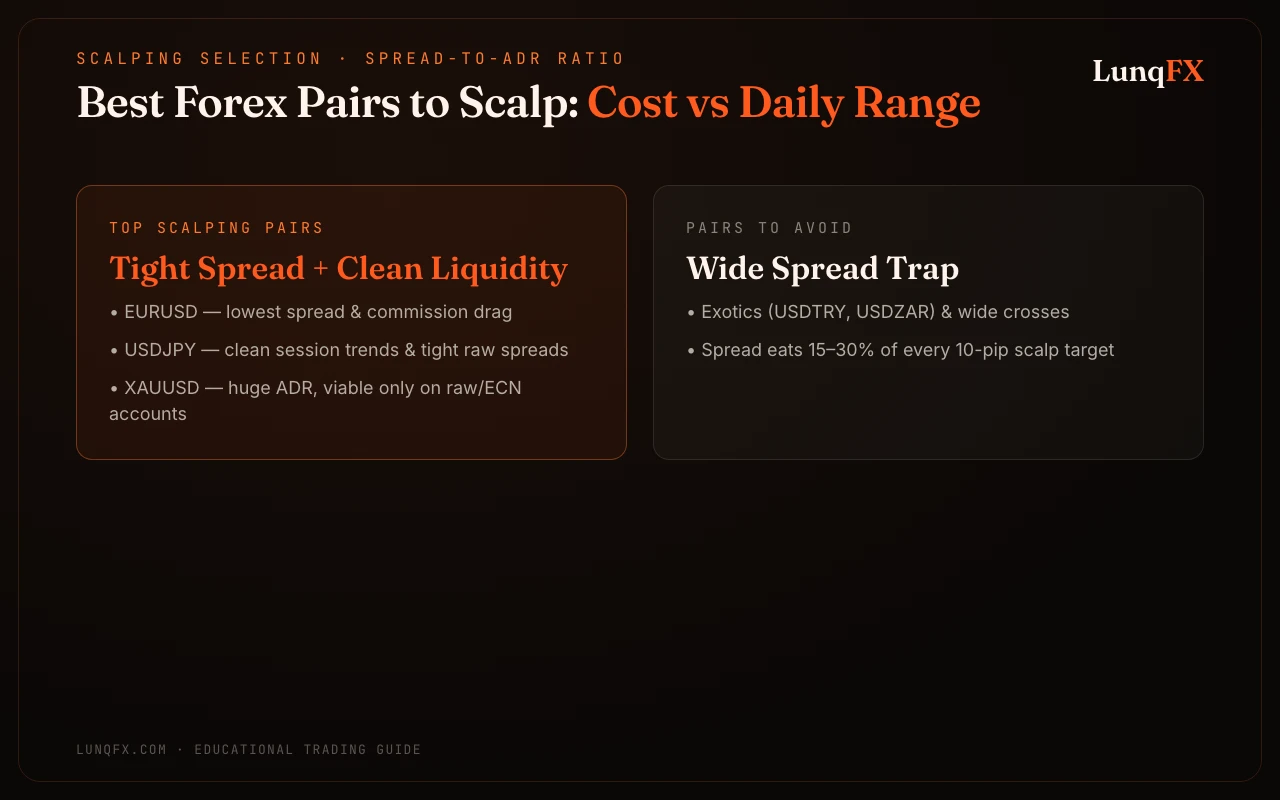
Most scalpers pick currency pairs the wrong way. They open a chart that "looks fast" — usually GBPJPY or an exotic cross — take 20 trades on a 1-minute timeframe, and wonder why their equity curve bleeds even when half their reads are right. Choosing the best forex pairs to scalp has almost nothing to do with how exciting a candle looks and everything to do with transaction cost relative to daily movement.
If you scalp for 8 to 15 pips per trade, a 1.5-pip spread is not a minor inconvenience; it is a 10–19% tax on every winner before slippage. This guide breaks down the exact metric professionals use to rank scalping pairs — the spread-to-ADR ratio — compares the top majors and gold side by side, and explains which pairs quietly destroy scalping expectancy.
The Metric That Actually Ranks Scalping Pairs: Spread-to-ADR
A pair with a 0.2-pip spread that only moves 25 pips a day is no bargain. Conversely, a pair that moves 130 pips a day with a 3.5-pip spread is still expensive on a 5-minute chart. You need both numbers in one formula:
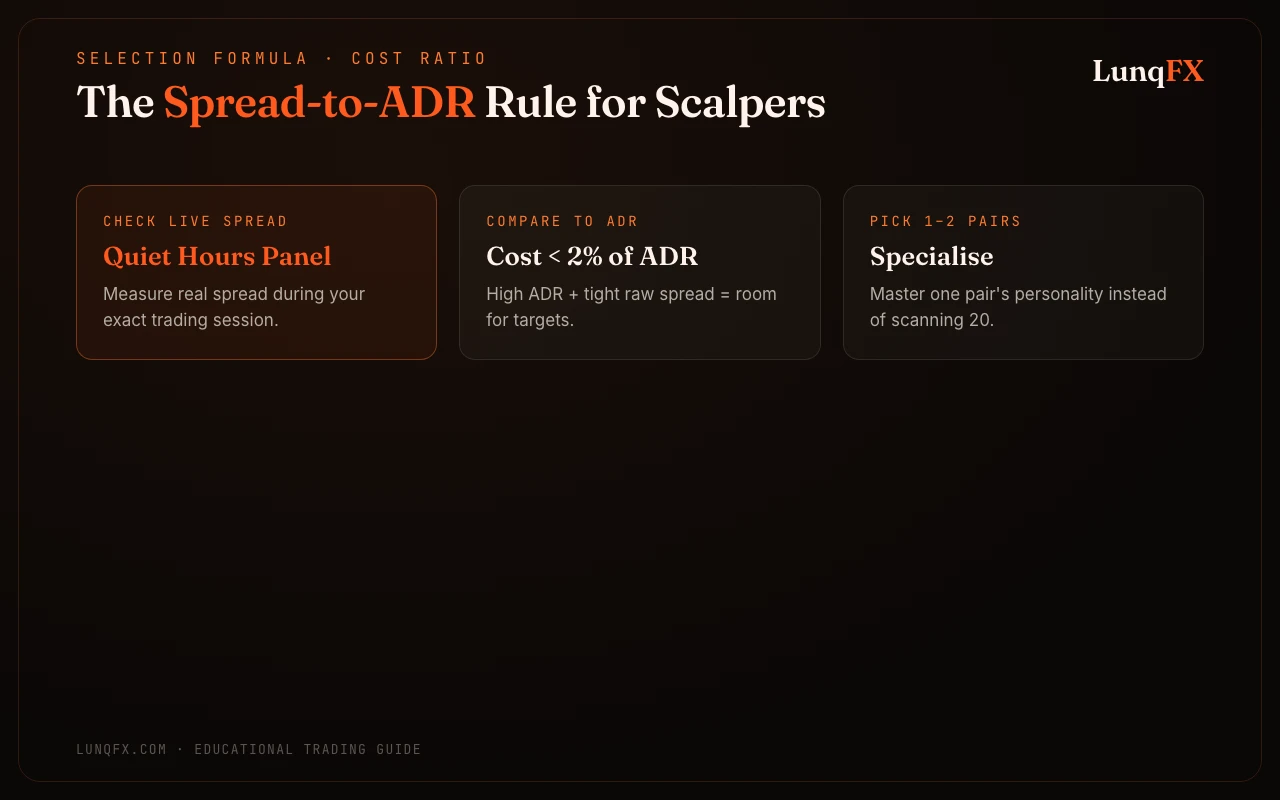
Spread-to-ADR (%) = (Total Round-Trip Cost in Pips ÷ 14-Day ADR in Pips) × 100Crucially, Total Round-Trip Cost must include both the quoted spread and your broker's commission converted into pips. On a typical raw spread account, a \$7.00 round-turn commission per standard lot equals roughly 0.7 pips on EURUSD. Ignoring commission makes raw accounts look artificially cheap and hides the true cost of high-frequency entries.
The benchmark: For M1–M15 scalping, aim for pairs where total round-trip cost is under 1.2% of the 14-day ADR during your active session. Anything above 2.0% means you are fighting uphill arithmetic on every trade.
Top 4 Best Forex Pairs to Scalp (Worked Numbers)
Using typical London/New York overlap pricing on a raw ECN feed (0.7-pip equivalent commission included), here is how the most liquid instruments compare:
| Pair | Typical Raw Spread | Commission (Pip Eq.) | Total Cost | 14-Day ADR (Pips) | Spread-to-ADR |
|---|---|---|---|---|---|
| EURUSD | 0.1–0.3 pips | 0.7 pips | ~0.9 pips | 75 pips | 1.20% |
| USDJPY | 0.2–0.4 pips | 0.7 pips | ~1.0 pip | 110 pips | 0.91% |
| GBPUSD | 0.3–0.6 pips | 0.7 pips | ~1.2 pips | 105 pips | 1.14% |
| XAUUSD (Gold) | 1.2–1.8 pips (\$0.12–0.18) | 0.7 pips | ~2.2 pips | 320 pips (\$32) | 0.69% |
1. EURUSD — The Cleanest Technical Benchmark
Why it works: EURUSD carries the deepest institutional order book in global FX. Slippage is minimal outside major news, price respects intraday liquidity levels cleanly, and you can size positions accurately without sudden 10-pip air pockets.
The catch: Its average daily range is modest (often 65–85 pips). If you try to scalp EURUSD during the dead Asian hours or London lunch (10:30–12:00 GMT), hourly movement drops to 8–12 pips and your 0.9-pip total cost suddenly eats 10% of the range. Trade it strictly during London open (07:00–10:00 GMT) and NY overlap (13:00–16:00 GMT).
2. USDJPY — Volatility Without Exotic Spreads
Why it works: Driven directly by US Treasury yields and Bank of Japan policy expectations, USDJPY regularly delivers 100+ pip daily ranges while keeping raw spreads near 0.2–0.4 pips. That pushes its spread-to-ADR ratio below 1.0%, making it arguably the most efficient pure-FX scalping vehicle during both Tokyo morning and New York.
The catch: Sudden verbal intervention or yield spikes can trigger sharp 20-pip vertical candles. Always check the US bond calendar before tightening stops to 5 pips.
3. GBPUSD — Extra Range for Session Scalpers
Why it works: Cable moves roughly 30–40% further per day than EURUSD, giving M5 breakout-retest traders cleaner 12–20 pip swings. Total cost remains ~1.1% of ADR during London and New York hours.
The catch: GBPUSD has thinner book depth than EURUSD, meaning it sweeps prior swing highs and lows aggressively before reversing. Give stops slightly more breathing room than you would on EURUSD.
4. XAUUSD (Gold) — Lowest Cost-to-Range, Highest Discipline Required
Why it works: On raw numbers, gold's spread-to-ADR ratio (around 0.69%) beats every major currency pair. A \$32 daily range gives scalpers plenty of room to capture \$3–\$6 moves without needing razor-thin 4-pip stops.
The catch: Gold punishes sloppy timing. Outside the best time to trade gold, spreads widen rapidly and whipsaws accelerate. Treat XAUUSD as a session-specific scalping instrument, not an all-day toy, and follow a structured gold scalping strategy rather than chasing 1-minute spikes.
EURUSD vs GBPJPY and Exotic Pairs: What to Avoid
Many traders graduate from EURUSD to GBPJPY, GBPAUD, EURNZD, or exotics like USDTRY and USDZAR looking for bigger candles. That usually backfires for three reasons:
Wide spreads erase small targets: On GBPJPY, raw spreads of 0.8–1.5 pips plus commission put total cost around 1.8–2.2 pips, and during off-peak hours it easily jumps to 3.0+ pips. On crosses like GBPAUD or EURNZD, total cost frequently hits 2.5–4.0 pips. To keep your cost ratio under 1.2%, you would need a 250+ pip daily range — which those pairs do not reliably deliver.
Slippage scales with thin liquidity: Exotic pairs and minor crosses have shallow order books. A market order or stop-loss trigger during a fast candle can slip an extra 1.5–3.0 pips, turning a planned 1:2 R:R scalp into a 1:1 coin flip.
Hidden correlation doubles your exposure: Scalping EURUSD, GBPUSD, and AUDUSD simultaneously is not diversification — it is tripling the same US dollar bet. Before adding a second scalping chart, understand forex correlation so one NFP surprise or DXY spike does not stop out three "unrelated" positions at once.
How Session Conditions Change the Rankings Live
Static tables only tell half the story. A pair that ranks #1 at 13:30 GMT can become untradeable at 22:05 GMT.
Suppose you normally scalp USDJPY because its spread-to-ADR sits at 0.91%. During the 22:00 GMT rollover window, spreads widen to 4.0 pips while the 1-hour range shrinks to 6 pips. Your live spread-to-range cost has just jumped by a factor of ten, even though the pair's name on the chart didn't change.
Instead of guessing whether conditions are favourable, monitor the live numbers directly on your terminal. Quiet Hours displays a live spread/ADR panel on MT4 and MT5, alongside session boundaries and rollover warnings. When you see live spread creeping above your threshold relative to current ADR, you simply wait rather than donating edge to the broker.
Choosing Your Scalping Pair by Account Size and Style
If you are deciding between scalping vs swing trading or building a focused two-pair watchlist, keep it simple:
- Small accounts or strict prop firm challenges: Stick to EURUSD and USDJPY during 07:00–10:00 GMT or 13:00–16:00 GMT. Lowest slippage, predictable pip value (\$10/pip per standard lot on EURUSD), and minimal gap risk.
- Experienced intraday scalpers: Add GBPUSD or XAUUSD once your execution and risk sizing are consistent. Never trade more than two active charts at once on M1–M5 — attention splits faster than your reaction time.
- Pairs to drop immediately: Any exotic (USDZAR, USDMXN, USDTRY) and wide-spread minor crosses (GBPNZD, EURAUD) unless you are swinging on H4/D1 where a 4-pip spread is negligible.
FAQ
What is the single best forex pair to scalp for beginners? EURUSD is the best starting pair for scalpers because it combines the tightest institutional spreads, minimal slippage, and predictable pip values. Trade it during the London open (07:00–10:00 GMT) or London–New York overlap (13:00–16:00 GMT) when volume is highest.
Why is spread-to-ADR better than looking at spread alone? Spread alone ignores how much the pair actually moves. A 0.3-pip spread on a pair moving 30 pips a day costs more proportionally than a 1.5-pip spread on gold moving 320 pips (pips equivalent) a day. Dividing total round-trip cost by 14-day ADR shows true execution efficiency.
Is GBPJPY good for scalping? GBPJPY moves fast, which attracts scalpers, but its wider spread (often 1.5–2.5 pips all-in) and sharp liquidity sweeps make it unforgiving on M1–M5. Most traders achieve better net expectancy on USDJPY or GBPUSD with lower transaction friction.
Should I scalp on a standard or raw spread account? Always use a raw spread (ECN) account with transparent commission for scalping. Standard accounts mark up spreads by 1.0–1.5 pips per side, which can cut a scalper's net profit by 30–50% over 100 trades.
How many pairs should a scalper watch at the same time? One or two maximum. Watching four or five charts on a 1-minute or 5-minute timeframe leads to late entries, missed exits, and accidental overexposure on correlated USD pairs.