Mean Reversion Trading Strategy: How to Trade Overextended Price in Forex
· 8 min read · LunqFX Team
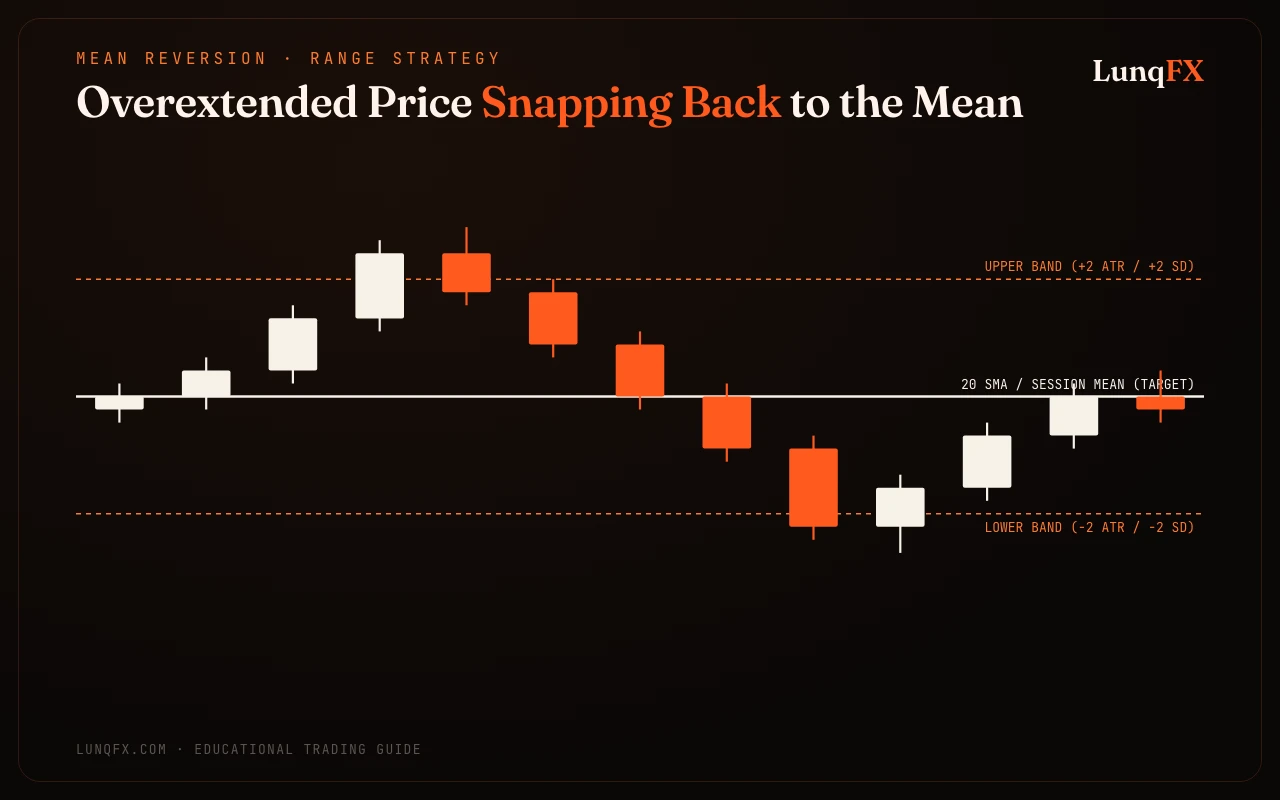
Every retail trader eventually hears the same comforting half-truth: price always returns to the average. Built into a naive mean reversion trading strategy, that assumption is one of the fastest ways to blow an account — because when a currency pair enters a genuine macro trend, price can stay far away from its moving average long after your margin runs out.
Mean reversion forex trading works only when you treat it as a conditional, regime-specific edge rather than a law of physics. This guide covers why price actually reverts, how to filter out trending markets before they run you over, the exact entry and stop rules that keep losses bounded, and the quiet GMT windows where mean reversion is structurally strongest.
Why Price Reverts (Liquidity and Inventory, Not Magic)
Price does not snap back to a moving average because an indicator line exerts gravity. It reverts because of market-maker inventory and short-term order-flow exhaustion.
When an aggressive wave of market orders hits a pair without a sustained fundamental catalyst behind it, liquidity providers absorb that flow and accumulate unwanted inventory. Once the burst of buying or selling pauses, dealers shade their quotes back toward recent fair value to offload that inventory, while short-term momentum traders take profits. Without fresh buyers or sellers stepping in at the extreme, price drifts back toward the middle of its recent distribution.
That mechanism explains both when mean reversion works and when it fails. During quiet, two-way trading, an overextended price is usually just a temporary liquidity imbalance. During a central bank surprise or a high-volume institutional repricing, the imbalance is the new fair value, and fading it means standing in front of a train.
The Regime Filter for a Mean Reversion Trading Strategy
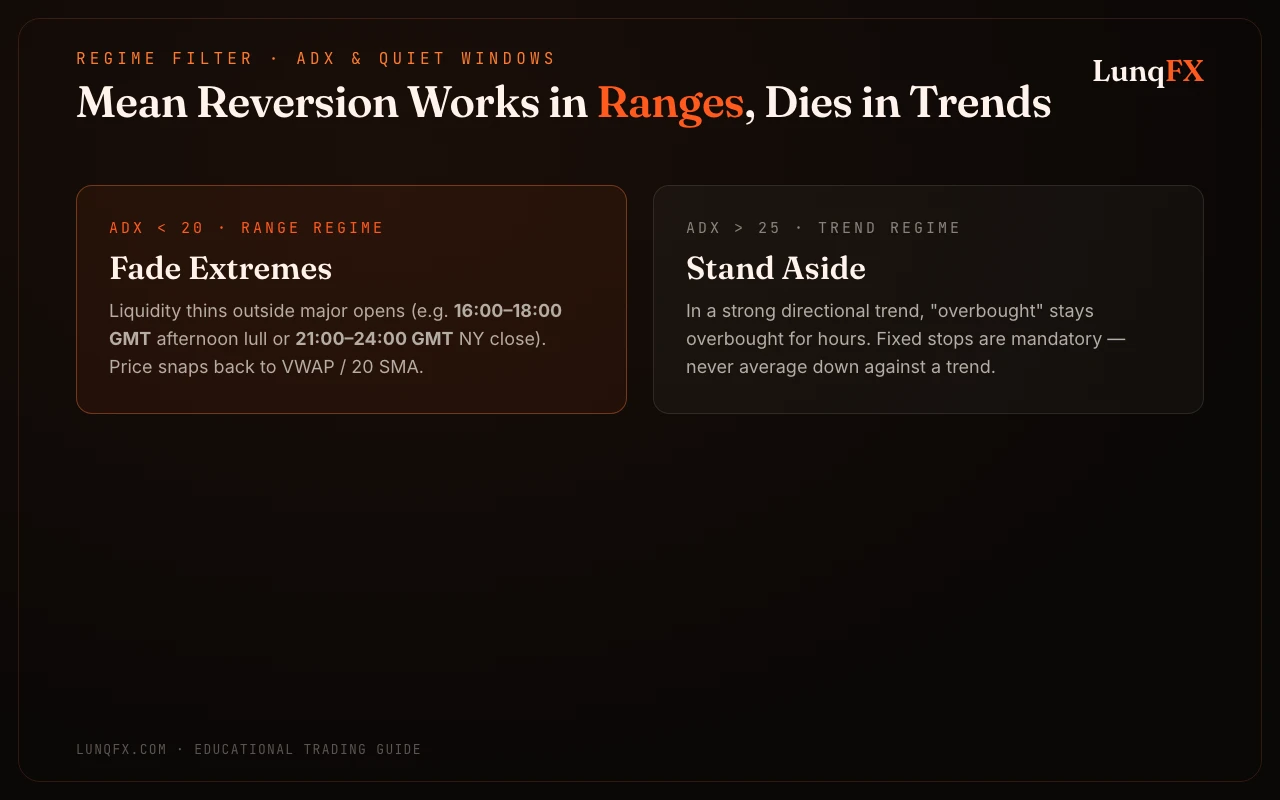
The single most important rule in any mean reversion trading strategy is knowing when not to trade it. You need a mechanical regime filter that keeps you out of directional expansion.
ADX(14) as a gatekeeper: The Average Directional Index measures trend strength regardless of direction. A practical threshold used across intraday and swing systems:
- ADX < 20: Weak or absent trend. Price is rotating around equilibrium; mean reversion setups are permitted.
- ADX 20–25: Transitional zone. Reduce size or require stronger structural confirmation.
- ADX > 25: Established trend. Stand aside on counter-trend fades; switch to trend-continuation logic or stay flat.
Volatility and momentum confirmation: Pair your ADX range filter with a measure of stretch. Standard two-standard-deviation envelopes — covered in detail in our Bollinger Bands strategy guide — or an ATR multiple beyond fair value show when price has actually overextended rather than merely drifted. Momentum tools such as RSI divergence can confirm that the push into the extreme is losing follow-through, though divergence alone is never a substitute for a range filter.
Defining the Mean: VWAP, 20 SMA, and Session Midpoint
"Return to the mean" is meaningless until you define which mean you are trading. Three definitions cover almost every practical forex application:
20-period Simple Moving Average (20 SMA): The standard dynamic mean on M15, H1, or H4 charts. It reacts fast enough to track shifting intraday value while smoothing out single-candle noise. Entries trigger when price closes more than 1.5× to 2× ATR(14) away from the 20 SMA and prints a rejection candle back toward it.
VWAP (Volume-Weighted Average Price): Useful for intraday traders on futures-correlated pairs or brokers providing reliable tick-volume proxies. Because VWAP weights price by activity, it approximates the session's true institutional fair value. Fading a 2-standard-deviation VWAP stretch works best once London or New York morning volume has already established the day's range.
Session midpoint: In defined quiet windows, the mean is often horizontal rather than a moving average — specifically the midpoint of the preceding session's late range or the 50% level of a consolidation box. This is especially clean when trading pairs that mean-revert tightly after major desks close.
Entry, Stop, and Target Rules
Vague fades turn into "I'll just hold until it comes back." Define all three parameters before clicking buy or sell.
Entry: Wait for the signal candle to close. Never place blind limit orders into a vertical spike hoping to catch the exact tick of a reversal. Wait for price to pierce your outer band (for example, >2× ATR from the mean), then close back inside the band or print a clear rejection wick on bar close.
Stop loss: Place a fixed hard stop beyond the recent swing extreme plus a volatility buffer — typically 0.5× to 1.0× ATR(14) outside the entry candle's high or low. If price breaks through that buffer, your premise is wrong: the move is expanding, not reverting. Never widen a stop and never average down into a losing fade; that turns a bounded strategy into the exact trap explained in our breakdown of martingale and grid EA risks.
Target: Take partial or full profit at the mean itself (TP1 = 20 SMA, VWAP, or session midpoint). Mean reversion is not about catching 5R home runs; it is about high-probability returns to equilibrium. If momentum carries through the mean, a secondary runner can target the opposite band (TP2), though in quiet sessions TP1 delivers far more consistent expectancy.
Time-of-Day Mean Reversion: The Quiet Windows
Not all hours of the forex day behave the same. During the London–New York overlap (13:00–16:00 GMT), institutional order flow and macro data routinely drive sustained breakouts. Trying to fade extensions there is fighting peak liquidity. For a broader map of liquidity shifts across the clock, see our forex session times and kill zones guide.
Mean reversion thrives in the lull windows when major desks square books and fresh catalysts are scarce:
16:00–18:00 GMT (Afternoon Lull): London has closed and New York's morning impulse is spent. Institutional flows thin out before the late-day rollover window, leaving pairs like EURUSD, AUDUSD, EURAUD, GBPUSD, GBPCHF, and XAUUSD prone to snapping back from late-day overextensions. Automated systems like SIESTA are built specifically around this 16:00–18:00 GMT window, flattening all positions by 20:00 GMT with a fixed stop and target on every trade so nothing is carried overnight.
21:00–24:00 GMT (NY Close / Quiet Night Range): After the 21:00 GMT rollover transition settles, Tokyo liquidity is still building. Moves that stretch away from the late New York range without news often mean-revert tightly inside this three-hour pocket. NIGHT OWL targets this exact 21:00–24:00 GMT quiet night range with a fixed stop loss on every trade and zero martingale. Keep an eye on spreads right at 21:00–21:15 GMT, however — rollover widening can distort tight intraday stops if your execution doesn't filter for spread.
Whether you trade these windows manually or prefer scalping vs swing trading frameworks, matching the strategy to the session matters as much as the entry trigger itself.
Mean Reversion vs Trend Following
Understanding mean reversion vs trend following prevents you from demanding the wrong behaviour from your equity curve.
| Feature | Mean Reversion | Trend Following |
|---|---|---|
| Ideal regime | ADX < 20, quiet sessions, post-news consolidation | ADX > 25, London/NY overlap, macro catalysts |
| Typical win rate | Higher (often 55%–70% with realistic targets) | Lower (often 35%–45%) |
| Reward-to-risk | Modest (typically 1:1 to 1.5:1) | Asymmetric (2:1 to 4:1+) |
| Primary failure mode | Trend days, catching falling knives | Choppy, sideways ranges (death by a thousand cuts) |
| Holding time | Short intraday (minutes to a few hours) | Hours to days |
Neither style is superior. Trend following suffers long strings of small losses in sideways months; mean reversion collects steady gains in ranges and takes sharp, controlled losses when a range breaks into a trend.
The Honest Limitations
Three realities will save you months of frustration if you accept them upfront:
Trend days will hit your stops. Even with an ADX < 20 filter, every range eventually ends in a breakout. That is not a flaw in the filter — it is the cost of doing business. Fixed stop losses ensure those transition days cost 1R rather than 40% of your account.
Catching knives is a real psychological trap. When price is two ATRs below its mean, the chart looks "cheap." Clicking buy before a candle closes or before structure stabilises is guessing, not mean reversion.
Backtests can flatter range systems. Curve-fitting a band width or ADX threshold to a quiet six-month period produces gorgeous equity curves that collapse in the next trending quarter. Always backtest in MT5 Strategy Tester across multi-year samples that include high-volatility macro regimes, and be sceptical of unfiltered forex robots that promise smooth returns in every market condition.
A tool that measures distance from fair value objectively — such as Nova Reversal Bands, which flags >2× ATR overextensions on closed candles without repainting — removes the temptation to eyeball "stretched" charts and jump in early. What it cannot do is protect you if you ignore the regime filter or trade through scheduled high-impact news.
FAQ
What is the best indicator for a mean reversion trading strategy? No single indicator works alone, but combining ADX(14) below 20 as a regime filter with a 20 SMA or VWAP and an ATR-based band (such as 2× ATR) gives you an objective definition of both range conditions and overextension.
Does mean reversion work in forex? Yes, particularly during lower-momentum hours like the 16:00–18:00 GMT afternoon lull and the 21:00–24:00 GMT NY-close window, provided you use a trend filter and a fixed stop loss on every trade.
What is the biggest risk of mean reversion trading? Fighting a developing trend without a hard stop loss. If you widen stops or add to losing positions expecting a guaranteed return to the mean, a single trend day can wipe out months of gains.
Should I use a fixed stop loss on mean reversion trades? Always. Place your stop beyond the recent swing extreme plus an ATR buffer. If price invalidates that level, the market has shifted from range to expansion and you want out immediately.
Can you automate a mean reversion strategy? Yes, because the rules — session window, ADX threshold, ATR distance, fixed stop, and mean target — are purely quantitative. Just verify that any EA uses fixed stops per trade rather than grid or martingale recovery.