Can You Use an EA on a Prop Firm? What the Rules Actually Ban
· 8 min read · LunqFX Team
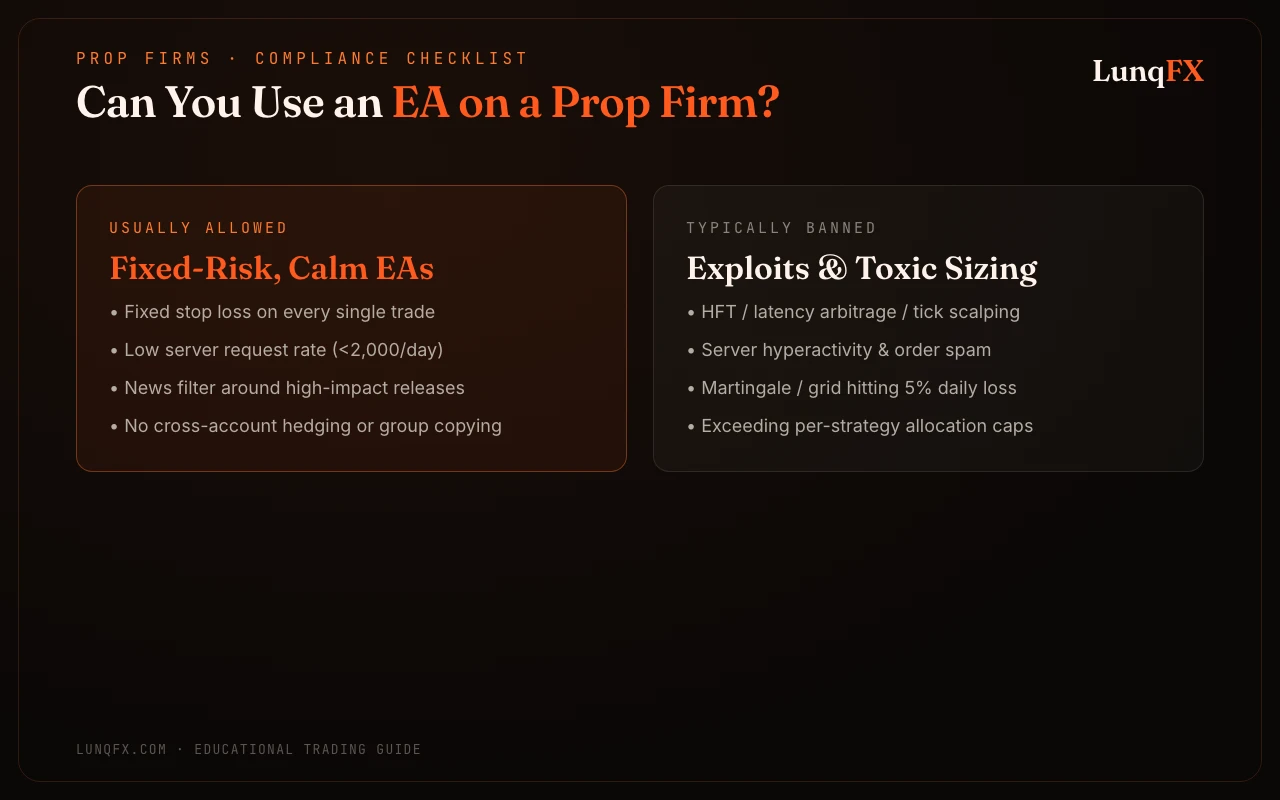
Yes — can you use an EA on a prop firm? At most major proprietary trading firms, the short answer is yes, automated trading is permitted. The catch is that firms do not judge your Expert Advisor by whether it is automated; they judge it by its behaviour on the server and its correlation with other traders.
Traders routinely pass a challenge with a commercial bot only to have the funded payout denied during the compliance review. This guide breaks down the prop firm EA rules that actually trigger breaches, why third-party bots create hidden allocation risk, and what to verify before you attach any script to an evaluation account.
The Short Answer: Permission vs Behaviour
Most prop firms split automation into two buckets: execution assistance (trade managers, risk calculators, trailing stops) and fully automated strategies (entry-to-exit EAs). Both are usually allowed on standard challenge and funded accounts, provided the EA behaves like a legitimate retail trader rather than an exploit.
The confusion comes from marketing. Firms advertise "EAs allowed" on their landing pages, while their Terms and Conditions quietly outlaw half the tactics commercial bots rely on. Passing a prop firm challenge with automation means reading the forbidden-practices clause as carefully as the drawdown table.
What Prop Firm EA Rules Actually Ban
Every firm writes its own rulebook, and those rulebooks change without much notice. Across the industry, however, five behaviours account for almost every EA-related termination.
1. HFT and latency arbitrage
An HFT ban is standard on live and funded accounts, even at firms that tolerate high-frequency trading during evaluations. Latency arbitrage bots compare a fast institutional feed against a slower broker feed and snipe stale quotes before the simulated execution engine updates. In live markets that edge vanishes into slippage and rejections, which is why prop firms refuse to pay out on it.
2. Tick scalping and feed-delay exploits
Tick scalping — opening and closing dozens of trades in seconds to harvest one- or two-pip micro-glitches — triggers the same compliance flags. Sub-minute trades around illiquid rollover or news spikes are treated as feed exploitation.
3. Server hyperactivity
An EA that modifies pending orders, shifts trailing stops on every tick, or loops OrderModify puts heavy load on the broker bridge. FTMO, for example, cites 2,000 server requests per day as its threshold for hyperactivity — crossing that ceiling can result in an immediate warning or account closure. Code your EA to check conditions on bar close and send modifications only when the stop level actually changes. On a forex VPS, remember that the limit applies per account, not per chart.
4. Cross-account hedging
Opening a buy on Account A and a simultaneous sell on Account B — within one firm or across two — is banned almost everywhere. You are guaranteeing one account passes while sacrificing the other, turning an evaluation into a coin-flip arbitrage.
5. Group trading and copy trading across users
Copy trading prop firm accounts is usually permitted only between accounts you personally own and control. Copying signals from a Discord group or another trader's account creates identical timestamps and lot ratios across unrelated clients — which compliance flags as account management.
| Behaviour | Typical Status | Why Firms Flag It |
|---|---|---|
| HFT / latency arbitrage | Banned (funded stage) | Exploits simulated feed latency |
| Tick scalping (<10s holds) | Restricted / flagged | Unreplicable on real liquidity |
| >2,000 server requests/day | Banned (e.g. FTMO) | Overloads broker bridge |
| Cross-account hedging | Strictly banned | Games challenge pass math |
| Third-party copy trading | Banned across users | Indicates external account management |
| Fixed-SL, time-boxed EA | Generally allowed | Replicable, bounded risk |
The Third-Party EA Trap
Here is the rule that catches buyers off guard even when their bot does not use HFT or spam the server: shared strategy allocation limits.
When hundreds of traders buy the same commercial EA from a marketplace and run it with default settings, they all open the exact same EURUSD sell at 14:32:05 GMT. From the prop firm's risk desk, those accounts look like one giant correlated position — or a single trader bypassing maximum capital limits.
FTMO, for instance, caps the combined allocation for a single strategy or third-party EA on a prop firm at $400,000 across all clients using it, and reserves the right to deny payouts if a popular bot pushes firm-wide exposure past that ceiling. Other firms take an even harder line and ban off-the-shelf commercial EAs altogether unless you can prove you wrote or uniquely configured the strategy. Rules vary significantly by firm, so "allowed" on a sales page means nothing if fifty other buyers hit the firm's cap before you request your first withdrawal.
This is one of the core reasons to scrutinise claims in our guide on whether forex robots are worth it: a bot sold to thousands of challenge buyers carries correlation risk you cannot see from a backtest.
Prop Firm News Rules and Automated Execution
Many traders run an EA for weeks without realising it trades straight through red-folder releases. On Standard accounts at firms like FTMO, the prop firm news rule prohibits opening or closing trades within a 2-minute window before and 2 minutes after high-impact releases (such as NFP, CPI, or rate decisions). That restriction normally covers pending orders, stop losses, and take profits — if volatility triggers your stop inside that four-minute window, it counts as a breach. Challenge phases or dedicated Swing accounts may be exempt, so always verify your account type and review our guide on how to trade forex news.
Why Martingale and Grid EAs Fail Even When "Allowed"
Most prop firms do not need an explicit rule banning martingale or grid systems, because the 5% maximum daily loss (equity-based) kills them automatically. Suppose a martingale EA starts at 0.10 lots on a \$100,000 account and doubles on every adverse step: 0.10 → 0.20 → 0.40 → 0.80 → 1.60 lots (3.10 lots total). A 40-pip move against a 5-level basket generates over \$5,000 in floating drawdown, breaching the daily limit in one afternoon trend. Because firms measure equity rather than closed balance, a smooth balance curve hides the spike that ends the challenge — as detailed in our guide on martingale and grid EA risks.
Can You Use an EA on a Prop Firm Checklist
Before attaching any Expert Advisor to a prop firm evaluation or funded account, run through these seven checks:
- Read the current Terms and Conditions. Prop firm EA rules change frequently; check the firm's FAQ and prohibited-practices page on the day you buy the challenge.
- Verify third-party EA policy. Confirm whether commercial bots are permitted, whether you must vary settings, and whether a combined capital cap applies.
- Audit server requests on demo. Run the EA on a demo account for a week and check the Journal/Experts tab for repeated order-modification errors or excessive requests.
- Check the news filter. Confirm whether your account type restricts trading around high-impact news, and whether the EA automatically pauses new entries and manages existing stops outside the blackout window.
- Confirm fixed stop-loss logic. Ensure every position carries a hard stop loss at entry with bounded risk per trade (typically 0.25%–1% on prop accounts) and zero martingale or averaging down.
- Check rollover and weekend holding. Verify if the firm bans weekend holds or if rollover spread widening triggers false stops or daily-loss spikes.
- Isolate your execution environment. Run the terminal on a dedicated VPS so local Wi-Fi drops or laptop sleep never leave an open basket unmanaged.
What Prop-Compatible Automation Looks Like
If you strip away the marketing, the profile prop firms tolerate best is boring on purpose: fixed stop loss on every trade, no martingale, low order-modification frequency, a hard daily loss limit, and a built-in news filter.
Time-boxed mean-reversion EAs such as SIESTA (which trades a defined 16:00–18:00 GMT window, flattens by 20:00 GMT, uses fixed stops and a news filter) and NIGHT OWL (21:00–24:00 GMT with fixed stops and single-trade risk sizing) are built around that bounded-risk profile — though no third-party EA is "prop-firm approved" or guaranteed to pass, and you remain responsible for checking whether a specific firm allows commercial automation. If you prefer keeping final execution discretion yourself while automating detection and sizing, tools like Obsidian handle signal detection and one-click risk-calculated execution without handing full autonomy to a background loop.
The Honest Limitations
Even a compliant, well-coded EA cannot solve two realities of prop trading:
Compliance reviews are asymmetric. Firms reserve wide discretion in their terms to flag "unacceptable risk" or "toxic flow" even if you did not violate a numbered rule. Keeping risk per trade conservative (0.25%–0.5%) and avoiding all-in lot sizing reduces the chance of triggering a manual review.
Rules evolve faster than forum posts. A setup that passed smoothly six months ago may violate an updated news or third-party EA clause today. Always verify directly against the firm's live documentation before deploying capital.
FAQ
Are Expert Advisors allowed on prop firm challenges? Yes, most prop firms allow Expert Advisors on both challenges and funded accounts, provided the EA does not breach rules such as an HFT ban, latency arbitrage, server spamming, or cross-account hedging.
Do prop firms ban third-party or commercial EAs? Some firms ban them outright, while others (such as FTMO) allow them up to a combined strategy allocation cap — for example, \$400,000 across accounts running identical logic. Always check the firm's current policy before running a marketplace bot.
What happens if my EA triggers a stop loss during a news blackout? On accounts with a strict news rule (such as a 2-minute window around high-impact releases), even an automated stop loss or take profit filling inside the restricted window can count as a rule breach.
Are martingale and grid EAs allowed on prop firms? Even where not explicitly named in the banned list, martingale and grid EAs routinely breach the 4%–5% equity-based daily loss limit during normal trend moves.
Can I copy trade between my own prop firm accounts? Most firms allow copying trades between accounts you personally own, up to their maximum capital allocation. Copying signals from other traders or third-party signal groups is generally prohibited.