How to Trade Forex News Without Getting Wrecked by Slippage
· 8 min read · LunqFX Team
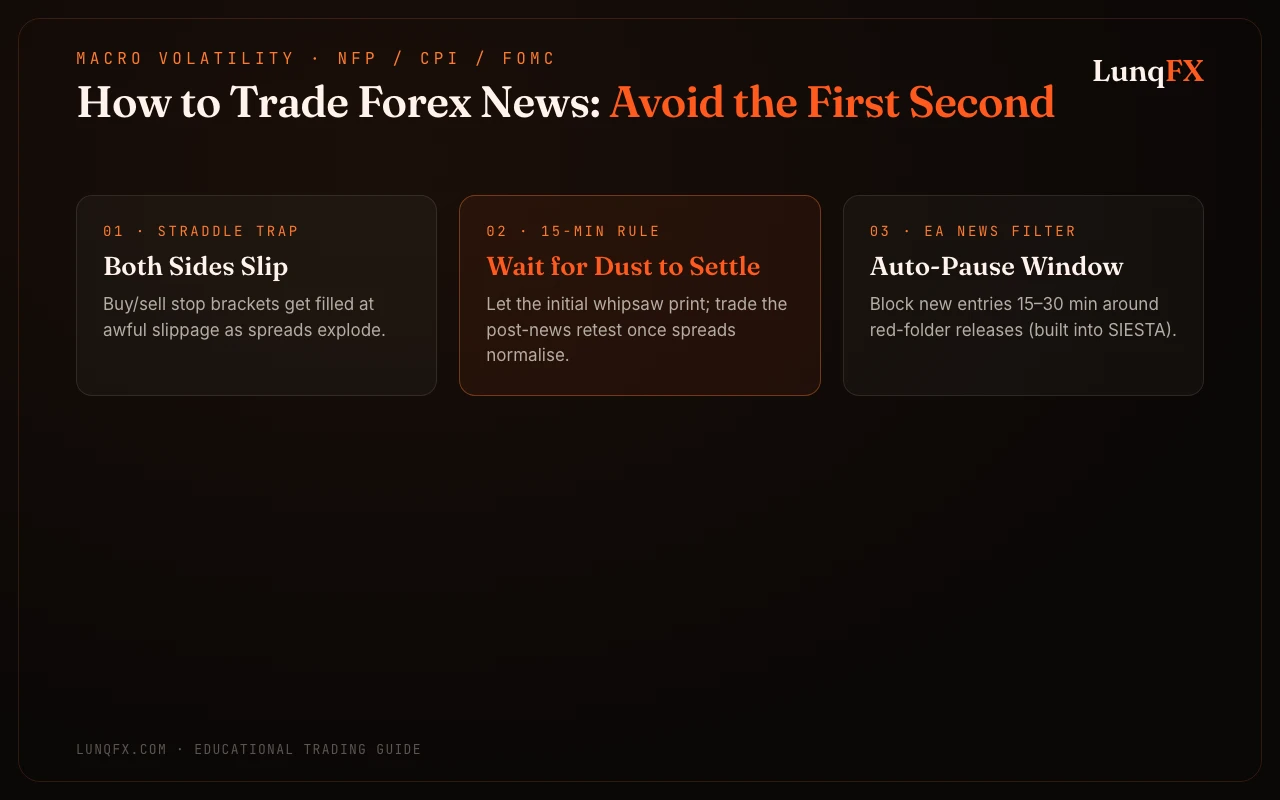
Most tutorials on how to trade forex news show a neat five-minute candlestick shooting straight up on NFP and pretend you could have bought the base of the wick. What they leave out is what happened inside the order book in the two seconds before that candle printed: liquidity providers pulled their quotes, spreads multiplied by ten, and stop orders filled twenty pips past their trigger.
Trading high-impact news is less about guessing whether the headline will beat or miss, and more about understanding liquidity gaps, revisions, and timing. This guide covers the major releases that actually move markets, what happens to execution in the first seconds, the three ways traders handle events (and why straddles fail), and the 15-minute rule.
The High-Impact Events That Actually Move Markets
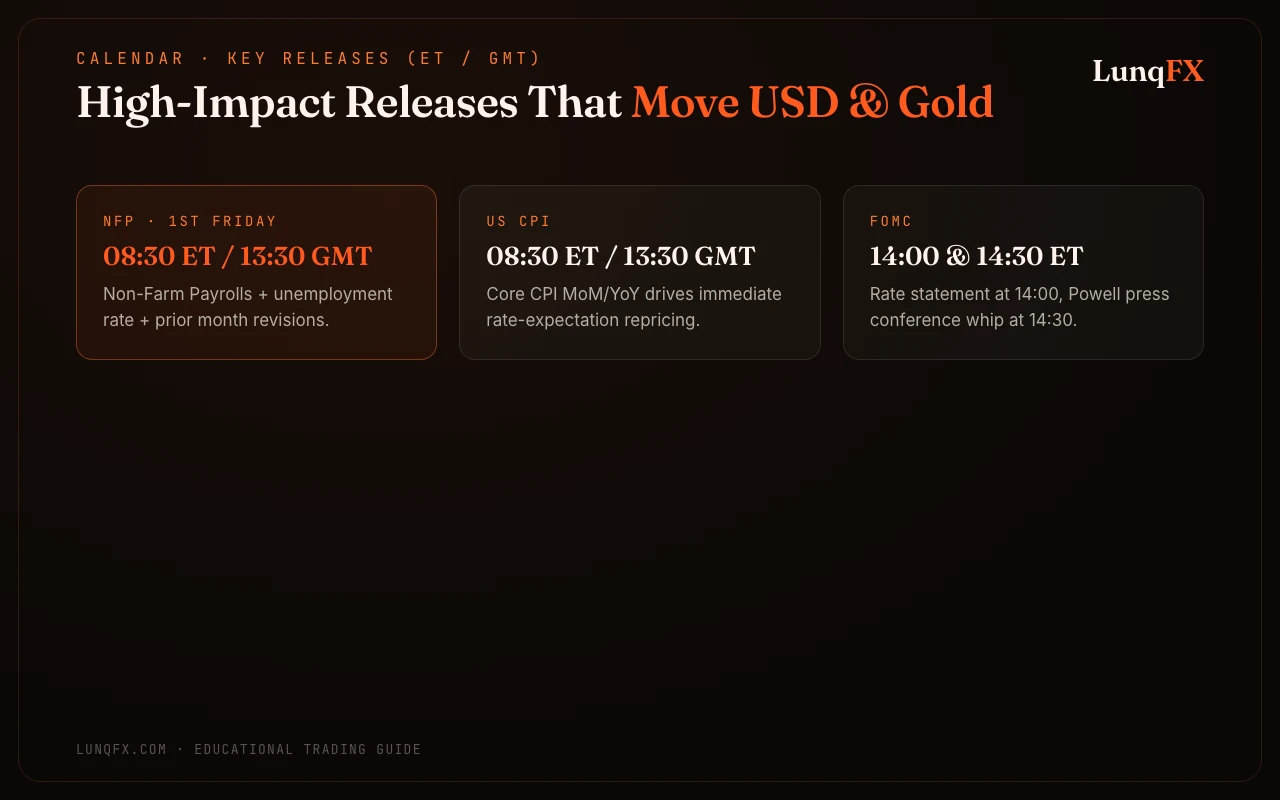
Dozens of red-folder events appear on an economic calendar every week, yet only a handful consistently reprice global liquidity. Focus your calendar alerts on three US releases — and central bank rate decisions from the ECB, BoE, and BoJ when policy is in play:
| Event | Schedule (Eastern Time) | GMT Equivalent | Typical Market Behaviour |
|---|---|---|---|
| NFP (Non-Farm Payrolls) | First Friday, 08:30 ET | 12:30 GMT (EDT) / 13:30 GMT (EST) | Sharp initial spike, frequent whipsaw on revisions |
| CPI (US Inflation) | Monthly, 08:30 ET | 12:30 GMT (EDT) / 13:30 GMT (EST) | Cleanest directional repricing on large surprises |
| FOMC Rate Decision | 8×/year, 14:00 ET | 18:00 GMT (EDT) / 19:00 GMT (EST) | Initial knee-jerk on statement; trend often flips at 14:30 ET |
Indices and gold react hardest. While EURUSD or USDJPY might move 50–100 pips on a major surprise, XAUUSD, NAS100, and US30 regularly whip several dollars or hundreds of points in seconds because they sit directly at the intersection of real yields and risk sentiment. If you trade indices, our NAS100 and US30 guide covers how those bursts behave around US market hours.
Notice the FOMC two-step: the rate decision and statement drop at 14:00 ET, triggering a violent first move. Thirty minutes later, at 14:30 ET, the Fed Chair's press conference begins — and Q&A comments routinely reverse the entire 14:00 spike. Treating 14:00 ET as a settled trend is one of the most expensive habits in news trading.
What Actually Happens to Spreads and Slippage
In the 30 to 60 seconds before a major release like NFP or a CPI release, market makers and institutional liquidity providers widen spreads or withdraw resting limit orders entirely to avoid getting run over by faster institutional algos.
That creates two execution realities no backtest shows:
- Spreads explode on release. A 0.2-pip EURUSD spread can jump to 5–15 pips; gold can widen from 20 cents to 200+ cents in a fraction of a second. (This is the same liquidity-withdrawal mechanism you see daily at forex rollover time, only compressed into a violent burst.)
- Stop orders become market orders. A
Buy StoporStop Lossdoes not guarantee execution at your exact price — it guarantees triggering a market order once price crosses that level. If the market gaps 25 pips through your stop in a single quote update, you fill 25 pips worse. That is negative slippage, and during NFP it applies equally to entries and exits.
How to Trade Forex News: Three Approaches
When deciding how to handle red-folder events, you really only have three choices. One of them is a mathematical trap.
1. Avoid the release entirely
The highest-expectancy decision for most retail strategies is stepping aside. Close intraday positions 15–30 minutes before the print, disable pending limit orders that could get tagged by a blind spike, and let the market digest the number. You miss the occasional runaway candle, and you eliminate the unquantifiable slippage that ruins position-sizing maths.
2. Trade the post-news retest
Rather than guessing the first tick, wait for the initial impulse to establish a clear directional break, then trade the pullback or retest once liquidity providers return to the book.
For example: CPI prints hotter than expected, USD spikes higher, and XAUUSD drops \$18 in two minutes. Instead of chasing the bottom tick into a 150-cent spread, you wait for spreads to normalise, mark the broken intraday support or fair value zone, and look for a structured short on the retest with normal stop-loss sizing. You trade with confirmed order flow and predictable execution costs.
3. The straddle (and why it fails)
The classic "beginner NFP trading strategy" places a Buy Stop 15 pips above price and a Sell Stop 15 pips below price at 08:29 ET, aiming to catch whichever way the market explodes.
In practice, straddles fail for three reasons:
- Whipsaw double-tag: An initial spike triggers your Buy Stop, reverses instantly, and triggers your Sell Stop — leaving you stopped out on both sides in under 60 seconds.
- Asymmetric slippage: Your Buy Stop sits 15 pips above market, but the post-print gap fills you 35 pips above market — right at the top of the wick.
- Spread activation: Even if Bid never reaches your Buy Stop, a sudden Ask spike can trigger it prematurely before price drops.
Straddles worked marginally better fifteen years ago on slow dealing-desk feeds. On modern STP/ECN execution, they are a donation to slippage.
The 15-Minute Rule
If you want one practical filter that immediately improves your results around red-folder events, use the 15-minute rule: no new entries for at least 15 minutes after a high-impact release.
Fifteen minutes accomplishes three things simultaneously:
- Spreads return to baseline. LPs repopulate the order book so your stop distance is not eaten by a 5-pip spread.
- Revisions and secondary headlines get priced in. Algos read the headline in milliseconds, then human desks read the sub-components and prior-month revisions over the next ten minutes.
- Fakeout spikes reveal themselves. By minute 15, you can see whether the initial candle held its gains or wicked straight back into the prior range.
Checking whether volatility has settled before resuming your normal forex session times routine turns news days from a gamble into normal technical structure.
How to Read an Economic Calendar Properly
Every economic calendar prints three columns: Previous, Forecast (consensus), and Actual. Most traders only compare Actual against Forecast — and get blindsided when the market moves the opposite way.
Here is what actually drives the reaction:
- Surprise vs consensus: Markets price in the Forecast before 08:30 ET. An "ugly" number that matches Forecast rarely moves price far; a small number that shocks consensus does.
- Revisions to Previous: Watch NFP especially. If Actual headline payrolls beat Forecast by +30k, but the Previous month's figure is revised down by −60k, the net two-month jobs picture is weaker, not stronger — causing an immediate spike up followed by a sharp reversal down.
- Sub-components: On NFP day, the market weighs Average Hourly Earnings and the Unemployment Rate alongside headline payrolls. On CPI day, Core CPI (excluding food and energy) often matters more than Headline CPI.
News Filters, Prop Firms, and Automated EAs
If you trade funded accounts, news is not just a slippage risk — it is a compliance hazard. Many firms enforce a strict blackout window (commonly 2 minutes before and after high-impact releases on standard funded accounts) where even an automated stop loss filling inside the window can breach the account. We cover those exact restrictions in our prop firm EA rules and prop firm challenge guide.
Manual traders can check a calendar and sit on their hands; an automated Expert Advisor cannot unless it has a news filter EA module built in. A proper news filter pulls calendar timestamps, pauses new entries ahead of high-impact events, and avoids leaving tight intraday setups exposed to binary spikes. SIESTA, for instance, pairs its 16:00–18:00 GMT trading window and daily loss limit with an integrated news filter so the EA stays flat around scheduled macro releases without manual babysitting. For discretionary traders monitoring when volatility is safe to trade again, the free Quiet Hours indicator displays session boxes alongside live spread and ADR on one panel.
The Honest Limitations
Unscheduled news has no calendar. Geopolitical headlines, surprise central bank interventions, and sudden tariff announcements hit without warning — no 15-minute rule or economic calendar filter can protect you from an unscheduled shock, which is why hard stop losses on every position are non-negotiable.
Waiting 15 minutes means missing V-shaped trends. Occasionally a massive CPI surprise produces a one-way trend that never pulls back cleanly. Accepting that missed move is the cost of avoiding the ten whipsaws that precede it.
FAQ
What is the best strategy for trading forex news? Waiting for the initial spike and spread widening to settle — typically via the 15-minute rule — and then trading the structured pullback or retest offers far cleaner execution than trying to catch the first second.
Why do NFP straddle strategies fail? Straddles suffer from severe negative slippage on stop orders, sudden spread widening that triggers entries early, and violent two-way whipsaws that stop out both sides within seconds.
Which forex pairs and assets move most during US news? Gold (XAUUSD), US indices (NAS100, US30), and USD majors such as EURUSD and USDJPY react most aggressively to NFP, CPI, and FOMC releases.
How long should I wait after high-impact news before trading? Waiting at least 15 minutes allows liquidity providers to restore normal spreads, revisions to be digested, and false initial spikes to resolve.
Can I use an EA during high-impact forex news? Only if your risk rules and prop firm terms allow it. Most disciplined EAs use a built-in news filter to block new entries around red-folder releases so spreads and slippage do not distort backtested expectancy.