Supertrend Indicator Strategy: How to Stop Bleeding in Sideways Chop
· 7 min read · LunqFX Team
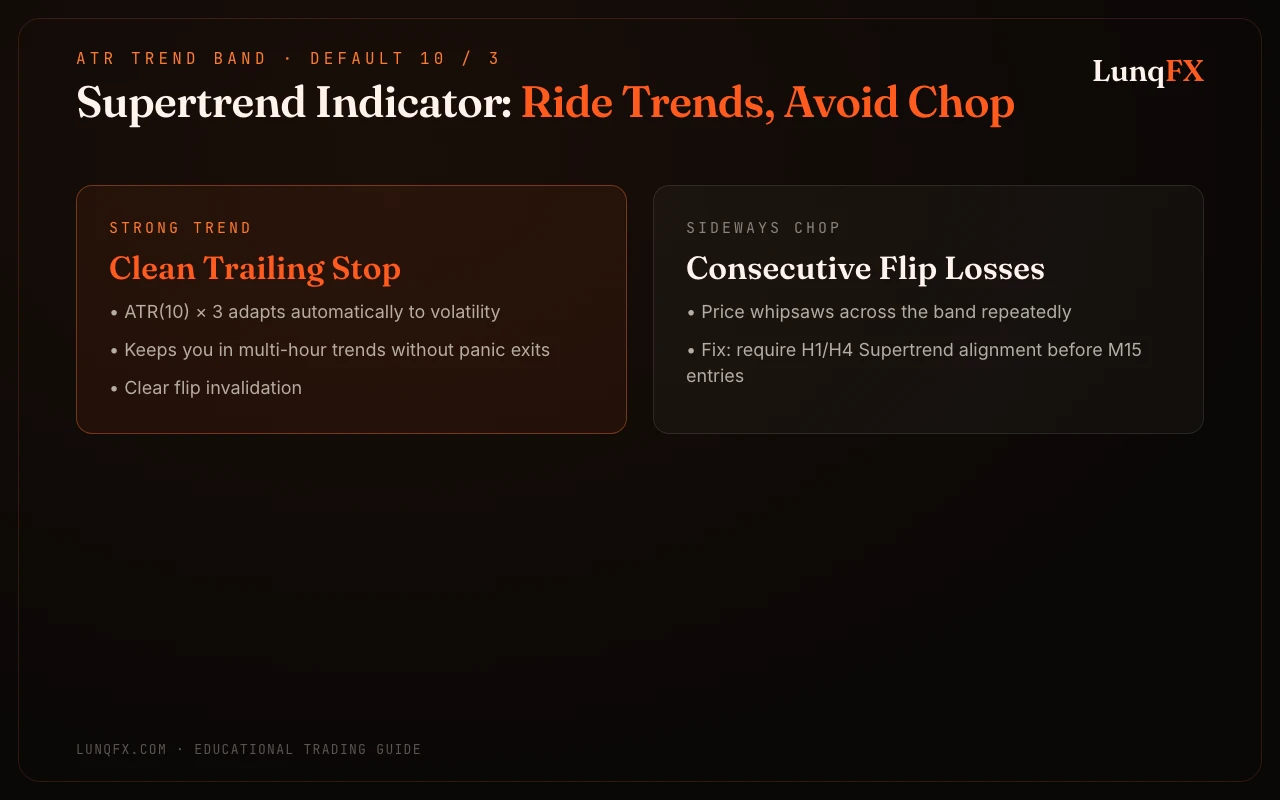
A Supertrend indicator strategy looks deceptively clean on a scrolling chart: a single colour-changing line that sits below price in an uptrend, flips above price in a downtrend, and never repaints once a candle closes. Beginners love it because it removes ambiguity—green means buy, red means sell.
Then you run it live for two weeks on an M15 EURUSD chart and watch it flip from green to red five times in a single Asian-London consolidation, handing back every pip you made on Tuesday's trend. Like every volatility-based trend follower, Supertrend is brilliant at riding directional expansion and terrible at surviving sideways chop. Fixing it does not require exotic indicator settings; it requires changing how you enter and adding one higher-timeframe filter.
How the ATR-Based Trailing Band Works (10, 3 Default)
Created by Olivier Seban, Supertrend is not a moving average—it is an ATR-based trailing stop band anchored to the midpoint of each candle:
Upper Band = (High + Low) ÷ 2 + (Multiplier × ATR(Period))
Lower Band = (High + Low) ÷ 2 − (Multiplier × ATR(Period))
With the default settings of Period = 10 and Multiplier = 3:
- In an uptrend (green): The indicator plots the Lower Band, which can only step up or stay flat—it never moves down while the trend is active. If a candle closes below the Lower Band, Supertrend flips bearish (red) and jumps to the Upper Band.
- In a downtrend (red): It plots the Upper Band, which can only step down or stay flat. A candle close above it flips the indicator bullish (green).
Because it uses Average True Range (ATR), the band widens automatically during volatile London/NY sessions and tightens during quiet hours. For a deeper look at how ATR measures noise and stop distance, see our ATR stop loss guide.
Choosing Supertrend settings by trading style
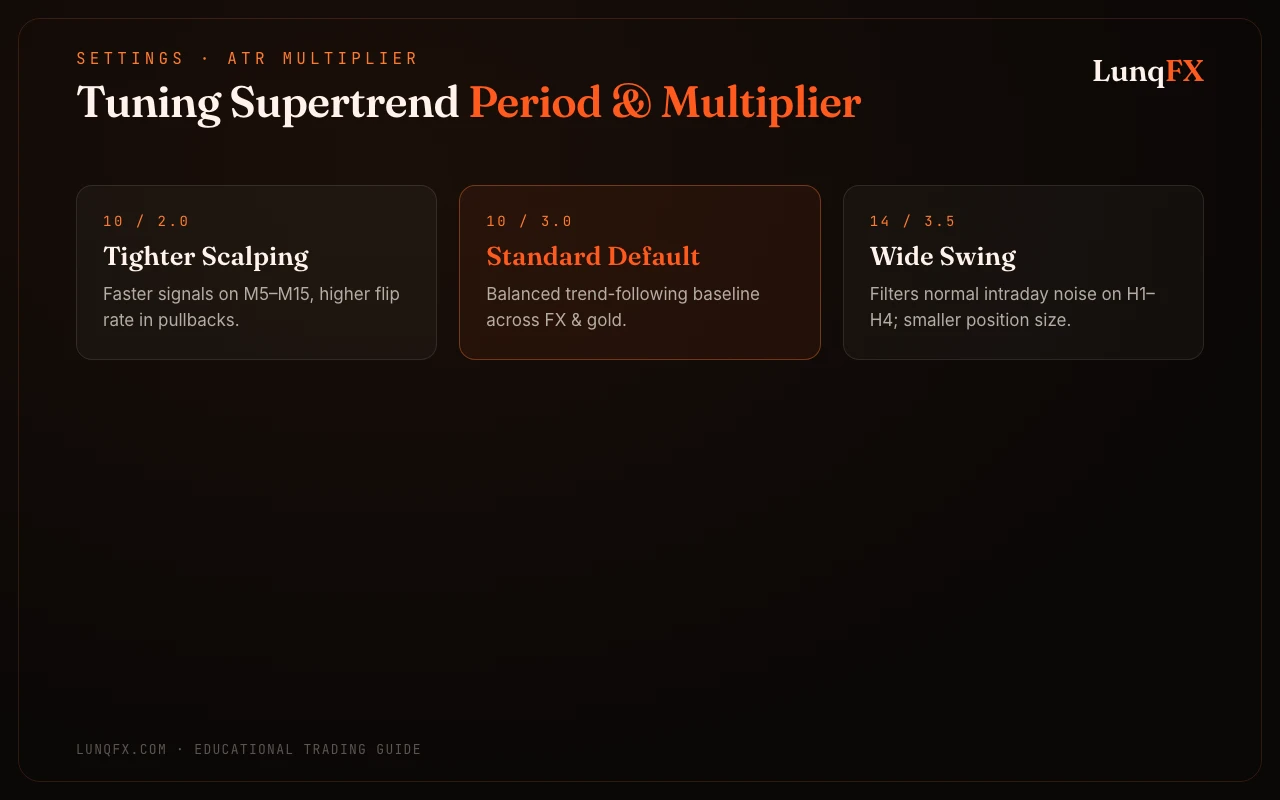
| Style / Timeframe | ATR Period | Multiplier | Behaviour |
|---|---|---|---|
| Scalping (M5–M15) | 10 | 2.0 – 2.5 | Tighter trailing stop, faster flips, more whipsaws in ranges |
| Intraday Swing (M15–H1) | 10 | 3.0 (Default) | Best all-round balance between breathing room and responsiveness |
| Position / H4–D1 | 14 | 3.5 – 4.0 | Filters out multi-day pullbacks; captures macro trends |
Warning: lowering the multiplier below 2.0 turns Supertrend into a hyperactive noise detector that gets stopped out by normal spread and wick spikes.
Why Supertrend Shines in Trends and Bleeds in Chop
Supertrend is mathematically incapable of predicting a range. It assumes every break of 3 × ATR(10) is the start of a new trend.
- In a trend: That assumption pays handsomely. The
3 × ATRcushion keeps you in the move through routine pullbacks, locking in profit step-by-step while letting winners run—the exact strength of a volatility-based trailing stop vs breakeven approach. - In a range: Price swings 1.5–2× ATR from support to resistance and back. Every time price touches the top of the range, it closes above the red Supertrend line (triggering a late buy near resistance). Two candles later, price drops to the bottom of the range and closes below the green line (stopping you out and triggering a late sell near support).
If you trade every colour flip blindly, your equity curve will look like a staircase going down during consolidations, punctuated by occasional spikes during trends.
Fixing the Supertrend Indicator Strategy With HTF Bias and Pullback Entries
To keep the trend-riding power while cutting out 70% of the range bleed, apply two structural rules.
Rule 1: Trade only in the direction of Higher-Timeframe (HTF) bias
Before looking at M15 or H1, check H4 or D1 using multi-timeframe analysis. You can use either a 50 EMA slope or a second Supertrend (10, 3) on the H4 chart:
- H4 Supertrend is green (or price > rising 50 EMA): Only take long setups on M15/H1. Ignore every red flip on the lower timeframe—treat red flips as pullbacks, not short signals.
- H4 Supertrend is red: Only take short setups on M15/H1.
- H4 price is flat inside a tight multi-day box: Stand aside completely.
This single rule stops you from shorting normal pullbacks in an uptrend and keeps you aligned with the dominant order flow.
Rule 2: Enter on pullbacks toward the band, not the colour flip
The raw Supertrend flip candle is almost always extended—because by definition, price had to travel 3 × ATR from the prior midpoint just to trigger the flip. Entering at the close of the flip candle forces you to place a massive stop loss (often 3–4× ATR away) right as price is due for a breather.
Instead, use this pullback entry sequence:
- Confirm the flip: Wait for your execution timeframe (e.g., H1) Supertrend to flip green in alignment with H4 bullish bias.
- Wait for the retrace: Let price pull back toward the green Supertrend line (within 0.3–0.8× ATR of the band) without closing below it.
- Enter on resumption: Enter when a bullish candle closes rejecting the band (pin bar, bullish engulfing, or break of the minor pullback candle high).
Worked numeric example (USDJPY H1):
- H4 bias is bullish (price above rising 50 EMA). On H1, ATR(10) is
24 pips. - At 09:00 GMT, USDJPY breaks out and flips H1 Supertrend green at
154.60, with the green band sitting at153.88(72 pips away—too wide for a raw entry). - Rather than chasing
154.60, you wait four hours. Price drifts down to154.05(just 17 pips above the153.88band) and prints a bullish pin bar closing at154.22. - Entry:
154.22. - Stop loss:
153.78(10 pips below the Supertrend band = 44 pips total risk, compared to 82 pips if you had chased the flip). - Target: Scale 50% at 2R (
155.10), and trail the remaining 50% using the green Supertrend line itself—exiting only if an H1 candle closes below it.
If you already use moving averages for trend structure, pairing a moving average crossover strategy for bias with Supertrend strictly as your trailing exit mechanism is one of the cleanest combinations in retail trading. And for MT4 traders who want non-repainting trend-regime filtering and pullback alerts built into a single view, Phantom Pulse delivers clean non-repainting indicator signals without cluttering your chart—just keep the same discipline: trade with HTF bias and wait for the candle close.
Supertrend Mistakes That Destroy Expectancy
- Using the flip as an immediate reverse signal: Closing a long and instantly opening a short on a flip in a choppy market doubles your transaction costs and locks in losses on both sides.
- Stacking two Supertrends on the same chart blindly: Using
(10, 3)and(10, 1)on the same timeframe often gives conflicting signals during normal volatility spikes. Keep the filter on a higher timeframe instead. - Moving stops manually inside the band: The whole point of
3 × ATR(10)is to survive normal noise. If you tighten your stop manually inside the band out of fear, you defeat the math.
FAQ
What are the best Supertrend indicator settings for forex? The default (10, 3) setting—10-period ATR with a multiplier of 3—is the most reliable baseline for H1 and M15 intraday trading. For H4 or D1 swing trading, (14, 3.5) reduces premature stop-outs during multi-day pullbacks.
Does the Supertrend indicator repaint? No, Supertrend does not repaint past candles. While the current candle is still forming, the line can shift if price moves sharply, so always wait for the candle to close before confirming a flip or exit.
Why does Supertrend give so many false signals? Because it is a pure volatility-breakout trend indicator with no built-in range detector. In sideways markets, normal swings between support and resistance trigger repeated colour flips until you filter trades with higher-timeframe bias or ADX.
Should I enter right when Supertrend changes colour? Usually no. The flip candle is often overextended, forcing a wide stop loss. Waiting for price to pull back toward the newly formed Supertrend band gives a tighter stop and a much better risk-to-reward ratio.
Can Supertrend be used only as a trailing stop? Yes—and many experienced traders prefer it that way. Entering via price action or EMA pullbacks and using Supertrend (10, 3) purely as an objective trailing stop lets you capture large trends without relying on Supertrend for entries.