Trailing Stop vs Breakeven: Why Early "Free Trades" Cost You Money
· 7 min read · LunqFX Team
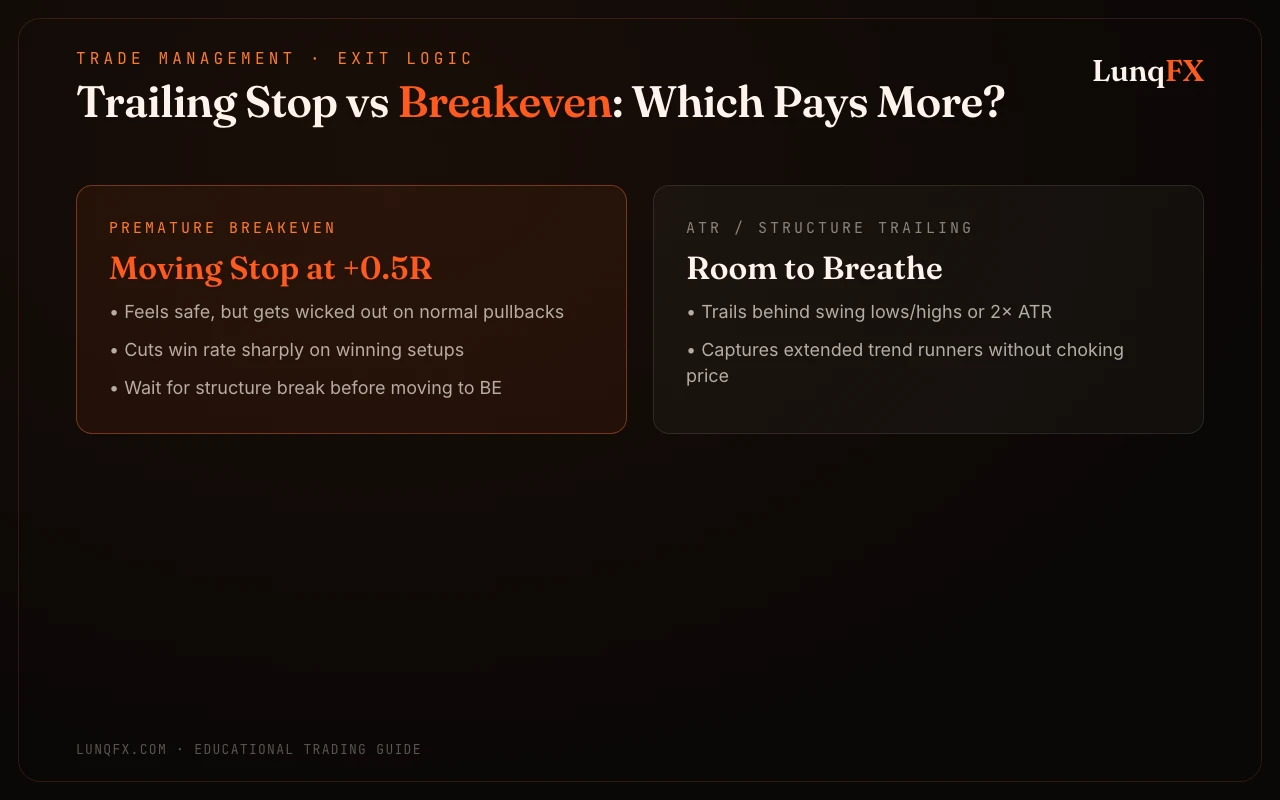
The trailing stop vs breakeven debate is where most traders quietly sabotage a profitable entry model. Moving your stop loss to entry as soon as a trade shows +0.5R feels responsible — you tell yourself you have eliminated risk and locked in a "free trade." In reality, you have usually turned a +2R or +3R winner into a 0R scratch before the market finishes its normal pullback.
This guide breaks down the expectancy maths behind early breakeven stops, compares fixed-pip trailing against ATR and market-structure trailing, and shows how a partial close plus a runner solves the psychological urge to protect open profit without suffocating your edge.
What Breakeven and Trailing Stops Actually Do
Both tools exist to solve the same problem: trade management after entry. Yet they operate on completely different assumptions about price behaviour.
- Breakeven stop: moves your stop loss once to your entry price (plus commission and spread, if you want a true net zero) after price travels a set distance in your favour, and then leaves it there.
- Trailing stop: continuously ratchets your stop loss behind price as the trade moves in your direction, locking in progressively larger unrealised gains while giving the trade room to breathe — or choking it, depending on the trailing distance.
Comparing trailing stop vs breakeven is not about which one "feels safer." It is about which one produces a higher expectancy in your trading journal over 100+ trades.
Why Moving to Breakeven at +0.5R Kills Win Rate and Expectancy
Most traders move to breakeven at +0.5R or +1R because they hate watching a green position turn red. The problem is that financial markets do not move in straight lines — they break a level, retest it, sweep shallow liquidity, and then expand.
Consider a simple worked example across 100 trades on a system with a natural 1:2.5 risk-to-reward ratio and a 42% base win rate:
| Management Rule | Wins (+2.5R) | Scratches (0R) | Losses (-1R) | Net Return | Expectancy / Trade |
|---|---|---|---|---|---|
Set-and-forget (-1R / +2.5R) | 42 | 0 | 58 | +47.0R | +0.47R |
Move to BE at +0.5R | 24 | 41 | 35 | +25.0R | +0.25R |
Move to BE at +1.0R | 33 | 22 | 45 | +37.5R | +0.38R |
Look at what happened in row two: moving the stop to breakeven at +0.5R cut losses from 58 down to 35, which felt wonderful. Yet it also chopped 18 full +2.5R winners into 0R scratches because normal pullbacks revisited the entry zone before continuing. Your win rate collapsed from 42% to 24%, and your total profit nearly halved from +47.0R to +25.0R.
The rule of thumb: a breakeven stop only improves expectancy if your entry sits at an invalidation point that price should never revisit once +0.5R is cleared. On breakout retests, trend continuations, and volatile pairs like XAUUSD, entry is rarely that clean. If you move to breakeven early, you are no longer trading your strategy — you are trading your anxiety.
Fixed-Pip Trailing vs ATR and Structure Trailing
If early breakeven chokes winners, a poorly calibrated trailing stop is just as destructive. The mistake most MT5 traders make is using MetaTrader's built-in fixed-pip trailing stop (for example, trailing 20 pips behind price).
Why Fixed-Pip Trailing Fails
Volatility is not constant across pairs or sessions:
- During London–New York overlap on
XAUUSD: a20-pip($2.00) trail is smaller than a single M5 noise candle. You get stopped out on routine wick fluctuations while the trend is still intact. - During late Asian consolidation on
EURUSD:20 pipsmay represent half the entire session's range, leaving your stop miles behind price and giving back 70% of the move when it finally reverses.
ATR Trailing vs Structure Trailing
Two adaptive methods beat fixed-pip trailing on almost every liquid instrument:
- ATR trailing stop: places the trail at a multiple of the Average True Range — typically
1.5 × ATR(14)to2.0 × ATR(14)on your execution timeframe. Because ATR expands during high-volatility impulses and contracts during quiet consolidations, your stop automatically adjusts to current market noise. Our ATR stop-loss guide covers the exact multiplier math for intraday versus swing setups. - Market-structure trailing: trails behind confirmed swing lows (in an uptrend) or swing highs (in a downtrend) on your signal timeframe, moving the stop only when a new candle closes beyond the prior structural pivot. This is the cleanest method for trend-following systems because your stop sits behind actual invalidation rather than an arbitrary distance.
Trend-focused gold systems such as AURUM rely on volatility-adjusted trailing logic rather than rigid fixed-pip trails precisely because gold's intraday expansion can spike 30–50 pips on a single liquidity sweep before resuming its primary leg.
Trailing Stop vs Breakeven: Side-by-Side Comparison
| Factor | Breakeven Stop | Fixed-Pip Trailing | ATR / Structure Trailing |
|---|---|---|---|
| Best market regime | Mean-reversion or sharp impulse breakouts | Rarely optimal; static ranges only | Trending markets and multi-leg expansions |
| Impact on win rate | Drops sharply if triggered under +1R | Moderate drop from noise stop-outs | Preserves base win rate if buffer ≥ 1.5× ATR |
| Impact on average winner | Preserves full target if it survives | Frequently clips winners early | Captures extended tail moves (+3R to +6R) |
| Emotional comfort | High early on, high regret when clipped | Medium; constant small wins | Lower early on; requires trusting structure |
| Execution risk | Needs server-side SL or VPS | Client-side MT5 trail fails if terminal closes | Best coded into an EA or managed on candle close |
Notice the technical catch on MetaTrader 5: MT5's native right-click Trailing Stop runs client-side inside your terminal, not on your broker's server. If your laptop sleeps or loses internet, the trail stops updating — unlike a static stop loss or an EA running on a VPS.
The Middle Path: Partial Close Plus a Runner
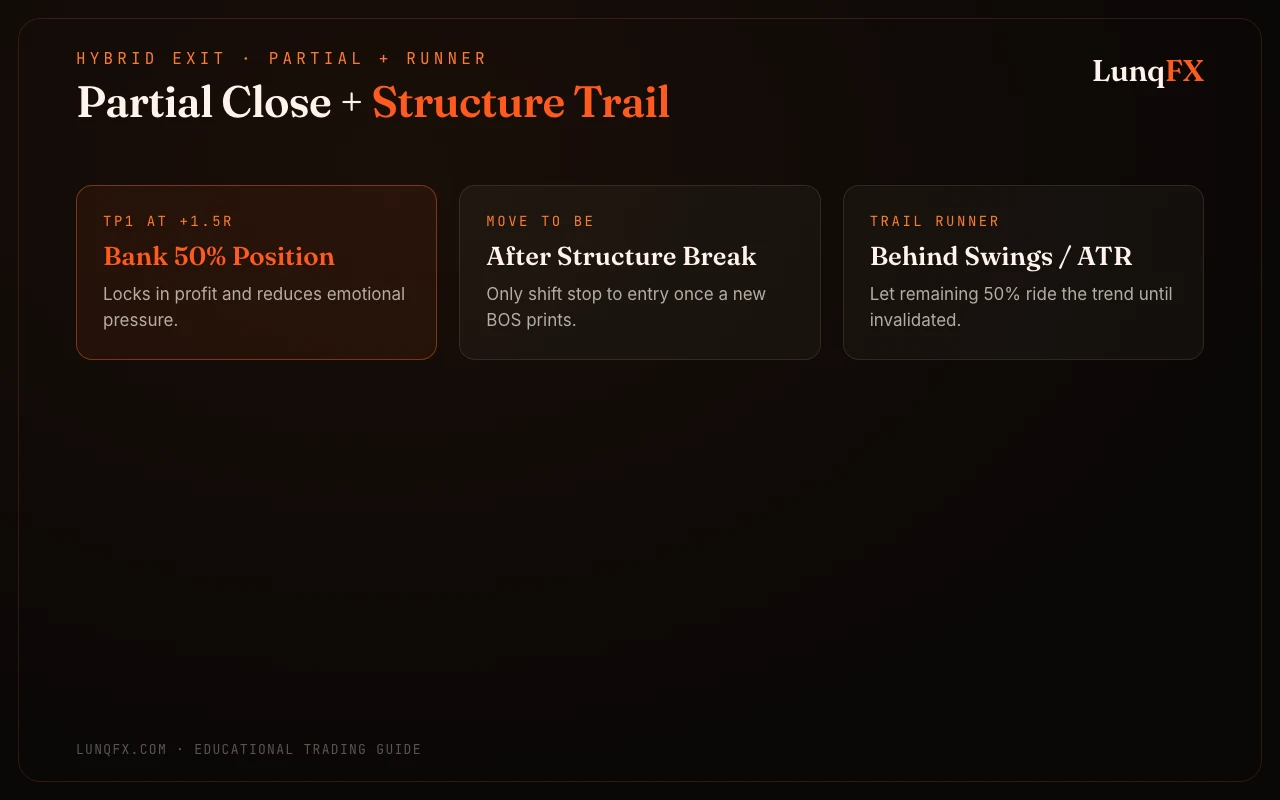
You do not have to treat stop management as an all-or-nothing choice. One of the cleanest ways to reconcile mathematical expectancy with human psychology is a two-part exit:
- Close 50% at
+1.0Rto+1.5R: this locks in real realised profit (+0.5Rto+0.75Rbanked) and reduces your remaining risk exposure if the trade reverses to your original stop. - Move the remaining 50% only after structure shifts (or to breakeven at
+1.5R): once the trade has cleared+1.5Rand formed a higher low (for longs), move the runner's stop to entry or trail it behind1.5 × ATR(14)/ swing structure.
Let's check the maths: if you bank 50% at +1.5R (+0.75R guaranteed) and the second half gets stopped at breakeven (0R), you still walk away with +0.75R instead of a 0R scratch. And when the runner catches a +4R trend leg, your combined trade pays (0.5 × 1.5R) + (0.5 × 4.0R) = +2.75R.
There is one honest caveat: partial closes lower your ceiling on runaway trends compared to holding 100% of the position to +4R. You are trading maximum theoretical return for smoother equity curves and fewer psychological mistakes — a trade-off that is usually worth making if early breakeven stops have been ruining your win rate.
How to Test Which Exit Works on Your Data
Stop guessing and audit your last 50–100 closed trades in your journal using MFE (Maximum Favourable Excursion) and MAE (Maximum Adverse Excursion):
- Check how often winners pulled back through entry: if more than 30% of your
+2Rwinners retraced to0Ror-0.3Rafter first hitting+0.5R, an early breakeven rule is actively costing you money. - Check your MFE distribution: if your trades regularly reach
+3.5RMFE while you exit everything at+2R, an ATR or structure trail on a50%runner will likely lift your net expectancy. - Account for execution costs: on a raw spread vs standard account, a true breakeven stop must cover commission (for example
0.7 pipsequivalent onEURUSD), otherwise a "breakeven" exit still bleeds your balance over 200 trades.
FAQ
When should I move my stop loss to breakeven? Only move to breakeven after price has cleared at least +1.0R to +1.5R and printed a new structural swing or broken a key level. Moving to breakeven at +0.5R usually gets you clipped by normal entry-zone retests.
Is an ATR trailing stop better than a fixed-pip trailing stop? Yes, in almost every market. An ATR trailing stop adapts to expanding and contracting volatility, whereas a fixed-pip trail (such as 20 pips) is too tight during high-volatility sessions and too loose during quiet ranges.
Does MT5's built-in trailing stop work if I close my computer? No. MetaTrader 5's native trailing stop runs locally inside your client terminal, not on the broker's server. If MT5 is closed or disconnected, your stop loss remains frozen at its last level.
What is the difference between a trailing stop and a breakeven stop? A breakeven stop moves your stop loss once to your entry price and stays fixed there, aiming for a 0R worst-case outcome. A trailing stop keeps moving behind price as the trade advances, locking in progressively larger profits until price reverses far enough to hit it.