VWAP Trading Strategy: Institutional Fair Value (and the Spot Forex Catch)
· 7 min read · LunqFX Team
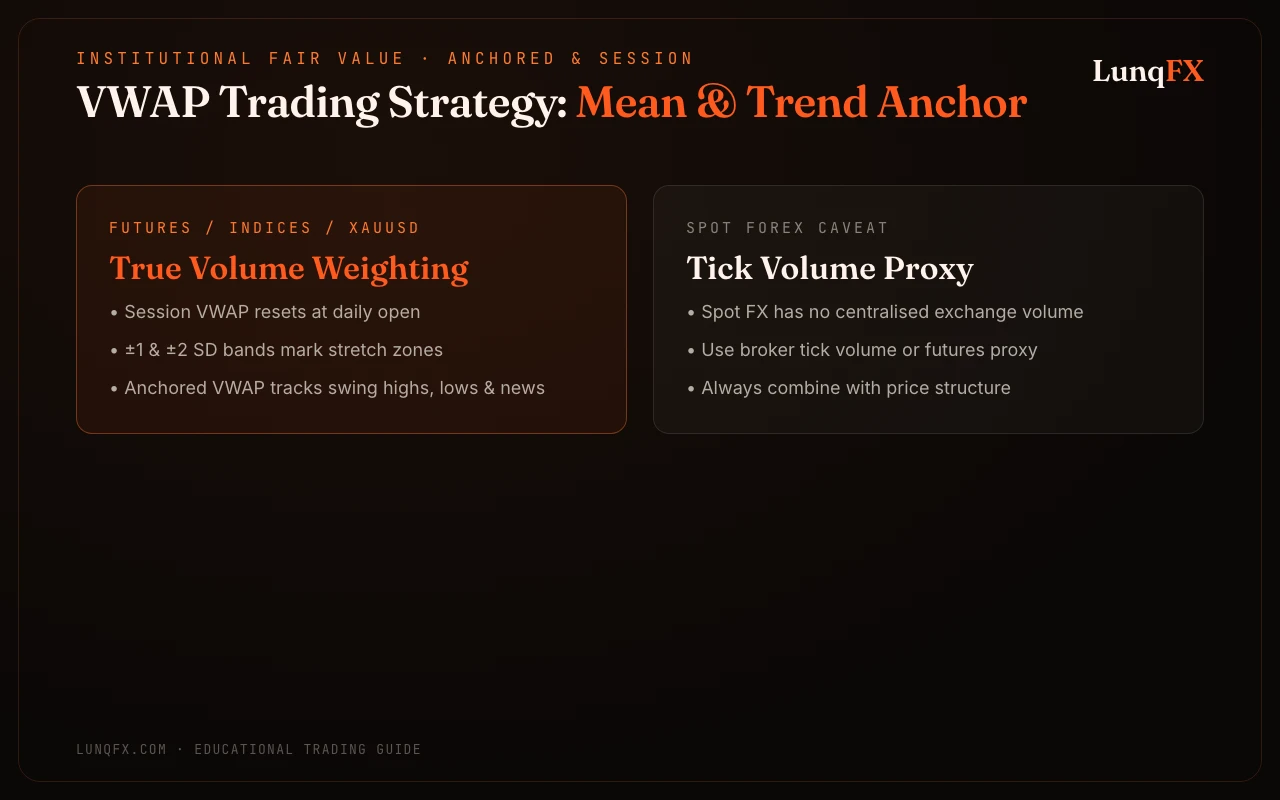
A VWAP trading strategy gives you something almost no standard price oscillator can: a dynamic benchmark of where the bulk of the day's volume actually traded. On equities, futures, and index CFDs, institutional execution algorithms are literally benchmarked against Volume Weighted Average Price—if a fund buys below VWAP, their execution desk beat the market average; if they buy above it, they overpaid.
There is, however, an uncomfortable truth that most forex blogs gloss over: spot FX has no centralised exchange and no true volume feed. Applying a VWAP indicator blindly to an MT4 or MT5 spot forex chart without understanding what data it is reading will give you a distorted line. Here is how VWAP actually works, how to trade session vs anchored VWAP with standard deviation bands, and how to solve the spot forex volume problem properly.
What VWAP Actually Calculates
Unlike a Simple Moving Average—which treats a quiet Asian-session candle and a violent Non-Farm Payrolls candle equally—VWAP weights every price bar by the volume transacted during it:
VWAP = Σ (Typical Price × Volume) ÷ Σ Volume
where Typical Price = (High + Low + Close) ÷ 3
Because the numerator and denominator accumulate from a fixed starting point (such as the daily session open), VWAP acts as a volume-weighted equilibrium:
- Price above VWAP: Buyers are in control and paying above the session's average volume-weighted cost.
- Price below VWAP: Sellers are in control and transacting below average cost.
- Flat, horizontal VWAP: Balanced, two-sided auction—ideal for mean reversion back to the VWAP line.
- Steeply sloped VWAP: Imbalanced, directional trend—ideal for trend pullbacks.
This is the intraday cousin of volume profile trading: Volume Profile maps where volume clustered across price levels horizontally, while VWAP tracks the evolving average price paid per unit of volume over time.
Session VWAP vs Anchored VWAP
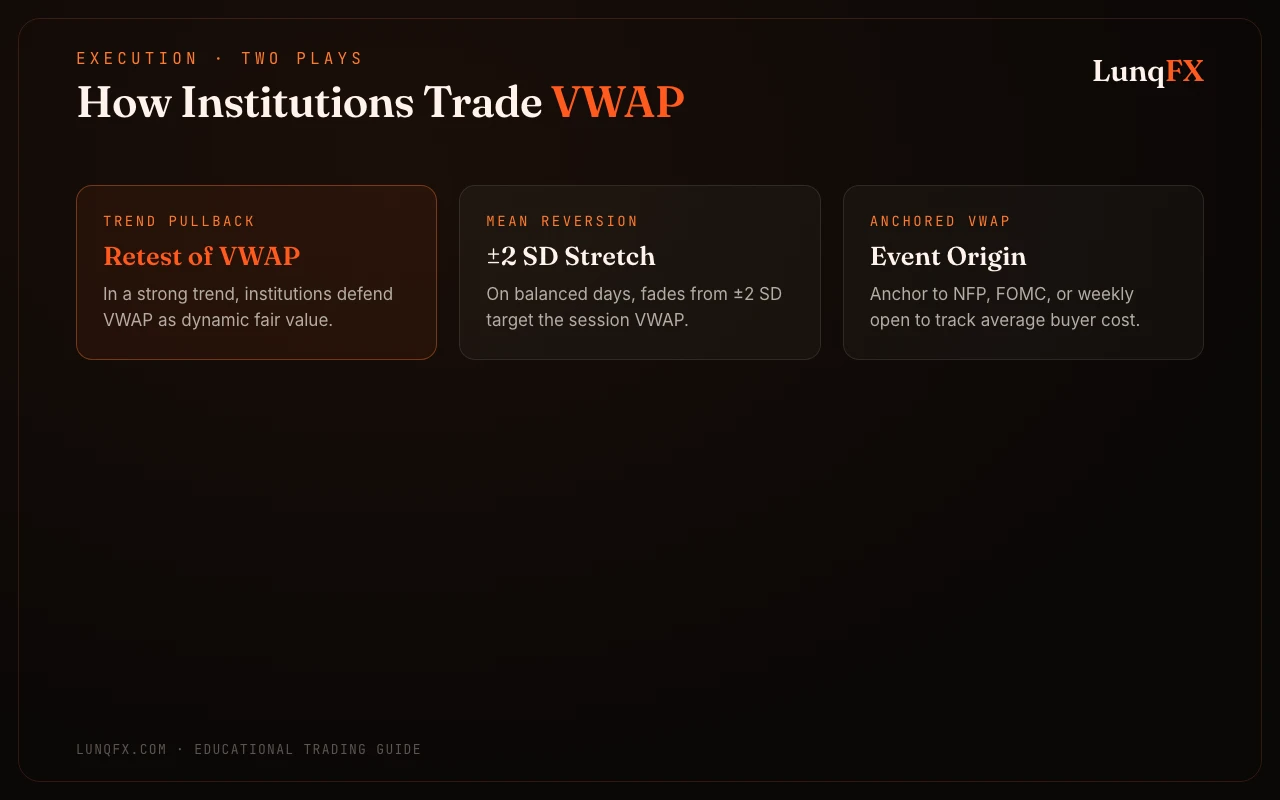
Standard Session VWAP resets to zero at the start of every trading day (typically 00:00 UTC / 00:00 EST for futures, or 17:00 EST / 22:00 GMT for FX rollover). It is strictly an intraday compass. Early in the session, VWAP reacts quickly to new volume; by the London–New York overlap, the cumulative denominator is so large that VWAP becomes a heavy, slow-moving institutional magnet.
Anchored VWAP (AVWAP)—popularised by Brian Shannon—removes the arbitrary midnight reset. Instead, you anchor the calculation to a meaningful market event:
- A major swing high or swing low on H4/D1
- A central bank rate decision (FOMC, ECB, CPI release candle)
- The start of the week, month, or quarter
- A major support and resistance breakout candle
Anchoring VWAP to an FOMC spike or a weekly open tells you the exact average entry price of every participant who entered since that catalyst. When price returns to that anchored VWAP days later, trapped buyers or sellers are sitting right at breakeven—which is why reactions at AVWAP levels are often razor-sharp.
Trading the ±1 and ±2 Standard Deviation Bands
Plotting VWAP alone is useful; plotting ±1 and ±2 standard deviation (SD) bands around it turns VWAP into a complete execution map.
- VWAP (Fair Value): The mean. In a trend, pullbacks often bounce cleanly off VWAP or the ±1 SD band.
- ±1 SD Band: Contains roughly 68% of price action in a normal distribution. In strong trends, price frequently "walks" between VWAP and +1 SD (uptrend) or −1 SD (downtrend) without ever returning to the centre line.
- ±2 SD Band: Contains roughly 95% of price action. Reaching ±2 SD in a flat-VWAP (balanced) market signals statistical overextension—ideal for fading back toward VWAP.
Two Core Setups in a VWAP Trading Strategy
Setup 1 — Trend Pullback (Sloped VWAP):
- Confirm VWAP is clearly sloping up (or down) after the London or New York open.
- Wait for price to pull back from +1/+2 SD into the VWAP line or +1 SD band.
- Enter on a bullish rejection close (e.g., pin bar or engulfing bar) with your stop loss 0.5× ATR beyond the VWAP line.
- Target the prior session high / +2 SD band (minimum 1.8R–2R).
Setup 2 — Mean Reversion Fade (Flat VWAP):
- Confirm VWAP is nearly flat for at least 3–4 hours (balanced range day).
- Wait for price to spike into +2 SD or −2 SD at a known key level (such as a prior day high/low or round number).
- Enter back toward the mean on a reversal candle close.
- Stop loss: Beyond ±2.5 SD or the spike extreme. Target: 50% at ±1 SD, 50% at the central VWAP line.
Worked numeric example (NAS100 M15):
- NY cash open (14:30 GMT) drives NAS100 higher; Session VWAP slopes up cleanly at
19,420, with +1 SD at19,465and +2 SD at19,510. - At 15:15 GMT, price pulls back from
19,505directly to VWAP at19,425and prints a bullish engulfing candle closing at19,440. - Entry:
19,440. Stop loss:19,400(40 points, below VWAP and the pullback low). - Target:
19,520(retest of +2 SD / session high, 80 points = 2.0R).
The Spot Forex Volume Problem (and How to Fix It)
Because spot forex is a decentralised over-the-counter (OTC) market, your MT4/MT5 broker does not know how much total currency volume traded globally. It only sees tick volume—the number of price updates your broker's server received per candle.
Does tick volume break VWAP? Not completely, because tick volume correlates roughly 85%–90% with actual futures volume during liquid sessions—if you use a Tier-1 ECN feed. However, on thin off-hours or retail bucket-shop feeds, tick spikes distort VWAP.
Here are the three practical workarounds:
- Trade indices and futures CFDs directly: Instruments like NAS100, US30, S&P 500, and DAX mirror centralised exchange futures where volume is real and VWAP is respected to the tick. See our trading indices guide for session timing on US100/US30.
- Use CME currency futures as your VWAP proxy: Plot VWAP on TradingView using
6E1!(Euro futures) for EURUSD,6B1!for GBPUSD,6J1!for USDJPY, andGC1!(COMEX Gold futures) for XAUUSD. Read the VWAP levels on the futures chart, and execute on your spot MT4/MT5 broker. - Pair VWAP logic with dedicated session/volatility tools: For XAUUSD traders who want automated session structure and breakout/pullback execution without juggling external futures feeds, AURUM is built specifically around gold's London–NY volatility rhythm, while Obsidian helps structure institutional levels directly on your chart.
Common Mistakes That Ruin VWAP Trades
- Trading VWAP on the daily chart: Session VWAP is an intraday tool; if you switch to D1, a daily-reset VWAP collapses into a meaningless dot. Use Anchored VWAP for H4/D1 swing analysis.
- Fading ±2 SD on a trend day: When VWAP is steeply angled after a major news release, +2 SD is not "overbought"—it is a runaway trend. Never fade ±2 SD unless VWAP slope has flattened.
- Ignoring the first 30 minutes of a session: Right after the 00:00 reset or the NY 14:30 GMT open, volume is too small and VWAP whipsaws wildly. Wait at least 30–60 minutes for fair value to stabilise before trusting the bands.
FAQ
Does VWAP work in forex without real volume? Partially. Spot forex uses tick volume, which tracks real institutional activity fairly well on major pairs during London and New York hours. However, for maximum accuracy, read VWAP on CME currency or gold futures (6E1!, GC1!) and execute on your spot chart.
What is the difference between Session VWAP and Anchored VWAP? Session VWAP resets automatically at the start of each trading day and measures intraday fair value. Anchored VWAP starts from a specific event you choose—such as an FOMC candle, weekly open, or major swing low—and tracks fair value from that exact point forward.
What are the best timeframes for a VWAP trading strategy? M5 and M15 are the standard execution timeframes for Session VWAP. For Anchored VWAP on swing trades, H1 and H4 work best.
How do you use VWAP standard deviation bands? In a flat-VWAP range market, ±2 SD acts as a mean-reversion boundary to fade back toward VWAP. In a trending market with a sloped VWAP, VWAP and ±1 SD act as dynamic pullback zones to join the trend.
Is VWAP better than a 20 EMA? They serve different purposes. A 20 EMA weights recent prices equally regardless of participation; VWAP weights price by volume, making it far more accurate for identifying where large institutions actually transacted during the session.