How to Recover From Drawdown Without Digging a Deeper Hole
· 6 min read · LunqFX Team
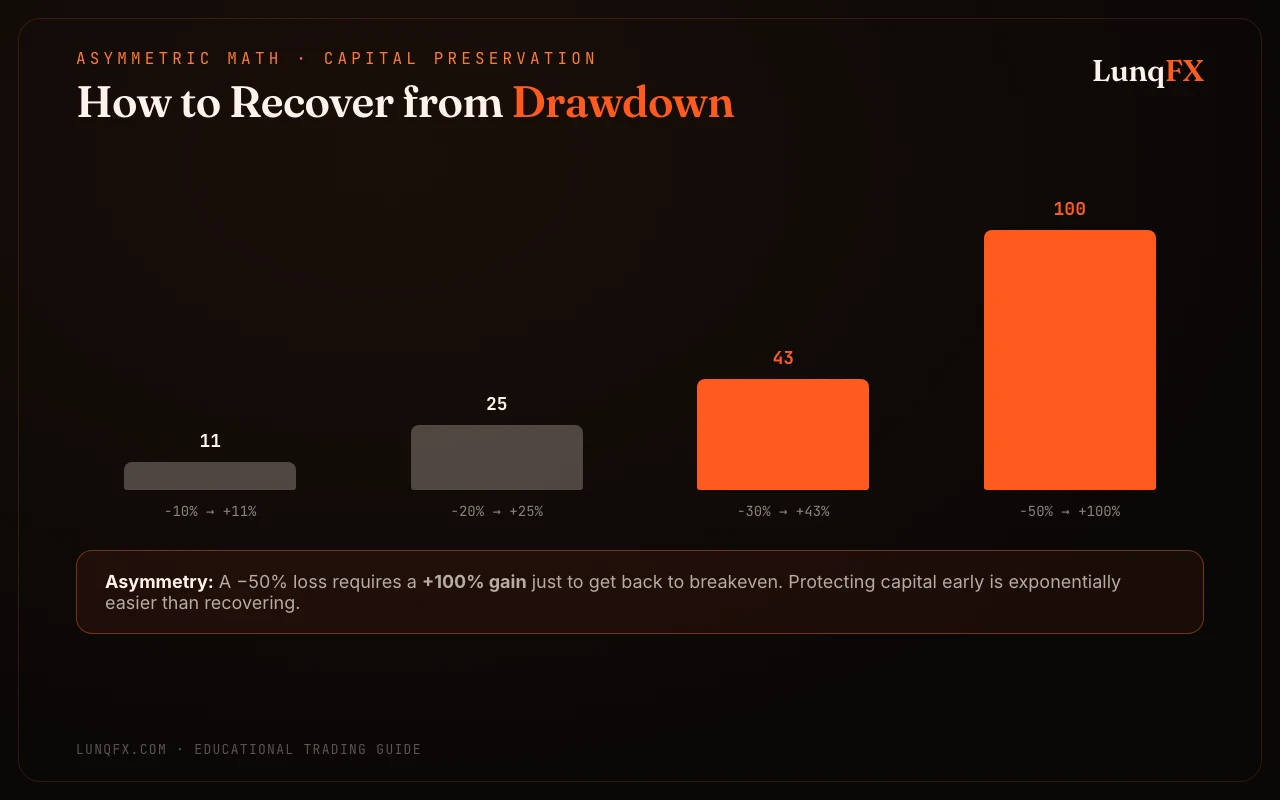
Every trader hits a losing streak eventually, yet very few have a written plan for how to recover from drawdown once it starts. The default instinct is almost universal: feel behind, trade slightly bigger to "get back to breakeven faster," take marginally weaker setups, and turn a manageable −8% dip into an unrecoverable −35% hole.
Recovery is not about finding a hotter setup or doubling your lot size. It is an arithmetic problem first and an execution problem second. Once you see the asymmetry of losses, the case for cutting risk in half — rather than sizing up — becomes obvious.
The Asymmetric Maths of Drawdown Recovery
Losses and gains are not symmetrical. When your account drops, you have less capital left to generate the percentage return needed to get back to your starting peak. The exact formula is:
Required Gain % = Drawdown % ÷ (1 − Drawdown %)If you lose 20% of a $10,000 account, you are left with $8,000. Making 20% on $8,000 only brings you to $9,600 — you actually need 25% ($2,000 ÷ $8,000) just to break even.
| Drawdown Depth | Remaining Capital (from $10,000) | Required Gain to Break Even | R-Multiples Needed at 1% Risk (Compounded) |
|---|---|---|---|
| −5% | $9,500 | +5.3% | ~5.1R |
| −10% | $9,000 | +11.1% | ~10.5R |
| −20% | $8,000 | +25.0% | ~22.3R |
| −30% | $7,000 | +42.9% | ~35.7R |
| −50% | $5,000 | +100.0% | ~69.3R |
| −75% | $2,500 | +300.0% | ~138.6R |
Look at the jump between −10% and −50%. A 10% drawdown requires an 11.1% gain — annoying, but completely normal over a few weeks of disciplined trading. A 50% drawdown requires doubling your remaining balance (+100%). A 75% drawdown requires quadrupling it (+300%).
That table explains why the single most important rule of drawdown recovery is stopping the bleed early. Preventing a −10% slump from becoming −25% saves you months of grinding.
Why Sizing Up Backfires (The Anti-Martingale Trap)
When traders are down 10%, the temptation to increase risk from 1% to 2% — "just until I'm back to even" — feels logical. Twice the size means half as many winning trades to recover, right?
Wrong, for two reasons:
- You are already inside a variance trough or a regime mismatch. Increasing lot size during a losing run amplifies the exact behaviour or market condition that caused the losses. Three more stops at 2% turns a −10% dip into −16%, and now you need +19% just to see zero.
- Prop firm floors punish aggression. On a funded evaluation, doubling risk near a trailing drawdown vs static drawdown floor almost guarantees a breach before your edge has time to play out.
Increasing size to recover losses is the same flawed logic behind martingale and grid EAs: it trades a high probability of small recoveries for a guaranteed blow-up when the inevitable extended losing streak arrives.
How to Recover From Drawdown: Step 1 — Cut Risk in Half Immediately
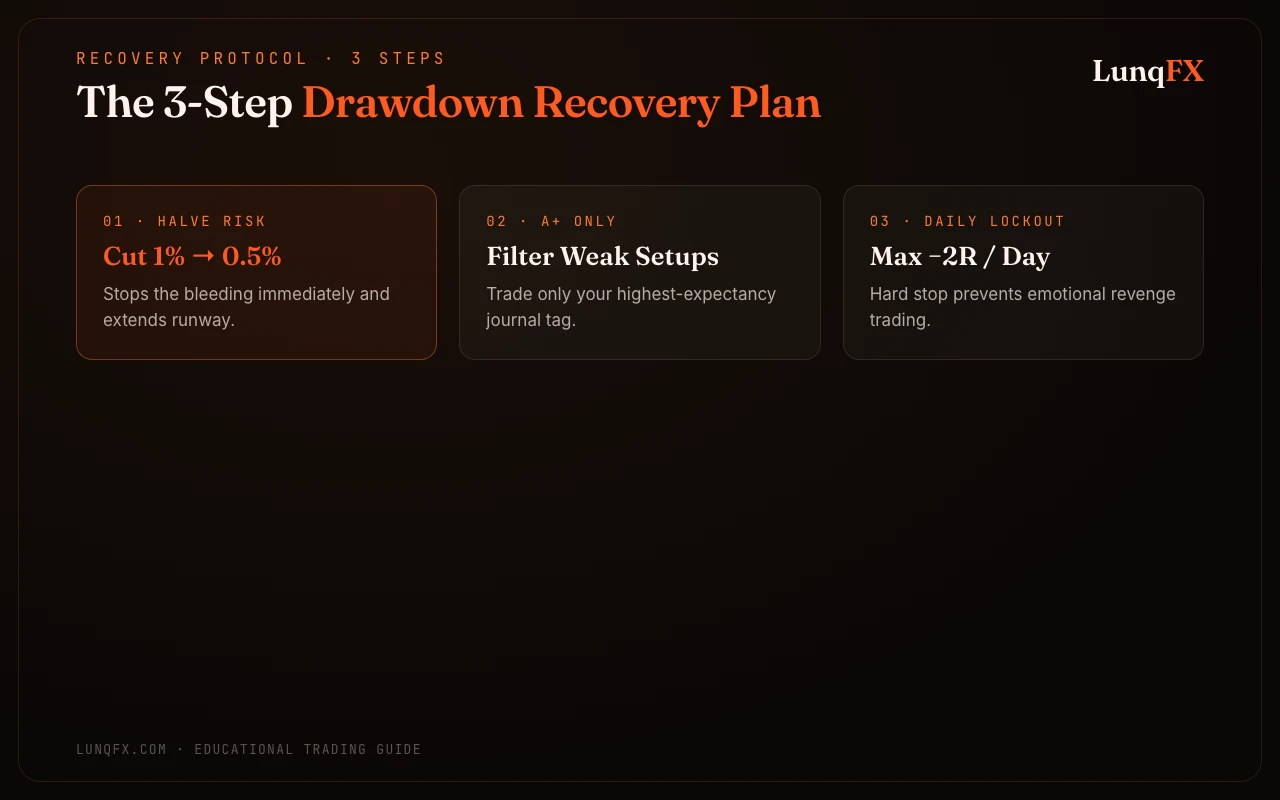
The professional response to a meaningful drawdown is the exact opposite of intuition: cut your risk per trade in half (for example, from 1.0% down to 0.5%, or from 0.5% to 0.25% on a prop account).
Trigger this automatically at a predefined threshold — typically −5% on a personal account or 50% of remaining drawdown buffer on a prop firm account. Here is what halving risk accomplishes:
- It buys statistical runway: At 1% risk, a −10% account with a 15% max drawdown limit can only survive five more losses. At 0.5% risk, it survives ten. Your strategy's positive expectancy needs sample size to reassert itself; halving risk gives it that sample size.
- It lowers emotional cortisol: Losing 0.5% feels like routine noise rather than a crisis, which stops you from moving stops or cutting winners early.
- It scales back up automatically: Once you recover half of the drawdown (say, from −10% back to −5%), step risk back up to 0.75%, and return to 1.0% only at a new equity high.
Use our lot size calculation formula to recalculate your exact units at the halved percentage — never guess lot sizes by eye when adjusting risk down.
Step 2: Enforce a Hard Daily Loss Lockout
Drawdowns rarely happen in neat, isolated −1R increments over three weeks. Most serious account damage happens in one or two undisciplined afternoons where a trader loses 2R, tilts, and loses another 5R before dinner.
Install a daily loss lockout: a hard stop at −2R or two consecutive losses in a single day, whichever comes first. Once hit, platform trading stops until the next calendar day.
Manual traders are notoriously bad at enforcing lockouts with willpower alone — which is why structural friction helps. Tools with built-in safeguards, such as RIPTIDE (which combines liquidity-sweep grading with automated lot sizing and a hard daily lockout), remove the negotiation step after two losses by locking execution automatically. Whether you use an indicator lockout, a broker equity guard, or a simple trade-copier rule, the lockout must require zero willpower at the moment you are angriest.
Step 3: Audit Your Journal Before Changing Anything
Before blaming your strategy, open your log and separate market variance from execution errors. Pull your last 30–50 trades and check the numbers outlined in our trading journal metrics guide:
- Did you follow your rules on 90%+ of trades? If half the drawdown came from oversized lots, off-session entries, or moving stops, your strategy is not broken — your overtrading and revenge trading habits are. Fix the discipline leak before touching the rules.
- What is your expectancy and win rate by setup tag? Often one specific pair, session, or setup grade is responsible for 80% of the red. Dropping that single weak tag while keeping your core setup intact can restore positive expectancy overnight.
- Has market volatility shifted? If your risk to reward ratio targets 3R swings in a market that has compressed into tight Asian-style ranges, your stops are fine but your targets are out of reach for the current regime.
Do not overhaul your entire strategy after 10 or 15 losing trades. Changing systems mid-drawdown is how traders string together three different losing streaks in a row without ever letting one edge recover.
Step 4: Rebuild With A+ Setups Only
During recovery mode, become ruthlessly selective. If you normally take A+ and B-grade setups, restrict yourself strictly to A+ setups for the next 20 trades. Fewer trades at halved risk means recovery will feel slow — and that slowness is a feature, not a bug.
Building a repeatable recovery protocol comes down to accepting a simple trade-off: you give up the fantasy of bouncing back in two heroic trades in exchange for making sure you are still solvent when your edge returns.
FAQ
How long does it take to recover from a 20% drawdown? At 0.5% risk per trade and a realistic expectancy of +0.30R per trade, recovering the +25% required to break even takes roughly 150 trades (or several months of steady execution). Attempting to force it faster by doubling risk usually deepens the drawdown instead.
Should I stop trading completely during a drawdown? Take a 24–48 hour cooling-off break if the drawdown was caused by emotional mistakes or tilt. Once calm, audit your journal and resume at half risk on demo or micro size — stopping indefinitely prevents your positive expectancy from ever playing out.
At what drawdown percentage should I cut my risk in half? On a personal account, cutting risk by 50% at −5% to −8% drawdown is a practical standard. On a prop firm account with a 5% or 10% max loss limit, cut risk in half as soon as you use 35%–40% of your available drawdown buffer.
Is it better to change strategy during a losing streak? Only if a 50–100 trade journal audit proves your edge has genuinely disappeared or market structure has shifted permanently. If your rules were broken or the sample is under 30 trades, keep the strategy and fix execution and position sizing first.