How to Stop Overtrading and Revenge Trading Without Willpower
· 6 min read · LunqFX Team
Every trader knows what overtrading feels like: you take two clean losses in the morning, tell yourself you will "just make it back before lunch," and by 5 p.m. you have placed eleven trades on four pairs you do not normally touch. Knowing the pattern does not stop it. That is why every guide telling you to "be more patient" or "control your emotions" fails — because how to stop overtrading is a structural engineering problem, not a willpower test.
Willpower is a finite resource that depletes fastest right after a losing trade. The traders who eliminate revenge trading and boredom clicks do not have superhuman self-control; they build hard rules and physical constraints that make extra trades impossible once a limit is reached.
Why Execution Discipline Beats Willpower
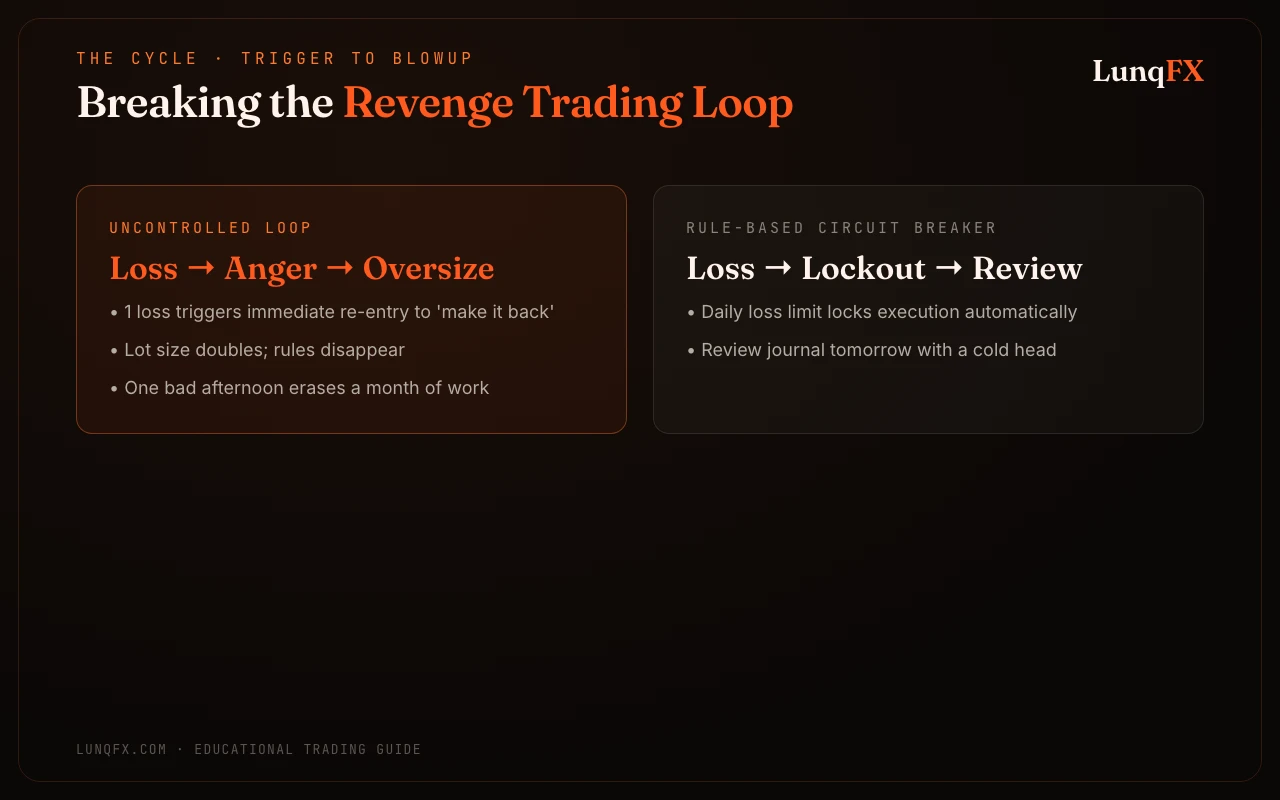
After a stop-out, your brain experiences a genuine stress response: cortisol rises, focus narrows, and the urge to restore the lost balance feels urgent. Asking yourself to make calm, objective decisions in that state is unrealistic.
Decision fatigue compounds the problem. Watching charts for eight hours straight forces hundreds of micro-decisions ("is this a breakout? should I enter early?"). By hour five, your brain looks for stimulation, and clicking buy or sell provides an immediate dopamine hit — even on a terrible setup.
That is why execution discipline beats willpower. Discipline is not gritting your teeth while staring at an M5 chart; discipline is setting up rules before the market opens so you are never in front of the chart during hours or emotional states where bad trades happen.
Rule 1: How to Stop Overtrading With a Daily Trade Cap
The simplest circuit breaker for curbing excessive volume is a fixed maximum number of trades per day — regardless of whether they win or lose.
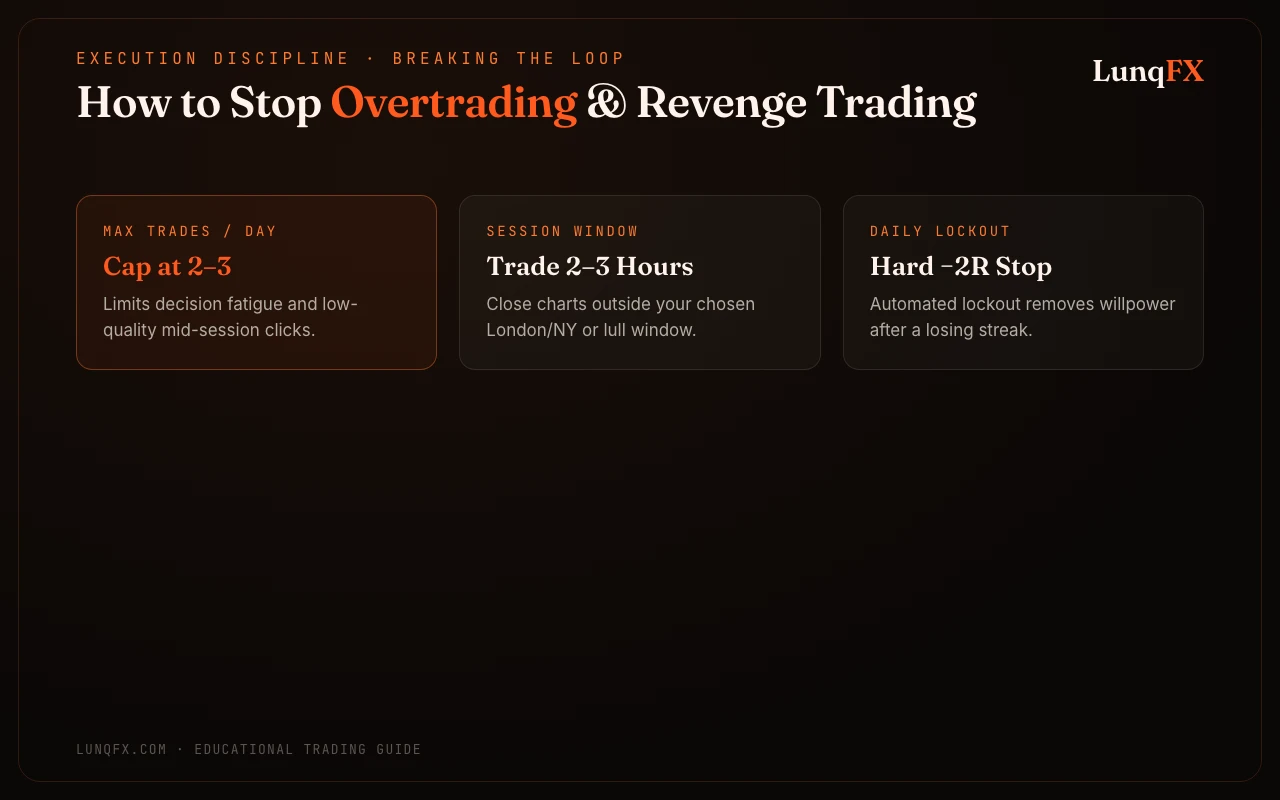
For most intraday traders, the sweet spot is 2 to 3 trades per session. Look at what a strict 3-trade cap forces you to do:
- Quality filtering becomes automatic: If you only have three bullets for the entire day, you stop firing at mediocre C-grade patterns at 9:15 a.m. Every entry has to earn one of your limited slots.
- Win-streak euphoria is contained: Overtrading does not only happen after losses; many traders give back a +3R morning by taking five sloppy afternoon trades because they feel invincible. A daily cap locks in green mornings before overconfidence gives them back.
- Consistency stays intact: Capping daily volume also protects you from triggering a prop firm consistency rule on unusually volatile days.
If you use setup grading — such as the A+ to C tiering inside RIPTIDE — pair your daily cap with a minimum grade rule: only A+ and A setups count; B and C alerts are ignored automatically. When you combine a 3-trade ceiling with strict setup grading, you eliminate 80% of low-expectancy clicks without needing a single ounce of extra motivation.
Rule 2: Trade Only Fixed Session Windows
Most overtrading happens in the dead hours between major market opens, when price drifts sideways and traders invent patterns out of boredom. The fix is a fixed session window with a hard start and a hard platform-close time.
| Trading Style | Suggested Window (GMT) | Why This Window Works |
|---|---|---|
| London Open | 07:00–10:00 GMT | Cleanest directional liquidity sweeps and breakouts |
| London–NY Overlap | 12:30–15:30 GMT | Highest daily volume and tightest spreads |
| Afternoon Lull | 16:00–18:00 GMT | Post-London mean reversion before rollover |
| NY Close / Asian | 21:00–24:00 GMT | Quiet range reversion once institutional flow stops |
Pick one two-to-three-hour window from our forex session times and kill zones guide that fits your schedule, and close your trading terminal completely outside it. You cannot revenge-trade at 3 p.m. if your charts are closed and your alerts are muted.
Automated systems enforce this better than humans ever will. Mean-reversion EAs like SIESTA (which trades strictly 16:00–18:00 GMT and flattens all positions by 20:00) and NIGHT OWL (21:00–24:00 GMT) have zero temptation to "check the charts" at 10 a.m. — the code simply refuses to trade outside its programmed hours.
Rule 3: Enforce a Daily Loss Lockout
A trade cap limits frequency; a daily loss lockout limits financial damage when you are out of sync with the market.
Set your daily loss lockout at −2R (or 2 consecutive losses in one day). The moment that threshold is hit, trading ends for 24 hours. No "half-size recovery trade," no switching to gold for "one quick scalp."
Why 2 losses? Data from thousands of trading journal metrics logs shows the same pattern: a trader's win rate on trade #4 and #5 after two consecutive intra-day losses drops sharply below their baseline. You are no longer executing your edge — you are executing frustration.
To make the lockout stick, add real friction:
- Platform or indicator lockouts: Use an EA, risk-manager utility, or indicator with a built-in daily lockout (such as RIPTIDE) that physically blocks new signals or orders after your daily loss limit is hit.
- Broker or prop-firm equity guards: Set a hard daily equity stop slightly tighter than your firm's official limit so you lock yourself out at −2% rather than risking a −5% breach.
- Physical separation: Close MetaTrader, shut the laptop, and leave your desk for 30 minutes immediately after a second loss.
If you are already in a multi-day slump, combine this lockout with the risk-halving protocol in our guide on how to recover from drawdown.
Rule 4: Pre-Commit With a Pre-Session Checklist
Revenge trading thrives in ambiguity. When your rules live only in your head, your brain will rewrite them on the fly after a stop-out ("well, technically that wick counts as a sweep").
Write a four-line pre-session contract on paper or in your journal before placing trade one:
- Session window: Exact start and stop time in GMT.
- Max trades & daily loss lockout: e.g.,
Max 3 trades | Stop for the day at −2R. - Allowed pairs: Maximum 1–2 instruments you actually track.
- Setup checklist: The 3 objective conditions required for entry.
Read it before the session, and log every rule violation separately from your P&L. A winning trade that broke your daily cap is a bad trade — rewarding rule-breaking with profit is how bad habits become permanent. Add a weekly review column in your journal that calculates how much money your extra trades (trade #4 and beyond) made or lost; for almost every trader, that single column is the wake-up call that makes the daily cap non-negotiable.
Breaking the cycle of overtrading and revenge clicks is not about becoming an emotionless robot. It is about accepting that your willpower will fail after a bad loss, and building daily trade caps, fixed session windows, and hard lockouts that protect your capital when it does.
FAQ
Why do I keep overtrading even when I know it hurts my account? Because overtrading is driven by dopamine and loss-aversion stress rather than lack of knowledge. Watching charts for hours causes decision fatigue, and taking a quick trade after a loss feels like taking control — even when the setup has no edge.
How many trades per day is considered overtrading? There is no universal number, but for most intraday forex and gold traders, taking more than 3 to 4 trades in a single session usually means you are forcing low-quality setups or chasing losses. Scalping EAs can take more, provided every entry follows strict coded rules.
What is the best way to stop revenge trading immediately? Implement a hard daily loss lockout at −2R or two consecutive losses, paired with a software lockout or physically closing your platform for 24 hours. Relying on "self-control" while staring at live candles almost never works.
Does trading fewer hours really make more money? Yes, for most retail traders. Restricting execution to a single 2–3 hour kill zone eliminates low-probability chop, cuts spread costs, and preserves mental energy for your highest-expectancy setups.