Prop Firm Consistency Rule: Why Hitting the Target Isn't Enough
· 7 min read · LunqFX Team
Passing a prop firm evaluation or qualifying for a funded payout used to have one clear finish line: reach the profit target without breaching the drawdown limit. Today, a growing number of firms enforce a prop firm consistency rule — and traders routinely hit their 8% or 10% target only to discover they are nowhere near eligible to pass or withdraw.
The rule is designed to filter out gamblers who pass challenges on a single oversized CPI or NFP spike. In practice, it also catches disciplined traders who happen to catch one unusually clean trend day and fail to cap their daily upside. Here is the exact maths behind consistency scores, how 20% to 40% caps reshape your target, and how to pace daily risk so a great trade does not become a liability.
How the Prop Firm Consistency Rule Works
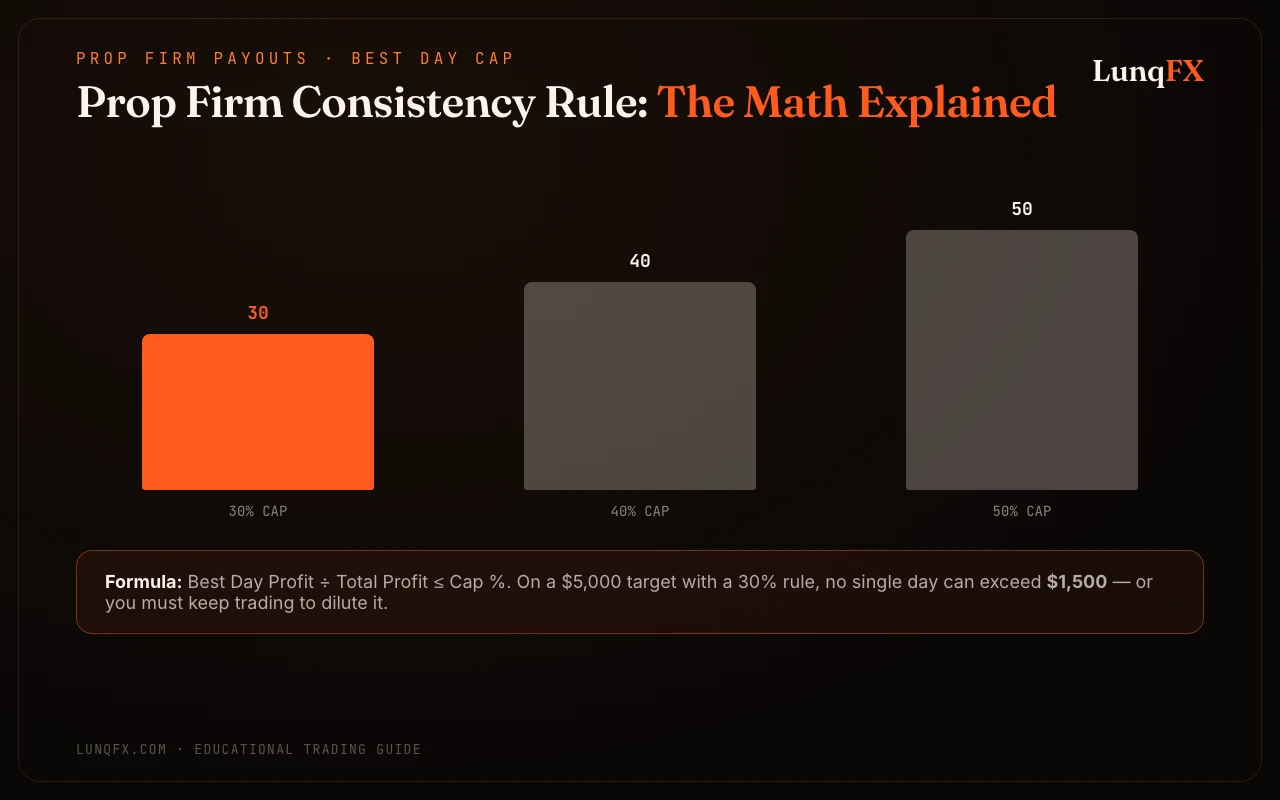
At its core, a prop firm consistency rule caps the percentage of your total net profit that can come from any single trading day (sometimes called the best day rule). Most firms calculate it with a simple ratio:
Consistency Score = (Best Trading Day Profit ÷ Total Net Profit) × 100%If a firm sets a 40% consistency cap, no single day may account for more than 40% of your total profits at the moment you request a payout or finish an evaluation phase. If your best day is 55% of your total profit, your account is not breached — instead, your pass or payout is locked until you generate enough additional profit on other days to dilute that outlier below 40%.
To find out how much total profit you now need, invert the formula:
Required Total Profit = Best Trading Day Profit ÷ Consistency CapThat second formula is the one traders wish they had known before pressing "close" on a +5% afternoon.
Worked Examples: 20%, 30%, and 40% Single-Day Caps
Suppose you trade a $100,000 account with an 8% ($8,000) profit target. You risk 1% per trade, catch a rare runner on Wednesday, and book +$4,000 in a single day. You are halfway to the target in 24 hours — or so it seems.
Here is what happens to your finish line under different consistency caps:
| Consistency Cap | Max Allowed Best Day (at $8k Target) | Your Best Day | Required Total Profit | Extra Profit Needed Beyond $8k |
|---|---|---|---|---|
| 40% cap | $3,200 | $4,000 | $10,000 | +$2,000 (+25% more) |
| 35% cap | $2,800 | $4,000 | $11,429 | +$3,429 (+43% more) |
| 30% cap | $2,400 | $4,000 | $13,333 | +$5,333 (+67% more) |
| 20% cap | $1,600 | $4,000 | $20,000 | +$12,000 (+150% more) |
Look at the 20% row. One $4,000 day on a $100,000 account forces you to make $20,000 — two and a half times the advertised target — before you can pass or withdraw. Even under a relatively forgiving 40% consistency cap, exceeding $3,200 in a single day pushes your true target from $8,000 to $10,000.
The trap worsens if you take a losing day after your big winner. If you reach $8,000 total profit ($4,000 on Wednesday, $4,000 across four other days) and then lose −$1,500 on Friday, your total net profit drops to $6,500 while your best day remains $4,000. Your consistency score jumps from 50% to 61.5%, pushing you even further from payout eligibility.
Why Hitting the Target Still Leads to Blown Accounts
The hidden danger of a best-day cap is not the payout delay itself — it is the behaviour it triggers afterwards.
- Forced trading to dilute the score: A trader sitting at $8,000 profit with a $4,000 best day realises they need another $5,333 under a 30% rule. Instead of trading their normal A+ setups, they start taking mediocre B- and C-grade entries just to "get the volume in."
- Drawdown compression: Every extra day spent grinding out dilution profit exposes the account to fresh losing streaks, trailing drawdown vs static drawdown ratchets, and daily loss limits.
- Psychological tilt: Feeling that you "already passed" while the dashboard keeps the pass button greyed out creates frustration — the fastest route into overtrading and revenge trading.
Many prop firms quietly rely on this exact dynamic: traders pass the profit target, get held back by the consistency filter, overtrade to clear the ratio, and breach the account before ever reaching a payout.
Other Consistency Variants to Check in the Small Print
Not every firm's consistency requirement is a pure single-day profit percentage. Before starting a challenge, check your firm's FAQ for three common variations:
- Lot-size consistency: Some firms flag accounts where your position size on one trade exceeds 2× or 3× your average lot size across the evaluation. Scaling from 0.5 lots on Monday to 4.0 lots on Friday can void a payout even if daily profit stayed under 30%.
- Minimum trading days: Requiring 5 to 10 separate trading days (each with at least one closed position or minimum profit) prevents one-day passes, though it is far easier to manage than a 20% profit cap.
- Stop-loss and duration rules: A few firms exclude trades held under 60 seconds or trades placed without a hard stop loss when calculating eligible profit.
All of these belong in your pre-challenge checklist alongside our prop firm challenge guide and prop firm EA rules.
How to Pace Daily Risk and Avoid the Consistency Trap
You cannot control when the market delivers a clean trend, but you can control how much profit you allow yourself to book in one session.
1. Set a hard daily profit cap (not just a daily loss limit)
Most traders set a −2% daily loss limit and leave the upside unlimited. On an account with a consistency rule, that is half a risk plan. Work backwards from the target and the cap:
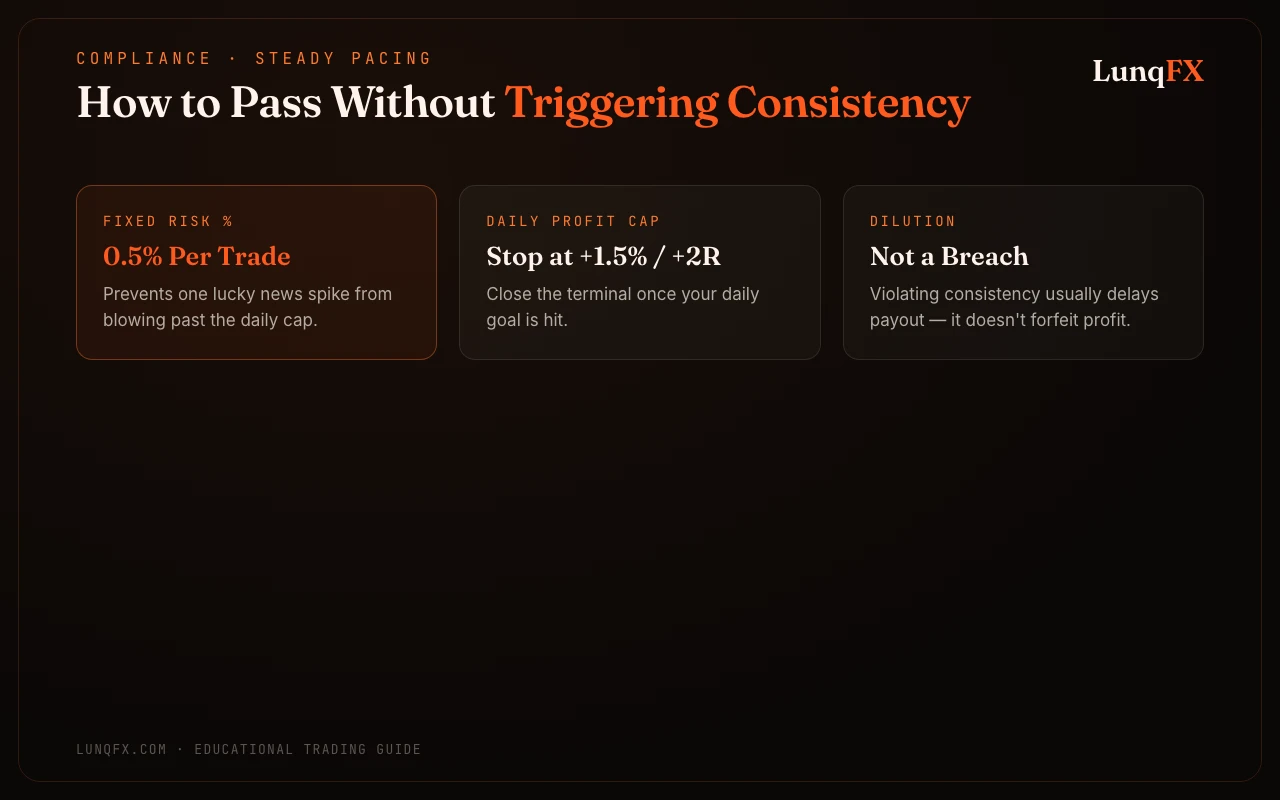
Safe Daily Profit Ceiling = (Target Profit × Consistency Cap) × 0.85On an $8,000 target with a 30% cap ($8,000 × 0.30 = $2,400), an 85% safety margin gives you a daily profit ceiling of ~$2,040 (about 2% of account). Once closed + floating profit hits +2% on the day, flatten and walk away. Leaving a runner open past +2.4% literally makes your challenge harder to pass.
2. Standardise risk per trade and max trades per day
If your risk per trade is 0.5% ($500 on $100k) and your typical target is 2R (+$1,000), two winning trades put you at +$2,000 — right inside the safe zone. You would need four full-R winners in a single session to break a 30% cap, which naturally keeps your equity curve smooth. Track your average R per day in your journal using the trading journal metrics framework.
3. Avoid high-impact news lottery spikes
Non-Farm Payrolls and CPI releases are the number-one cause of accidental consistency violations. A wide-target breakout trade during news can slip into +4% in ninety seconds. If your strategy does not require news volatility, sit out the 15-minute window around tier-one releases.
4. Use rule-bound session execution
Manual traders struggle to stop at +2% when the market is flying; automated or strictly windowed systems have no such ego. Mean-reversion EAs that operate inside a single calm window — such as NIGHT OWL (21:00–24:00 GMT) or SIESTA (16:00–18:00 GMT, flat by 20:00 with a built-in news filter) — are engineered for steady, incremental R-multiples rather than one giant breakout day, which aligns naturally with strict daily profit caps.
A strict consistency filter is frustrating only when you ignore it until after you hit your target. Build the daily profit ceiling into your plan from day one, lock in +2% days without greed, and you will reach the payout button on schedule instead of grinding extra weeks to dilute one lucky afternoon.
FAQ
What is a good consistency score for a prop firm? Most firms require your best trading day to stay below 30% to 40% of total net profit, though stricter instant-funding programmes set the cap at 20% or 25%. Aiming to keep every single day under 25% of your target gives you a comfortable buffer against normal losing days.
Do you fail a prop firm challenge if you break the consistency rule? No — breaking the consistency rule is almost always a soft breach (or payout lock) rather than an account failure. You keep the account, but you must continue trading until additional profitable days dilute your best day below the firm's threshold.
How do you fix a bad consistency score? Stop aiming for home runs and stack smaller, consistent profitable days at your normal 0.25%–0.5% risk per trade. Use the formula Best Day ÷ Cap to calculate your new required total profit, and avoid increasing lot size to speed it up.
Does the consistency rule apply to funded accounts or only challenges? Both, depending on the firm. Many two-step evaluations have no consistency rule during the challenge phases but enforce a 30%–40% best-day rule on every funded payout request, while one-step and futures firms often apply it from day one.