Trailing Drawdown vs Static Drawdown: How Prop Firms Actually Measure Risk
· 8 min read · LunqFX Team
Most traders compare prop firms by headline numbers — profit split, challenge fee, and maximum loss percentage — and skip the line in the FAQ that defines how that maximum loss is calculated. That single omission accounts for more failed evaluations than bad entries. Understanding trailing drawdown vs static drawdown is the difference between having a 10% buffer and unknowingly trading on a 2% leash.
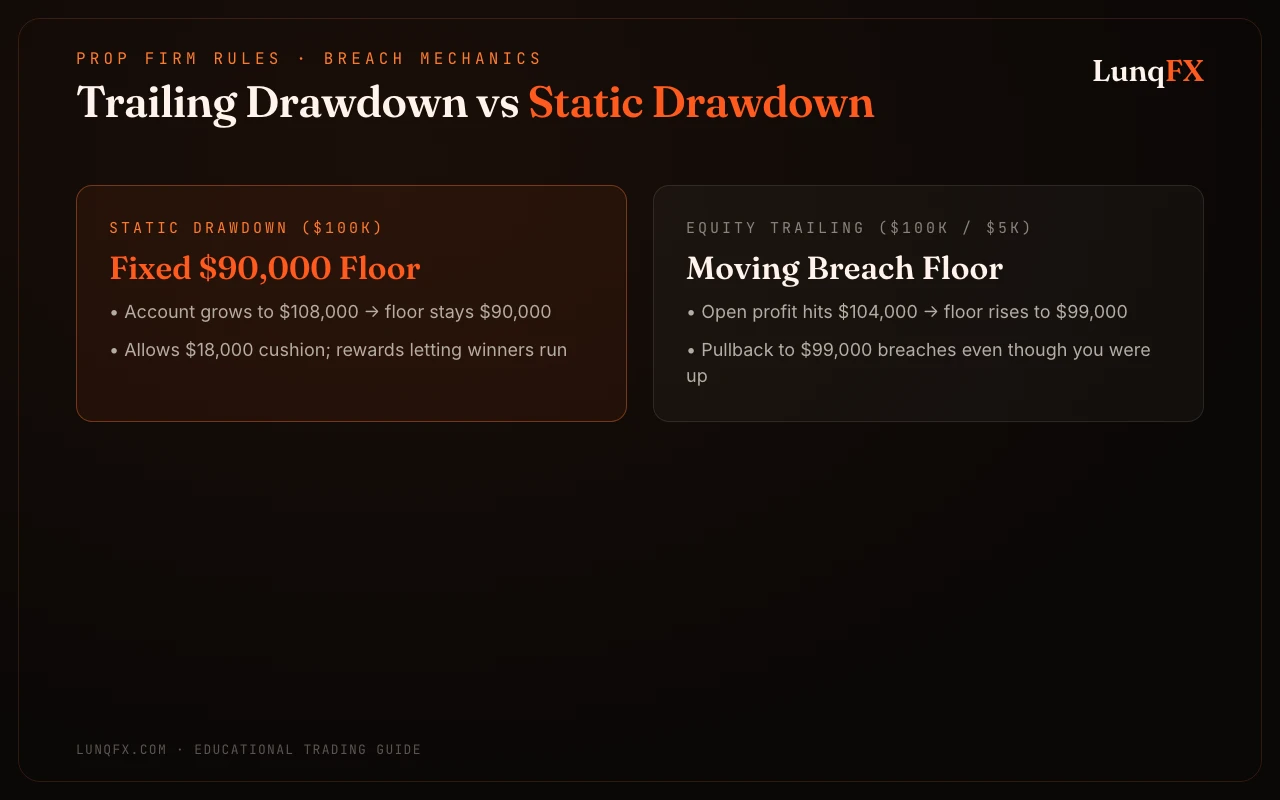
Both models cap how much you can lose before the account breaches, yet they behave completely differently once you open a trade. A static limit stays anchored to your starting balance, while a trailing limit follows your account upward — and in its strictest form, follows your unrealised floating profit tick by tick.
What Is a Static Drawdown?
Static drawdown sets a fixed equity floor on day one and never moves it, regardless of how much profit you make. If you buy a $100,000 challenge with a 10% maximum static loss, your breach level is $90,000 today, tomorrow, and after you are $6,000 in profit.
That fixed floor changes the maths of risk management in your favour:
- Your buffer grows as you win: Reaching $106,000 balance gives you $16,000 of total room above the $90,000 breach line (subject to any separate daily loss limit).
- Open winners are not penalised: Letting a trade run to +3R and pull back to +1.5R does not pull your liquidation level closer to your entry.
- Scaling is predictable: Every position size calculation from our lot size guide remains valid because the distance to breach never shrinks unexpectedly.
Static rules are most common on two-step evaluations and established forex prop firms, though many still pair them with a 4% or 5% daily drawdown reset each server midnight.
How Trailing Drawdown Works (EOD vs Intra-Day Equity)
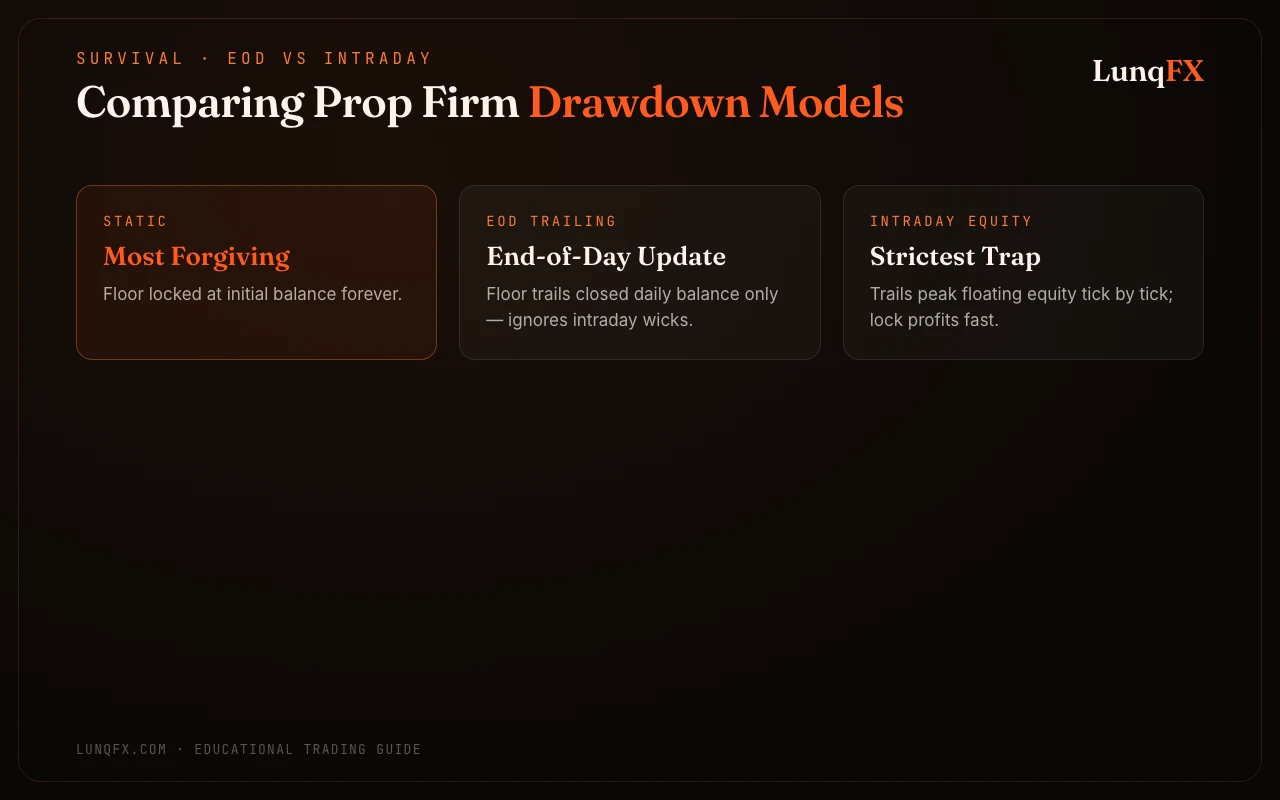
A trailing drawdown moves your breach floor upward as your account hits new highs. Once the floor moves up, it never moves back down. Where traders get caught is that "trailing" comes in two very different flavours, and firms rarely advertise the harsher one in big font.
End-of-Day (EOD) Trailing Drawdown
EOD trailing updates your high-water mark only once per day, at market settlement (typically 17:00 EST / 22:00 GMT). Your intra-day floating equity can spike +$4,000 and retrace to +$1,500 without shifting the floor, provided you close or settle at +$1,500 by the daily cutoff.
- Example: On a $100,000 account with a 5% ($5,000) EOD trailing limit, the initial floor is $95,000. If you close the day at $103,000, the new floor locks at $98,000.
- Cap at starting balance: Many EOD firms stop trailing once the floor reaches your initial balance ($100,000), effectively turning the rule into a static floor thereafter. Always verify whether the trail locks at breakeven or trails indefinitely.
Intra-Day Equity Trailing Drawdown
Intra-day equity trailing updates your high-water mark continuously in real time, based on floating (unrealised) equity rather than closed balance. Every tick your open position moves into profit, your breach floor ratchets up behind it.
This is the single most punitive rule in prop trading. It turns a normal trend-following pullback into an account breach even when the closed trade ends in profit or at breakeven.
| Feature | Static Drawdown | EOD Trailing Drawdown | Intra-Day Equity Trailing |
|---|---|---|---|
| Floor calculation | Fixed from initial balance | Highest daily settlement balance | Highest real-time floating equity |
| Floating profit impact | None | None if closed/settled lower | Raises breach floor immediately |
| Floor locks at breakeven? | Already fixed below start | Usually yes (verify firm rules) | Often yes on funded, sometimes no |
| Best suited for | Swing & trend traders | Intraday & session traders | Strict scalpers with fixed TP |
| Hidden trap | Separate daily loss limit | Holding losers into 22:00 GMT | Letting +3R winners retrace |
Worked $100k Example: Trailing Drawdown vs Static Drawdown
Numbers make the contrast unmistakable. Suppose you trade a $100,000 account with a 5% ($5,000) maximum drawdown and risk 1% ($1,000) per trade. Your starting breach floor under all three models is $95,000.
On Tuesday morning, you enter a long position on EURUSD. Price rallies strongly, pushing your floating profit to +$3,500 (account equity hits $103,500). You decide to hold for a +$5,000 target, so you move your stop to breakeven. News hits, price reverses, and your trade closes at $0 (breakeven).
Here is where your account stands under each rule set:
- Static drawdown: Closed balance is $100,000; breach floor is still $95,000. Remaining buffer: $5,000 (five full 1R losses).
- EOD trailing drawdown: Because the trade closed at breakeven before the 22:00 GMT settlement, your end-of-day balance is $100,000. Breach floor remains $95,000. Remaining buffer: $5,000.
- Intra-day equity trailing: The moment your floating equity touched $103,500, your breach floor ratcheted up to $98,500 ($103,500 − $5,000). When the trade closed at $100,000, the floor stayed at $98,500. Remaining buffer: $1,500.
Look at what just happened. You did not lose a single dollar on the trade, yet an intra-day equity rule stripped away 70% of your account buffer. Your next two normal 1R losses (−$2,000) will breach the account, even though you would only be down 2% from your starting balance.
Worse still, if that same trade had floated to +$4,800 ($104,800 equity, floor at $99,800) and you had left your stop at −$1,000 ($99,000), price hitting your original stop loss would have breached the account on a single −1% trade.
Why Trailing Drawdown Breaks Normal Strategies
When comparing these two drawdown models, most traders assume they just need to risk slightly less per trade. Reducing lot size helps, but it does not solve the structural mismatch between intra-day trailing and asymmetric trading.
Trend following suffers most. Letting winners run requires sitting through 30%–50% retracements of an open move. Under an intra-day equity trail, every healthy pullback eats directly into your permanent drawdown allowance. You are forced to scalp fixed targets or take partials aggressively, which often ruins the positive expectancy of a trend system.
Daily loss limits compound the squeeze. Even on a static account, a 5% daily loss limit calculated on equity (rather than balance) behaves like a mini trailing drawdown for that single day. If you start the day at $100,000, make +$3,000 in the London session, and give back $5,000 in New York, your equity drops $2,000 below the day's open — yet some firms calculate the 5% daily limit from your highest intra-day equity, breaching you at $98,000.
Consistency rules add another ceiling. Firms that pair trailing drawdown with a prop firm consistency rule punish both extremes: you cannot let winners breathe and you cannot hit the target in one big session.
How to Adapt Your Execution to Each Rule Set
You cannot trade a trailing account with static habits. Match your risk protocol to the exact drawdown formula in your firm's contract before placing trade one.
- Audit the contract wording, not the marketing banner. Look specifically for whether maximum loss trails closed balance or unrealised equity, whether it resets at EOD, and whether it stops trailing at the initial balance.
- Switch to fixed take-profits on intra-day trailing accounts. If floating equity moves your floor, trailing stops and "let it run" management become liabilities. Take full profit at 1.5R–2R rather than watching +3R retrace to +1R.
- Cap risk at 0.25%–0.5% per trade. A 1% risk per trade on a 5% trailing account leaves zero room for normal losing streaks once floating pullbacks tighten the floor. Our prop firm challenge guide breaks down why 0.5% is the practical ceiling.
- Avoid holding open trades through settlement and rollover. Spread widening at 22:00 GMT can trigger a phantom equity dip that breaches an EOD or daily limit by a few pips. Automated systems built for tight, flat-by-close windows — such as SIESTA (16:00–18:00 GMT, flat by 20:00) or NIGHT OWL (21:00–24:00 GMT) — naturally avoid holding floating equity across overlapping high-volatility sessions, provided your firm permits third-party bots under its prop firm EA rules.
- Cut risk in half at the first sign of compression. If your remaining buffer drops below 50% of its starting size, apply the step-down protocol in our guide on how to recover from drawdown immediately rather than trying to win it back on the next setup.
Choosing between trailing and static drawdown is not about which sounds easier on a landing page. A static 8% drawdown gives a trader dramatically more real-world breathing room than a 10% intra-day equity trail. Whenever you have the choice, pay slightly more for static or EOD rules — and if you already hold an intra-day trailing account, treat every pip of unrealised profit as borrowed time until you bank it.
FAQ
Is trailing drawdown worse than static drawdown? Yes, in almost every practical scenario. A static drawdown keeps your breach floor fixed at the starting loss limit, whereas a trailing drawdown reduces your margin for error as your account reaches new highs — especially if it tracks unrealised floating equity.
Does EOD trailing drawdown count floating profit? No, provided you close or manage the trade before the daily settlement cutoff (usually 17:00 EST / 22:00 GMT). Only your settled balance or equity at that exact cutoff updates the high-water mark, though you must still stay above the current floor during the day.
Does a trailing drawdown stop moving once it reaches the starting balance? On many two-step challenges and funded accounts, yes — the floor locks at your initial balance (breakeven) once you have earned the equivalent of the drawdown percentage. However, several futures and instant-funding firms trail indefinitely, so check your specific firm's terms.
Why did my prop firm account breach even though I was in profit overall? If your account uses an intra-day equity trailing drawdown, a large open profit raises your breach floor above your starting balance. When price reverses, you can cross that elevated floor and fail the account while your closed balance is still positive.