Demo vs Live Trading: Why Your Edge Disappears on Real Money
· 7 min read · LunqFX Team
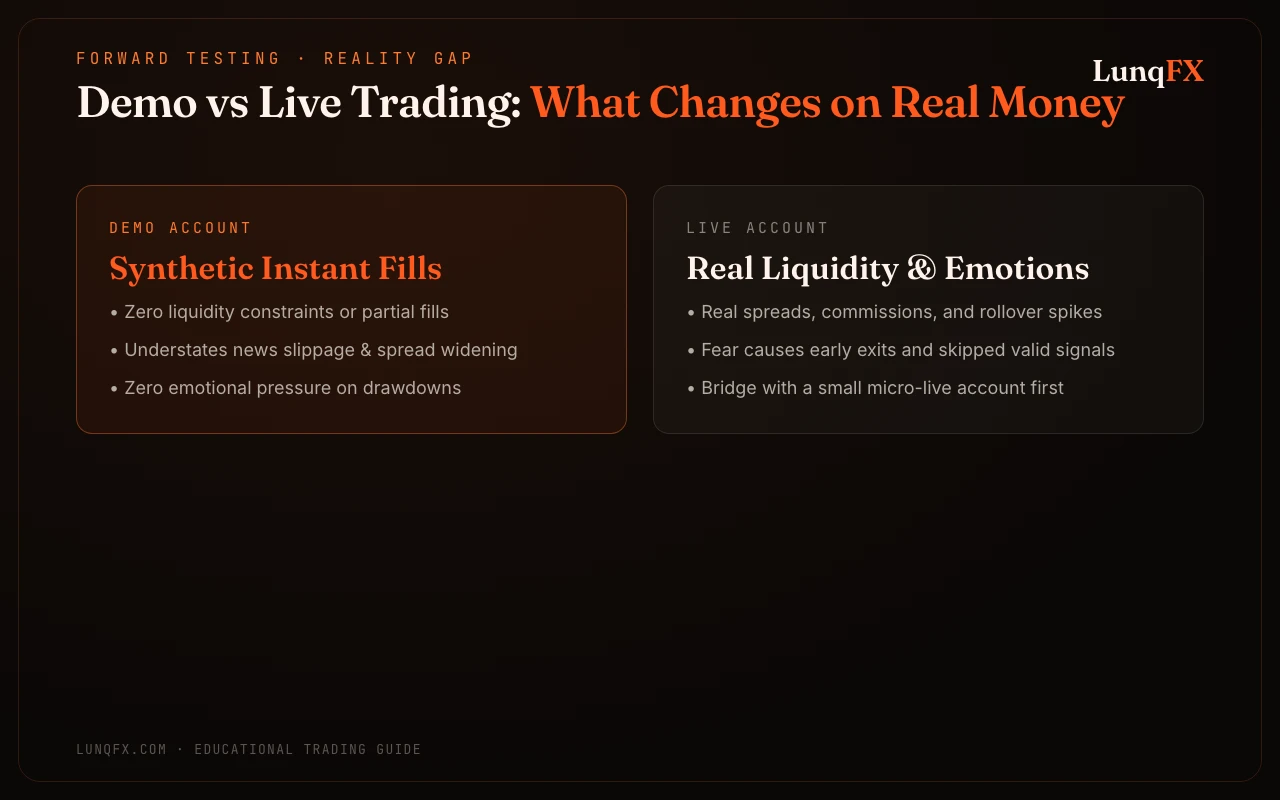
Almost every trader has lived through the same whiplash: three months of steady, calm profitability on a practice account, followed by a baffling losing streak the very week they fund real capital. Understanding demo vs live trading is not about blaming "broker manipulation" — it comes down to two concrete gaps between simulated environments and real liquidity: execution mechanics and human psychology.
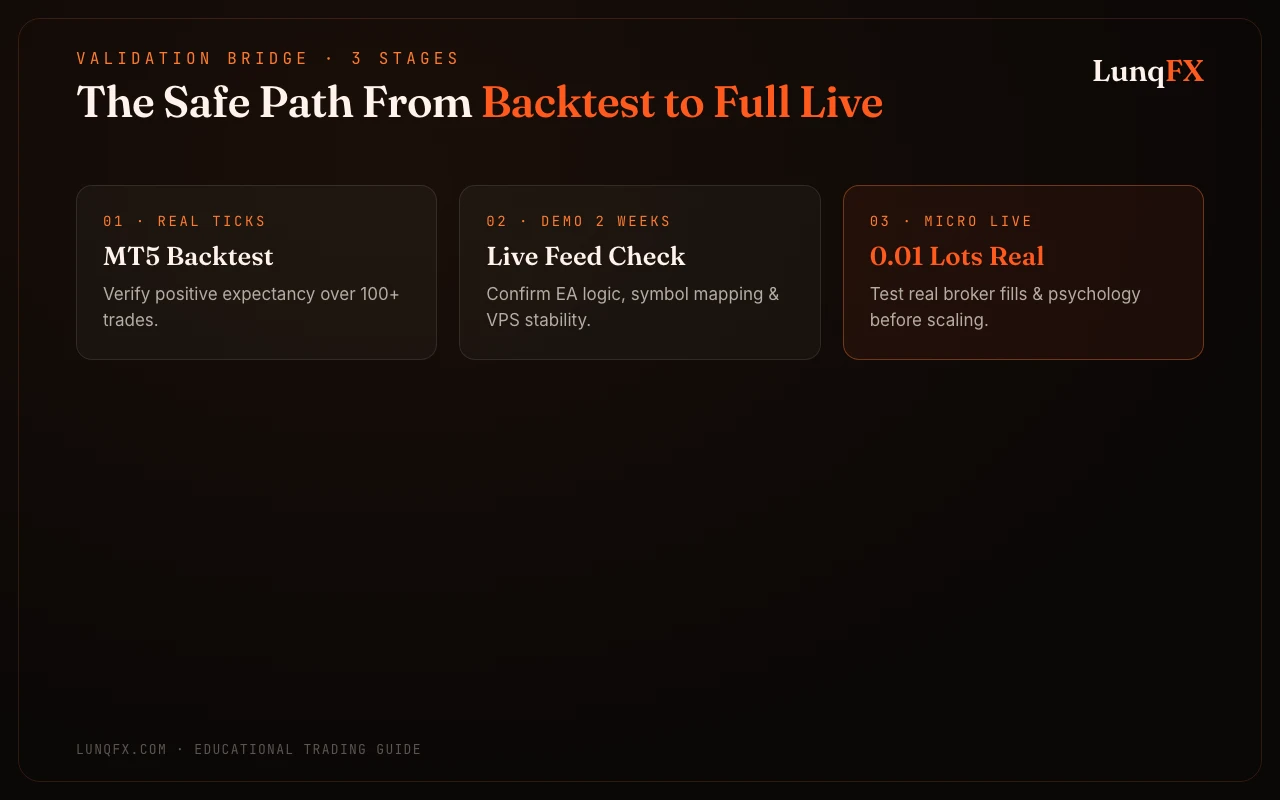
This guide breaks down exactly what changes under the hood when you switch from demo to live, why scalpers and EAs feel the execution gap hardest, and how a structured two-week micro-live bridge exposes hidden flaws before you risk meaningful capital.
Why Demo Accounts Feel Effortless
A demo account is a valuable sandbox for learning platform hotkeys, testing .set presets, and verifying that an Expert Advisor does not throw errors. What a demo account cannot replicate is real market friction.
1. Synthetic Zero-Rejection Fills
On most retail broker servers, demo accounts run on a simulated matching engine with infinite virtual liquidity at the top of the book:
- Zero market impact: whether you click
0.10 lotsor50.00 lotsonEURUSD, a demo server fills the entire clip at the exact screen quote. On a live ECN feed, larger orders sweep multiple book levels and incur slippage in forex. - No requotes or off-quotes: during fast volatility or news spikes, a live server may reject an order, widen the spread for
400 milliseconds, or slip a stop-loss by4–10 pips. Many demo servers fill cleanly at the stale quote. - Optimistic limit fills: on a live book, touching your buy limit at
1.08500does not guarantee a fill — there may be200 lotsahead of you in the queue. Demo servers frequently trigger your limit the instant the bid touches your price.
2. Cleaner Spreads and Rollover Behaviour
Some brokers feed identical raw quotes to demo and live, while others run a smoother, slightly tighter synthetic feed on demo to keep trials pleasant. Even when the price feed is identical, spread widening during rollover and illiquid hours hits live balances harder because live stops experience real book gaps.
This is why evaluating an automated system solely on demo results or Strategy Tester curves is dangerous. Before trusting any system with real capital, combine MT5 Strategy Tester backtesting with verified live telemetry — the exact principle behind checking a verified forex EA track record and publishing live-account stats on our Track Record page.
Demo vs Live Trading: Side-by-Side Execution Reality
| Dimension | Demo Account | Live Account | Who Feels the Gap Most |
|---|---|---|---|
| Order book depth | Infinite virtual liquidity at top quote | Finite real liquidity across price levels | High-lot traders and news scalpers |
| Slippage | Near zero; often symmetric or absent | Asymmetric during news & thin sessions | Tight-stop (< 10 pip) intraday traders |
| Limit order queue | Instant fill on price touch | Queue position & partial fills apply | Passive grid and limit-entry EAs |
| Commission & swap | Sometimes omitted or simplified | Real per-lot commission & triple swap | Strategies averaging < 5 pips per trade |
| Psychological load | Zero consequence; easy to hold winners | Loss aversion; early exits & revenge trades | Every discretionary trader |
Look closely at the fourth row: strategies with an average profit of 2–4 pips per trade (typical of ultra-tight scalpers) can look unstoppable on a zero-commission demo account, then bleed steadily on a live raw spread account once 0.7 pips of round-turn commission and 0.3 pips of average slippage eat 25–50% of the gross edge.
The Psychological Shift Nobody Prepares For
Even if demo and live execution were 100% identical, paper trading versus real capital would still produce different results because you are different when real money is on the line.
On demo, losing -$200 is a number on a screen. You let your trade play out to its +2.5R target because you do not care if it reverses to -1R. On live, that same -$200 represents a week of groceries or a utility bill, and three subtle behaviours creep in immediately:
- Cutting winners early: you close a clean setup at
+0.8Rinstead of+2Rto "lock something in," silently destroying your risk-to-reward ratio. - Moving stops to breakeven prematurely: you choke normal pullbacks into
0Rscratches just to relieve the discomfort of seeing red floating P&L. - Hesitating on the next valid signal: after two live losses in a row, you skip the third setup out of fear — which turns out to be the
+3Rwinner that pays for the week.
The uncomfortable truth: demo accounts train mechanics, not nerves. Staying on demo for twelve months waiting until you feel "ready" simply delays the day you actually meet your own psychology.
The 2-Week Demo-to-Micro-Live Bridge
Instead of jumping straight from a $50,000 demo account to a $10,000 live account (or staying on demo forever), use a 14-day micro-live bridge with a small amount of real money — typically $100 to $300 trading 0.01 micro lots (or a cent account if your strategy requires multi-position scaling).
Consider the position-sizing maths on a $200 micro-live account: trading 0.01 lots on EURUSD ($0.10 per pip) with a 20-pip stop loss puts exactly $2.00 (1%) at risk per trade. Ten consecutive losses cost $20, which is small enough to protect your savings yet real enough to expose hesitation, premature profit-taking, and real broker execution costs.
Here is the exact protocol:
- Days 1–3 (Execution baseline): place 10–15 normal trades (or let your EA run its standard schedule) on
0.01lots. Log the exactRequested Price vs Fill Price, commission per trade, and rollover spread behaviour in your journal. Compare your live average spread at entry against the same session on demo. - Days 4–10 (Real-money discipline): trade your exact rulebook without changing lot size. Even at
$0.10 per pip, real P&L triggers mild loss aversion — pay attention to every urge to move a stop, close early, or skip a signal. - Days 11–14 (Audit demo vs live delta): compare your 2-week micro-live average slippage, win rate, and rule-adherence score against your prior demo log.
- Scale only if both match: if execution costs stay within your strategy's margin of safety and your rule adherence exceeds
90%, scale up gradually (for example0.01 → 0.03 → 0.05lots over subsequent weeks). If either breaks, fix it while losses cost$2, not$200.
When You Should Go Back to Demo
Moving to micro-live early does not mean demo becomes useless. Return to a demo account immediately whenever you need to test something mechanical:
- Installing a new Expert Advisor or
.setfile for the first time (to verify lot rounding,MagicNumberisolation, and GMT offset). - Learning a new order-entry hotkey or trailing-stop workflow.
- Debugging why an indicator or webhook script behaves unexpectedly on live ticks.
Use demo for software and mechanics; use micro-live for execution reality and psychology. Separating those two jobs ends the demo vs live trading shock permanently.
FAQ
Why do I win on a demo account but lose on a live account? Two reasons happen together: live accounts introduce real slippage, commissions, and occasional order rejections that demo servers smooth over, and real money triggers loss aversion — causing traders to cut winners early, move stops prematurely, and hesitate on valid entries.
How long should I trade on a demo account before going live? Trade on demo only long enough to master platform mechanics, position sizing, and your strategy's entry rules cleanly — usually 2 to 4 weeks. After that, switch to a small micro-live account (0.01 lots) rather than spending months building false confidence on virtual money.
Are demo account spreads and prices the same as live? Many brokers stream the same raw price feed to both, but demo matching engines usually simulate infinite liquidity and zero slippage. That means tight scalps and limit orders still fill more optimistically on demo than on a live ECN book.
What is the safest way to transition from demo to live trading? Run a 2-week micro-live bridge with $100–$300 at 0.01 lots while logging slippage, commissions, and rule adherence. Only scale your deposit and lot size after your live execution costs and emotional discipline hold steady across at least 20–30 real trades.