Slippage in Forex: Why Your Fills Miss the Price (and How to Cut It)
· 7 min read · LunqFX Team
Every trader remembers the first time a 10-pip stop loss turns into an 18-pip loss on a quiet-looking chart. That gap between the price you clicked — or set on your stop order — and the price your broker actually filled is slippage in forex. Most retail traders immediately accuse their broker of cheating, when nine times out of ten they are simply watching basic order-book mechanics play out in a decentralised market.
This guide explains what causes execution slippage, why true ECN/STP execution produces both negative and positive slippage, how order types behave differently under pressure, and the concrete steps — from order selection to VPS latency — that cut execution bleed without switching brokers every month.
What Slippage Actually Is (and Why It Is Not Always Bad)
When you send a market order or trigger a stop order, you are not trading against a static number on a screen. You are matching against available liquidity sitting in your broker's liquidity pool at the exact millisecond your order arrives.
If you request to buy 2.00 lots of EURUSD at 1.08500, but only 0.80 lots are available at 1.08500 and the next 1.20 lots sit at 1.08504, your order sweeps both levels and fills at a volume-weighted average of 1.085024 — roughly 0.24 pips of negative slippage.
Positive vs Negative Slippage
On a genuine market-execution (NDD/ECN) feed, price can also move in your favour during the 10–80 milliseconds your order travels to the matching engine:
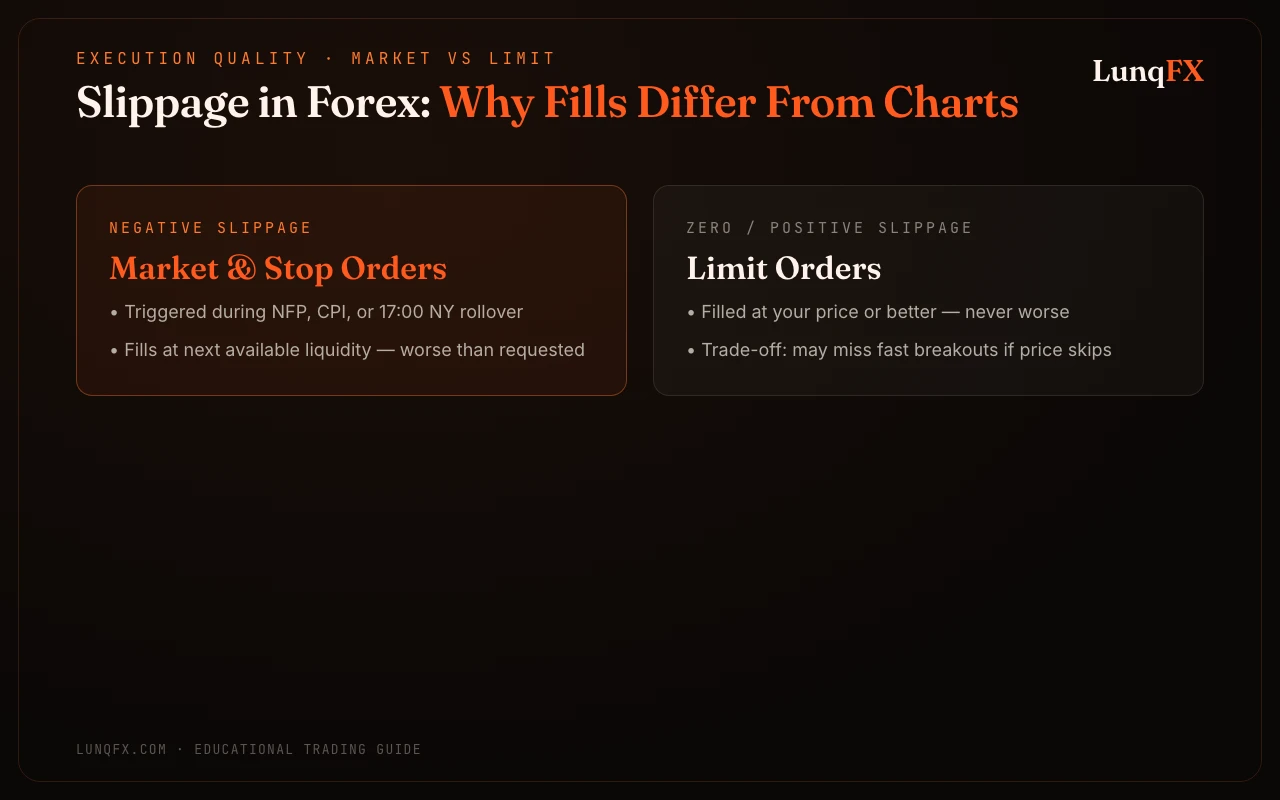
- Negative slippage: you receive a worse price than requested (buying higher, selling lower). Common on stop-loss and breakout stop-entry orders when price accelerates through thin books.
- Positive slippage (price improvement): you receive a better price than requested (buying lower, selling higher). Common on limit orders and take-profit orders when an aggressive seller hits your resting bid below your limit price.
The broker honesty test: if your account only ever records negative slippage on stops and never records positive slippage on limit take-profits over 100+ trades, your broker is likely running asymmetric execution (internalising positive price improvements while passing negative slippage on to you). Auditing both sides of slippage is one of the fastest ways to spot execution drag before comparing demo vs live trading.
Market and Stop Orders vs Limit Orders
Order type is the single biggest lever you control over price slippage, because each order type asks the matching engine to prioritise a different guarantee.
| Order Type | What It Guarantees | Can It Slip Negatively? | Can It Slip Positively? |
|---|---|---|---|
| Market Order | Immediate execution | Yes | Yes |
| Stop Order (Buy/Sell Stop & Stop Loss) | Trigger → becomes a market order | Yes (often heavily) | Rarely |
| Limit Order (Buy/Sell Limit & Take Profit) | Price (fill at limit or better) | No (fills at limit or not at all) | Yes |
A stop loss is a market order in disguise. Once price touches your stop level, MT5 fires a market order to close the position at whatever bid or ask is available next. During a fast impulse, there may be zero liquidity for 5 or 15 pips past your trigger — so you get filled on the other side of the air pocket.
A limit order, by contrast, refuses to fill worse than your stated price. The trade-off is fill certainty: if price touches your 1.08500 buy limit for one tick with insufficient volume and rockets to 1.08540, you suffer zero slippage — because you missed the trade entirely.
When Slippage Spikes: News Releases and 5pm NY Rollover
Under normal London or New York session liquidity, a 0.50-lot order on EURUSD on a raw spread account typically experiences 0.0 to 0.3 pips of slippage. Two recurring windows break that calm completely:
1. High-Impact News Releases (NFP, CPI, Rate Decisions)
Seconds before scheduled Tier-1 releases — covered in detail in our forex news trading guide — institutional market makers pull their resting limit orders to avoid getting picked off by faster news algorithms. Book depth collapses by 80–90% even before the number prints.
When the release hits, aggressive volume hits an empty book. A 15-pip stop loss placed right above a pre-NFP range can easily slip 12 to 25 pips, turning a planned 1% risk trade into a 2.2% loss. Worse, if you run a prop-firm challenge with a strict daily drawdown limit, a single slipped news stop can breach the account.
2. The 5pm New York Rollover Window (21:55–22:15 GMT)
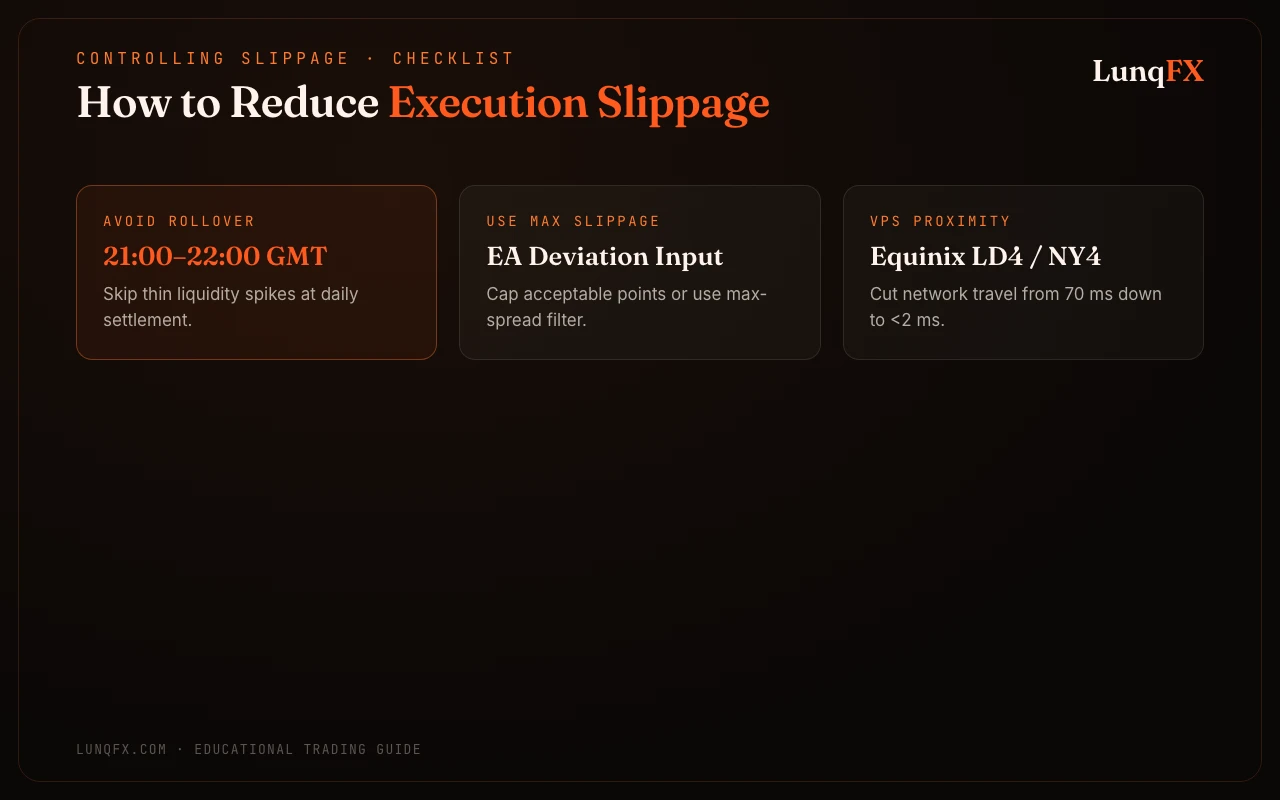
Every trading day at 17:00 EST (22:00 GMT in winter, 21:00 GMT in summer), banks settle swaps and reset liquidity feeds. During this 15–20 minute transition, spreads routinely jump from 0.1 pips to 3–8 pips on majors and 40–100+ points on XAUUSD.
Two things happen during rollover spread widening:
- Tight intraday stop losses get triggered by the widened ask/bid alone, even when mid-price barely moved.
- Market orders executed inside the rollover window face thin, fragmented quotes and erratic slippage.
Session-aware tools like Quiet Hours exist specifically to flag these illiquid transition windows on your chart, while automated night scalpers such as NIGHT OWL enforce strict spread and time gates so they stay flat until liquidity normalises.
How VPS Latency Affects Slippage
Every millisecond between your terminal and your broker's trade server is time during which the order book can move before your order arrives.
- Home broadband (
80–180 msping): in150 msduring a London open impulse,XAUUSDorGBPJPYcan easily tick2–5 points(0.2–0.5 pipson majors, more on gold) before your packet reaches the server. - Cross-connected or local VPS (
1–5 msping): hosting MT5 on a forex VPS for Expert Advisors in the same Equinix data centre as your broker (typicallyLD4London,NY4New York, orTY3Tokyo) cuts network travel time by 95%+.
Be realistic about what a VPS solves: a 1 ms VPS dramatically reduces random latency slippage on normal market entries and EA trailing stops. It will not eliminate liquidity slippage during NFP or weekend market gaps — if there is no counterparty at 1.08500 inside the matching engine, arriving in 1 ms instead of 120 ms still fills you at the next available quote.
Five Practical Ways to Reduce Slippage in Forex
You cannot eliminate slippage in forex completely without moving to synthetic instant-execution dealing desks (which simply requote or widen spreads instead), so focus on controlling what actually matters:
- Use limit entries on pullbacks instead of chasing breakouts with stop orders: limit entries cap your worst-case fill price at zero negative slippage.
- Avoid holding tight stops (
< 15 pips) through Tier-1 news and21:55–22:15 GMTrollover: flatten before the window or widen stops proportionally to volatility so routine spread spikes do not trigger market-exit stops. - Host automated EAs on a low-latency VPS near your broker's server (
< 5 msping): check your exact ping in the bottom-right corner of MT5. - Understand MT5's
Max Deviationsetting: on instant-execution accounts, MT5'sDeviationinput rejects fills outside your pip tolerance (giving a requote instead). On Market Execution (most ECN/raw accounts),Deviationis ignored by the server — do not rely on it for news protection. - Log slippage per trade in your journal: track
Requested Price vs Fill Priceover 100 trades. If negative slippage averages more than0.3 pipsoutside news on liquid majors, test a different broker or liquidity feed.
FAQ
Is slippage in forex normal, or is my broker scamming me? Moderate slippage (0.1 to 0.5 pips on majors, larger during news or rollover) is completely normal on real market-execution feeds because orders match against finite book liquidity. A broker becomes suspicious only if you experience constant heavy negative slippage during quiet hours while never receiving positive slippage on limit orders.
Can a limit order experience negative slippage? No. A limit order (including a take-profit order) can only execute at your specified price or better. If the market skips past your limit price without enough liquidity, the order simply stays unfilled rather than filling at a worse price.
Does MT5's Max Deviation setting prevent slippage? Only on Instant Execution accounts, where it triggers a requote if price moves beyond your tolerance. On standard Market Execution (ECN/Raw) accounts, the broker server ignores Deviation and fills at the best available market price.
How much does a VPS reduce forex slippage? Moving from a 120 ms home connection to a 1–3 ms VPS located in your broker's data centre (LD4 or NY4) cuts network-delay slippage noticeably during active sessions, though it cannot prevent liquidity-gap slippage during major news releases.